The ancient US discovery predating the pyramids

 Wisconsin Historical Society
A series of millennia-old canoes are being unearthed from the bottom of a lake in Wisconsin, spurring a renewed interest in Indigenous culture.
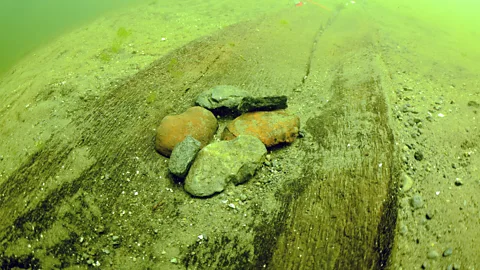
Dr Amy L Rosebrough will never forget where she was when she got the phone call. It was a sunny Saturday in June 2021, and the archaeologist was at her home in Madison, Wisconsin, when diver Tamara Thompsen, her colleague at the Wisconsin Historical Society, rang and said, "Hey, Amy, come out on the boat with me… I found something."
Thompsen and a fellow diver had been exploring Wisconsin's Lake Mendota. Just as her partner signalled that her oxygen tank levels were low and that she needed to return, Thompsen "looked down and discovered she was directly over a sunken dugout canoe", Rosebrough recalled.
"We thought it might be – if we're extraordinarily lucky – 300 years old," said Rosebrough, referring to the vessel. It turned out to be 1,200 years old. "Everyone lost their minds."
 Getty Images
They also thought this discovery was one of a kind. But again, they were wrong. In 2022 a second canoe pulled from the bottom of the lake turned out to be 3,000 years old. Since then, the remains of 14 more prehistoric canoes have been unearthed from Lake Mendota's depths – including six in 2025 – with radiocarbon dating revealing the oldest as 5,200 years old. Of the 16 canoes found so far, the youngest is 700 years old.
According to the Wisconsin Historical Society, this means that more than 4,000 years before the first Europeans sailed ashore and 400 years before the first pyramids were constructed in Egypt, Indigenous peoples called this land home.
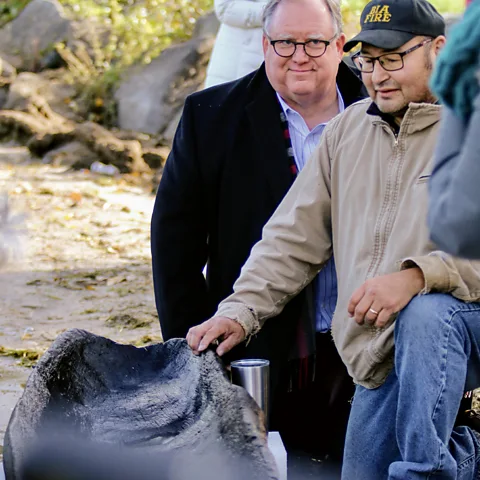
"How often do you get to touch something that's 1,200 years old?" said Bill Quackenbush, who was present when the first canoe was pulled ashore. Quackenbush is a tribal historic preservation officer and cultural resources division manager for the Ho-Chunk Nation, who are believed to have arrived in the region between 500-1200 CE.
According to Quackenbush, the discovery of these ancient canoes is helping Ho-Chunk tribal members better understand how early Indigenous peoples once navigated this land. It has also inspired new events and museum exhibits and enhanced Ho-Chunk guided tours that are awakening visitors to Madison's rich Native American history.
 Wisconsin Historical Society
Madison's rich Indigenous past
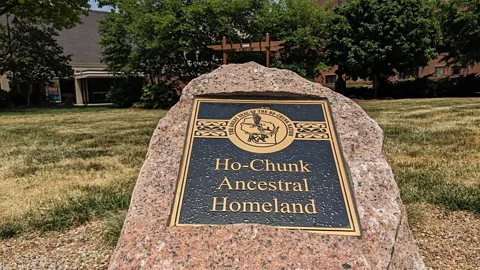
The Ho-Chunk Nation's ancestral lands once spread throughout central Wisconsin and northern Illinois. Since the canoes' discovery, archaeologists and Wisconsin's Native Nations now believe that villages were established around lakes in the region long before the Ho-Chunk arrived, and that they utilised an overland network of trails. The sturdy, heavy dugout canoes unearthed from Lake Mendota were similar to those the Ho-Chunk later utilised to fish and trade, and experts believe the original inhabitants left them for other tribe members to use. Rosebrough compares them to ancient "e-bike stations".
Permanent white settlers arrived in the late 18th Century, and after the War of 1812, the US coerced treaties and enforced multiple Ho-Chunk removals between the 1820s and the 1860s.
Today, the Ho-Chunk are spread into two geographical areas. While both share the same history, they are recognised as two distinct Nations by the US government. One of these eventually obtained a reservation in Nebraska and are known by the name of The Winnebago Tribe of Nebraska. The other was allowed to stay in Wisconsin without a reservation, and are known as the Ho-Chunk Nation.
Quackenbush says the practice of making dugout canoes had been "lost, knowledge-wise, within our own tribe", since many Ho-Chunk were displaced from the Great Lakes region and forced to leave their cultural practices. Since the canoe discoveries, the tribe has been inspired to restore that knowledge. In 2022, they launched an annual June Ho-Chunk Nation Dugout Canoe Journey that's now open to the public along the Ho-Chunk's ancestral waterways.
 Brandon Withrow
Since the millennia-old vessels were unearthed from the lake, canoes have played an important role in bringing the two Ho-Chunk tribes back together.
Join the paddle
The Ho-Chunk Nation Dugout Canoe Journey 2026 will begin in Portage along the Wisconsin River on 1 June and stop at historic locations along the Nation's ancestral waterways. Guests can join at any point along the way, and are responsible for their own accommodations. Upcoming details will be announced on the Nation's Facebook page.
"We definitely feel disconnected from our homelands, because of removals and everything that we've gone through," said Sunshine Thomas-Bear, a member of the Winnebago Tribe of Nebraska and the co-founder of Hisgexjį Horak, an organisation focused on Ho-Chunk cultural knowledge sharing and skills workshops. She views the discovery of the canoes and the annual paddles as a chance to heal relationships and raise cultural awareness. She explained that she brings other Ho-Chunk from Nebraska with her to the paddle, and she sees "the connection in their faces" when they experience their homeland. "I could feel that they were finally home."
A tourism revival
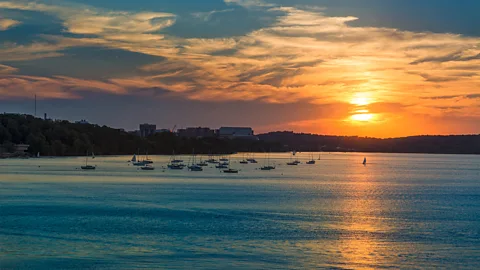
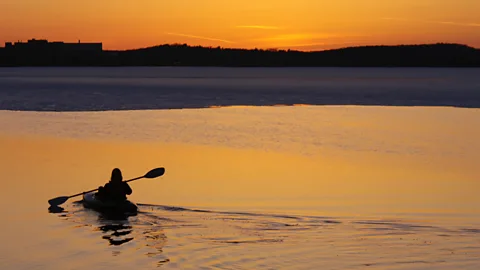
The Ho-Chunk hope that the discovery of the ancient canoes and the new public paddle will also encourage a broader awareness of Ho-Chunk history in Madison. The first canoe raised from Lake Mendota will be on show to the public when the new Wisconsin History Center opens in 2027. Aside from joining the annual The Ho-Chunk Nation Dugout Canoe Journey, Madison's proximity to several lakes provides an opportunity for travellers to paddle these traditionally Ho-Chunk waterways.
"Get in a kayak. Get a canoe. Get on the lakes," Rosebrough said. "The landscape itself may look a little bit different, but it's still here... You can kind of put yourself back in the past."
 Getty Images
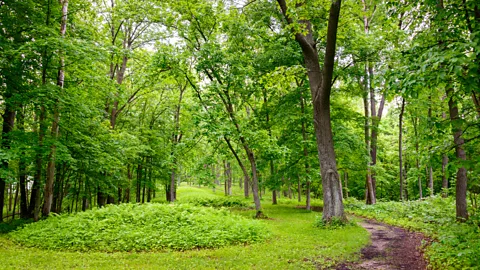
Beyond Lake Mendota, Ho-Chunk ancestors left their mark on the landscape through a massive collection of effigy mounds used for gathering, ritual and burial, with at least 4,000 remaining throughout Wisconsin. Today tourists can visit the roughly 200 mounds in Madison, and take the University of Wisconsin-Madison's First Nations Cultural Landscape Tour – a walking tour that explores upwards of 12,000 years of human history (running between 1 March and 30 November).
"I think the tours are so important for campus," said Omar Poler, an Indigenous education coordinator in the Office of the Provost and a member of the Sokaogon Chippewa Community. "They've changed the way that UW-Madison sees and understands its own place," Poler notes, adding that this is especially true of the tour guides.
More like this:
• The US's 2,000-year-old mystery mounds
• The Indigenous tribes reclaiming travel
• Minneapolis: The US city reclaiming its Native roots
One of those guides is student Kane Funmaker, a member of the Ho-Chunk Nation who is originally from the Wisconsin Dells. He says that before he was leading tours, he viewed Madison as a "Western" place, but now also sees it as Ho-Chunk territory and is "reclaiming the history of this place and sharing it with other people".
For those who prefer self-guided tours, a trail loop around Wingra Lake connects to some effigy mounds and Indigenous history. Other mounds, like the largest bird effigy, Eagle Effigy Mound, and the Effigy Mound Group can be found on the grounds of Mendota State Hospital. Additionally, UW-Madison's Mapping Teejop project provides self-guided tours for the area.
 Getty Images
And after a full day of canoeing and mound searching, tourists can grab a bite to eat at Tall Grass. Opening early this summer, the new restaurant at The Madison Museum of Contemporary Art will be led by Ho-Chunk Chef Elena Terry.
As these ancient canoes continue to be unearthed in Madison, it's a reminder that the story of Native people across the US is still being written, and even rediscovered.
"We still have aspects of our culture," said Quackenbush, "and we're longing to regain the stuff we lost."
--
If you liked this story, sign up for The Essential List newsletter – a handpicked selection of features, videos and can't-miss news, delivered to your inbox twice a week.
For more Travel stories from the BBC, follow us on Facebook and Instagram.
