Coda and the films finally treating deaf people with respect

 Apple TV+
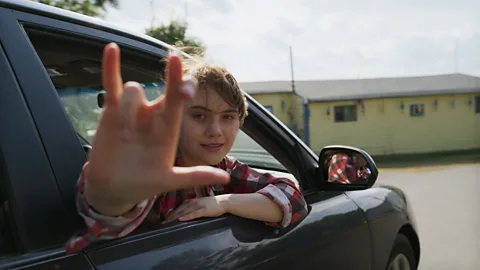
One of 2021's most anticipated releases is Coda, a drama about a majority-deaf family. Is it part of a watershed moment after years of patronising depictions, asks Jack King.
With the advent and now-ubiquity of streaming, massive disruption caused by the Covid-19 pandemic, and the much-discussed demise of the leading man, Hollywood is in greater flux than ever. While not all change may be wholly positive, one development that is unarguably a good thing is the proliferation of more stories centring hitherto marginalised groups and demographics within the mainstream – from the emergence of a strain of newly en vogue queer cinema in the early 2010s, including films like A Single Man, Carol and Call Me by Your Name, to the way in which the likes of Black Panther and Moonlight have marked a new epoch for black creatives both behind, and in front of, the camera.
More like this:
Now, another great shift in representation seems to be taking place – towards a more nuanced, powerful cinematic depiction of deafness. Whereas previously deaf characters were, so often, relegated to reductive bit-parts and comedic relief, in films including Todd Haynes' Wonderstruck (2017), John Krasinski's A Quiet Place (2018) and its sequel, and Darius Marder's Sound of Metal (2019), they have become full-on protagonists. Couple that with a new wave of deaf actors on the verge of stardom, like Millicent Simmonds, star of both A Quiet Place movies; Lauren Ridloff, who will be seen as one of the lead superheroes in Marvel's Eternals; and Shoshannah Stern, who was the first deaf doctor in hit medical drama Grey's Anatomy, and it seems like deaf people may finally be gaining the kind of visibility within the industry that they have long been denied.
 Alamy
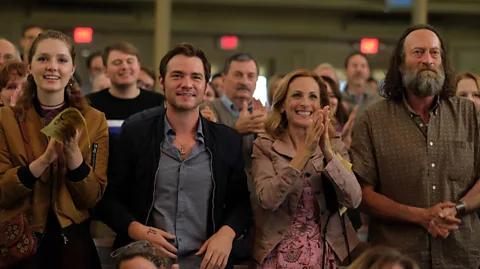
AlamyOne film out this week that could move the dial yet further is Coda, a coming-of-age indie movie that was the big talking point of this year's Sundance Film Festival and was picked up for worldwide distribution by Apple TV+ in a record $25m coup. A remake of the French film La Famille Bélier (2014), it centres on Emilia Jones' Ruby, the only hearing person in a deaf family who live in Massachusetts on the US East coast. They're humble fishers, making modest cash from the sea, but because they don't have enough money for a sign language interpreter, and the societal infrastructure around them is built with the hearing world in mind, they rely on Ruby to get by. Therein lies the conflict: she aspires to escape her small-town shackles for Boston, where she wants to pursue a singing degree, but she is bound by the ties of familial loyalty.
Though the central protagonist is a hearing teenager, it's the film's ensemble casting that makes Coda stand out: all three of the actors who make up Ruby's family are, themselves, deaf. The most recognisable of the three is Marlee Matlin: 35 years ago, she won the best actress Oscar for Children of a Lesser God, about a young deaf woman's tumultuous relationship with a speech teacher, and remains the only deaf performer to win such an award. In a recent Hollywood Reporter feature about the film, Matlin herself reflected on the change that Coda was a marker of: "to have a hearing actor put on a deaf character as if it was a costume. I think we've moved beyond that point now," she said. The profile of the film, and the buzz around it, suggest this is a significant moment for both deaf representation and casting on screen.
Reductive characterisations
Until very recently, deaf people were afforded measly characterisation in cinema; they seldom took centre stage, and nor did their lives, identities, or cultural idiosyncrasies. Often, they were framed as victims. "Historically, deaf characters and disabled characters more generally have often conformed to negative stereotypes," says Annie Roberts, advocacy officer for the UK's Royal National Institute for Deaf People (RNID). "Too many films ignore the wealth of deaf culture, the sense of belonging to a community, and often embark on the medical route where deafness is seen as something be cured. Often, a deaf character is just a token, used to tick a box, or is an object of ridicule." A particularly queasy example from the Hollywood Golden Age is 1948's Johnny Belinda, the plot of which hinges on the eponymous Belinda, a deaf-mute woman played by hearing actor Jane Wyman, being raped at a village dance; emphasised is her inability to scream for help. Wyman would go on to win an Oscar for the role. Roberts says that even Children of a Lesser God, for all of its awards-worthy bona fides, perpetuated negative stereotypes: "[Matlin's character] is in a subordinate position with no agency," suggests Roberts.
When she was 14 years old, film critic and access consultant Charlotte Little was diagnosed with a condition called Usher's Syndrome, "which meant that I was losing my peripheral vision," she says. "It's a leading cause of deaf-blindness: I usually say I'm hard of hearing and visually impaired. I have, like, tunnel vision – that kind of makes sense, but it's a really complex condition."
In Little's experience growing up, deaf and hard-of-hearing characters were frequently marred by reductive tropes and stereotypes. "They were always very two-dimensional: either the butt of the joke, in it for a few minutes, or portrayed in a very pitiful light. You never saw complex, flawed, beautiful, strong deaf characters – you just saw the bare, bare minimum."
More recently, she suggests, deaf representation has been tokenistic, with deaf characters written in by Hollywood studios to tick diversity and inclusion boxes, as a sort of cynical marketing ploy. She points to Toy Story 4 as a pertinent example. "I remember finding out that there was meant to be a character in the film with a hearing device [an unnamed boy with a cochlear implant] – but they're in it for a second," she says. "So using a deaf character to gain interest, but not actually honouring that representation."
But what does representation, which might feel quite nebulous on the surface, actually mean? The late critic Roger Ebert famously described movies as "machine[s] that generate empathy": cinema can be a direct route into understanding a little more about experiences different to our own, not least of marginalised groups. But also, as celebrated filmmaker Alejandro González Iñárritu, of Birdman, Babel and The Revenant fame, put it in a 2016 interview, "cinema is a mirror by which we often see ourselves". In that sense, a great movie can be a rich source of self-understanding. Little points to A Quiet Place, which she saw for the first time when she was 20, as the first time she saw herself on screen.
 Alamy
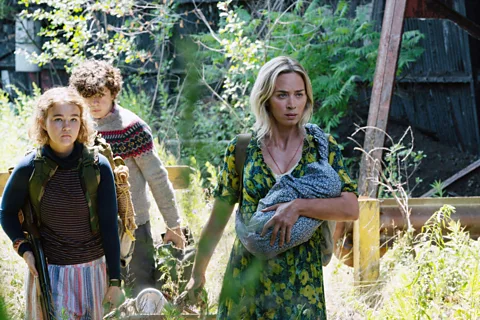
AlamyThe film begins 89 days after blind, quadrupedal aliens, clad from head-to-toe with impenetrable armour, are brought to Earth by what the sequel Part II subsequently implies to be a chance meteor collision. They kill everything that makes a discernible noise, and ruthlessly so, their instinct being to exterminate; like a man-eating super virus on gangly, clawed legs. By the time we meet the Abbott family – composed of dad Lee (John Krasinski), mum Evelyn (Emily Blunt), and kids Regan (Simmonds), and Marcus (Noah Jupe) – the human race has been decimated, with signs of organised survival few-and-far between. Crucially, Regan is deaf, just like the actress who plays her. Simmonds cut her teeth on Wonderstruck, which also centres her character's deafness as a central motif; unique to the depiction of Regan, however, is the total lack of pity with which her character is depicted.
A key subplot of A Quiet Place focuses on Lee's attempts to repair Regan's cochlear implant, which amplifies the little hearing she has left. The implant itself is set up quite early on as a Chekhov's gun, though you're left to wonder how it will become relevant. By the film's climax, however, all is clear: the feedback emitted from Lee's modified implant makes it an anti-alien superweapon. Advantage point, humans. Regan's deafness, then, by implication, is not something about which to feel sorry for her: it's the antidote to humankind's apocalyptic malaise, and perhaps the only route left to survival. Part II doubles down on Regan's heroism by emphasising her independence, bravery, and ruthless survivability. "[Her deafness is] a source of strength, it empowers her," says Little. "She's the hero of that franchise. Not in this superficial, 'oooh, she's a superhero,' sense: [she is] just this genuine, resourceful young deaf girl who has struggles with her identity."
Regan – and, in turn, Simmonds – represents a new kind of cinematic deaf protagonist, elevated by their condition which is, in turn, framed as a source of power, rather than superficially seen as a regrettable disability. "I think about how, if I saw more films like that growing up," Little adds, "would I have had a different relationship with my deafness? Would I have been [so] self-conscious?" With Wonderstruck and the A Quiet Place franchise already under her belt, along with a just-announced starring role in the television adaptation of deaf coming-of-age novel True Biz, Simmonds seems well on her way to A-lister stardom. She is, perhaps, the shining example of this new era of deaf representation; a leading lady whose image subverts the dusty old blueprint.
A new wave of deaf narratives
Following on from the commercial explosiveness and critical acclaim of A Quiet Place, we've seen a number of successful titles that centre deaf narratives, identities, and cultures across film and TV. Released in October last year, the Netflix reality series Deaf U features a Washington DC educational institution, Gallaudet University, established for deaf and hard-of-hearing students. The Sundance TV comedy series This Close also granted a nuanced look at the experiences of young, deaf US adults, focusing on the lives of two deaf best friends in their twenties.
The richest cinematic example is Darius Marder's recent Oscar-nominee Sound of Metal, in which Riz Ahmed plays a drummer, Ruben, who loses the lion's share of his hearing and joins a deaf commune. Made with hearing audiences in mind, the film offers a novel look into a deaf culture that, for many in the hearing world, would have been previously invisible. Here we get to see an expansive deaf world all of its own, independent of the dominant hearing culture, with its own music, social norms and customs.
While its aesthetic is far more austere indie than bombastic blockbuster sci-fi, it shares myriad similarities with A Quiet Place – most notably, in the formal methods and cinematic language it uses to communicate the protagonists' deafness, often involving a clever use of sound design. Both films, too, mostly avoid the maudlin sympathy some would suggest has long been inherent to the "hearing gaze", imbuing their deaf characters with nuance and strength. Little cites one scene in Sound of Metal as being particularly unique. "I think about when Ruben is in the audiology room, and he's getting his cochlear implant re-tuned," says Little, "It's one of the first times I've seen that. I felt like I was going back to those rooms, it was so immersive."
 Alamy
AlamyYet if representation is moving forward, another conversation that has come to the fore in tandem with the new wave of deaf heroes on screen is around authentic casting. For all of its plaudits, Sound of Metal has been criticised by some for casting hearing actors Ahmed and supporting star Paul Raci in deaf roles. In a piece for the magazine i-D, for example, the writer Shanti Escalante-De Mattei suggested of Sound of Metal that "when deaf actors far outnumber the few deaf parts available, the casting of a hearing actor is something of a slap in the face to the community." Little, on the other hand, is less critical. "Personally, I was happy with the casting," she says, emphasising the casting of deaf actors like Ridloff across the wider ensemble. "Joe [Raci's character] is an older, deafened war veteran and addict. Raci is also a war veteran and has [dealt with] addiction," says Little, "and while he's not deafened, he's a child of deaf adults and has been immersed in the deaf community for most of his life." Little points to Raci's proactive involvement with Deaf West Theatre in Los Angeles, and work with Hands of Doom ASL ROCK, a Black Sabbath tribute band who perform in American Sign Language.
Compounding these lingering issues around deaf representation are the real-world difficulties faced by deaf audiences. Captioned screenings are rare, and frequently relegated to off-peak times; for all of the plaudits A Quiet Place Part II has received for Regan's robust characterisation, it was reported that only 41% of UK cinemas offered subtitled screenings on the film's opening weekend. "I had to be really strong with my local cinema so I could see [the film,] but even then, I only got to see it two weeks after release," Little says. Sound of Metal, by contrast, was open captioned – meaning that all theatrical screenings of the film had subtitles by default – as, too, will be the release of Coda. The impact is simultaneously functional and artistic: audiences, hearing or otherwise, are treated on a level playing field, and captions are further used to communicate the struggles faced by Ruben as he assimilates into the culturally deaf world. "I think that's a very bold statement," says Little. She notes, however, that Ahmed was criticised on Twitter for sharing uncaptioned videos promoting the film. "[Initially] he wasn't particularly vocal about [the importance of deaf access] online, and I remember seeing interviews where Raci and Ahmed were being asked about deaf actors in the industry – those questions should've gone to the actual deaf actors in the film," she says.
Compared to the artistically inventive Sound of Metal, Coda is a fairly conventional melodrama, with all the expected dramatic beats and signposted conflicts. It is, nevertheless, imbued with rich compassion for its deaf ensemble, and possesses an acidic humour that Little suggests is rare in deaf stories on screen – perhaps because the impulse of the hearing audience is to sympathise with deaf characters, such that laughing feels taboo. "That's the thing we miss a lot, the funny side of it," she says. She cites one particularly great moment: Ruby attends a doctor's appointment with her parents as their interpreter, communicating to them the visceral details of a venereal disease they've contracted. She has to tell them – that's right, her parents – that they can't have sex again.
But beyond the humour, Little notes, there are some important insights for hearing audiences. "I hope people watch it and think about how the family lives in this small town, where they have no access to interpreters – especially in the doctor's office, or the court," she says. "They rely on Ruby to interpret for them, which isn't paid; and these are important services."
With the emergence of deaf-centric narratives over the past couple of years, the question is: have we reached a cinematic tipping point? "It's good to see a more positive trajectory in modern films [like Sound of Metal], where deaf culture is at the forefront and characters are less dependent on others," says Roberts. "When well researched, film and TV can be really effective in educating people on what being deaf or having hearing loss can be like." That Coda has been considered of such commercial value, and is being widely tipped as an awards contender, is also a good sign, as is the mainstream embrace of the likes of Simmonds and Ritloff, not just actors but actor-activists who understand the implicit political statement of their work.
But for all of these cheering developments, Robert says, questions still nag about where this new wave of deaf representation will lead – or not. "Could recent films be seen as an exploitation of the deaf community for entertainment purposes?" she suggests. "Will deaf characters [continue to] be viewed as a novelty, something extraordinary, rather than be respected and understood for what they actually are?" Roberts also points to the dearth of accessible screenings for deaf audiences as a major sticking point "[which] reinforces the message to audiences that hearing people have power over deaf people," she says. "The film industry have the opportunity to balance the equilibrium, but this continues to be grossly missed when deaf audiences cannot access the films." In Hollywood, progress has been repeatedly halting and fragile – and so, now that film and TV makers have shown what can be done with deaf stories, what happens in the next few years will be crucial.
Coda is in cinemas in the US and UK and on Apple TV+ from 13 August.
Love film and TV? Join BBC Culture Film and TV Club on Facebook, a community for cinephiles all over the world.
And if you liked this story, sign up for the weekly bbc.com features newsletter, called The Essential List. A handpicked selection of stories from BBC Future, Culture, Worklife and Travel, delivered to your inbox every Friday.
