The decline of the French bistro

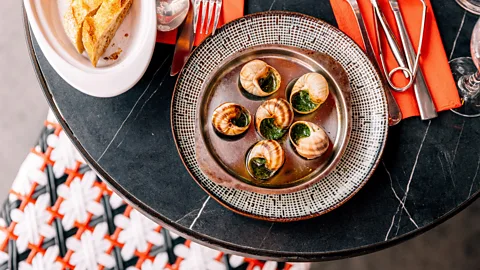 Getty Images
In France, traditional restaurants are disappearing – the French blame high costs and the "Americanisation" of eating habits.
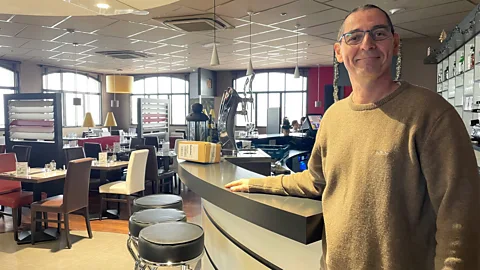
It's getting on for 12:30, and Mickael Moureaud anxiously eyes the empty tables in his restaurant L'Ange Vin. "We should be three-quarters full at this time, but we're more than three-quarters empty. It's been like this for about a year," he says gloomily.
L'Ange Vin is situated in an industrial park on the outskirts of Angers, a city in western France, some 300km (186 miles) from Paris.
A few years ago, if you drove through La France profonde (small town France), you'd come across dozens of little restaurants like this. Now, in many small towns, there is nothing but a bakery, and a pizza or doner kebab place.
Restaurants serving traditional French food like steak frites, coq au vin or mussels in white wine sauce are said to be closing at a rate of about 25 a day.
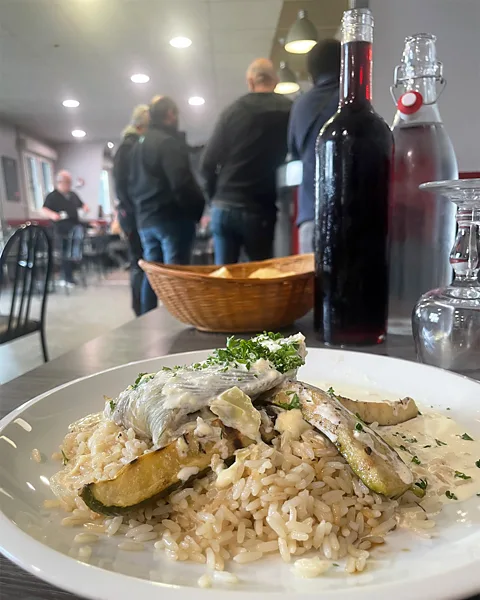
A waitress at L'Ange Vin comes over and announces today's menu to a table of men who work at a nearby small factory. For starters – smoked salmon salad, or a salad with blood sausage. While the mains are skate wings with puréed vegetables, or spaghetti carbonara. And the pudding is fruit crumble.
For the three courses of entrée, plat and dessert, the price is just €16.50 ($19.50; £14.30). Given that reasonable cost you might expect customers like these to be regulars, but they usually eat at the work canteen, they tell me. They're only here today because their boss is taking them out for a New Year's treat.
Moureaud says the past year has been really bad because of the rise in costs from his suppliers. "I've been doing this job for 20 years and purchasing has never been so stressful. Prices have risen between 10% and 30% over the past year. "A basic like minced beef, for example, was about €8 [$9.55; £6.93] a kilo a year ago. Now it's about 12 and a half [$14.33; £10.39]." Moureaud tells me that his policy has been to reduce his profit margin rather than pass on those cost increases to his customers. But nevertheless, his clientele is down 10% on a year ago.
Statistics for France as a whole show that profits for traditional restaurants across the country fell from 11% of turnover in 2023 to just 3% in 2024, as increased costs and fewer customers really started to bite.
 John Laurenson
For Moureaud, things are a bit worse than that. "Nowadays, I feel like I'm working for nothing," he says. "Once I've managed to pay my staff, pay my suppliers, and pay all the obligatory charges, taxes and contributions, it's almost a relief if I manage to break even." Some months he can't pay himself anything, he says. "I'm lucky enough to have a wife who works and who makes a decent salary," he explains.
"I love what I do. I have a restaurant that people like – we've got 4.5 stars out of five from customers on the internet – but we are barely getting by. It's really stressful actually.
"It's like everything's falling apart. It is possible that I'll lose everything. After 20 years of work! Twenty years with nothing to show for it!"
I leave Moureaud to look after his insufficiently-numerous customers, and drive into the centre of the city. It was a sobering experience talking to him. It's been a while since I've interviewed someone who's trying not to cry.
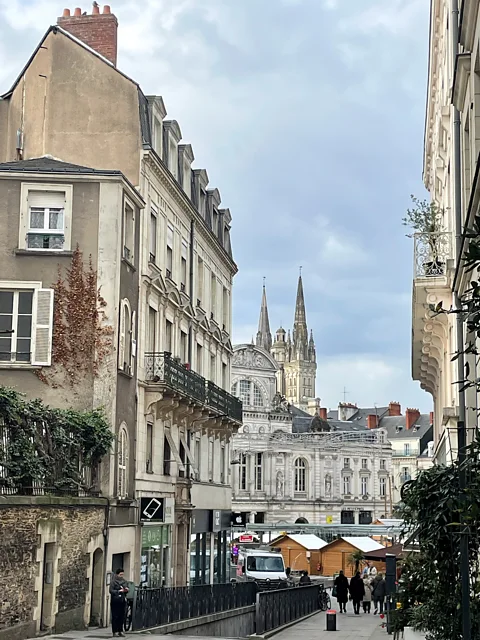
Sobering as well to think that across this country known the world over for its excellent cuisine and its solid, well-rooted food culture, there are thousands in situations like his or worse. In Angers, even restaurants in prime locations are struggling.
 John Laurenson
At a Frenchified burger restaurant called the Ernest Inn just off the main square, I meet up with Celine Viale. She runs three eateries including this one, and is département,or county-level, president of the hotel and restaurant owners' union.
"Between June 2024 and June 2025, the number of restaurants that closed in France increased by 10% [from the previous 12 months]. About 9,800 closed for good in that period," she says. "Sales figures were really bad too." She says that the average turnover of restaurants was down 22%, due to falling customer numbers.
Here in Angers, she adds, there have been plenty of closures in the past few years. Often it's traditional restaurants that go bankrupt and are replaced by kebab places, or burger chains, or some other fast-food outlet.
In 2010, the "gastronomic meal of the French", as it was phrased, was inscribed on Unesco's Intangible Cultural Heritage of Humanity list.
It recognised not so much the specific cuisine, but the social practice of the French meal – people gathering around a well-laid table to eat a structured sequence of dishes with a pairing of food and wine. It is a traditional way of eating that many are abandoning, says Viale. "The new generation – the sacrificed generation I call it – hasn't been brought up eating in a traditional French way. The Americanisation of our eating habits has been huge here and very sudden.
"We went from a very traditional to a very street food/fast food way of eating, very quickly. For many young people dinner is a bag of home-delivered nuggets.
"So just as Unesco celebrates the traditional French meal, many French people are giving it up," says Viale.
Out in the pretty central square surrounded by fine old white-stone buildings, there are lots of people out in the thin winter sunshine. Angers is a really pleasant town. On several occasions in recent years it has even been voted the best place to live in the whole country. It feels quietly prosperous and yet, few of the people I talk to do what was until recently the French thing to do – eat in restaurants.
"I just ate at a sandwich place," one twenty-something woman tells me. "I never go to proper restaurants.
"It's a question of time but also money. At the boulangerie [bakery], my lunch cost me €8.50, about $10 [£7.36]. You can't eat for that in a restaurant."
Another young passerby says she only goes to restaurants "for special occasions". He adds: "To celebrate getting my internship I went to a restaurant!
"But otherwise no. This lunchtime, for example, we went to McDonald's. Usually I eat at home because it's cheaper and healthier."
 John Laurenson
Many French people complain that restaurants have become too expensive, but Celine Viale tells me restaurant prices increased less than their costs from mid-2024 to mid-2025. However, a survey carried out over a longer period by Gira, a consultancy firm that advises owners, suppliers and investors in the restaurant sector tells a different story.
"Between the end of 2022 when inflation really jumped and mid-2024 when it stopped rising but remained at a very high level, raw material costs for restaurant owners rose 16% on average," says Gira's founder and chief executive Bernard Boutboul. "That's enormous."
"Some restaurant owners were reasonable and put prices up by 9% to 10%. Some didn't put up their prices at all, and that's a bit dangerous because that can wipe out your profit margin.
"But many put their prices up by more than 20%. In fact, the national average restaurant price increase for that period was 23%."
Boutboul adds that the timing could not have been worse as it came when French people were struggling with much higher prices for their groceries and their energy bills. "So the cost of the particularly French pleasure of eating in a restaurant suddenly became prohibitive for many people.
"We do a lot of customer surveys, and people often complain they can no longer find a restaurant where the dessert is under €9. Or that they are charged €10 for a half-bottle of mineral water! It's just much too much!
"France now has, in my opinion, restaurants that are much too expensive for French people."
Tastes have changed too. "We have, in France and all over the world, a new generation of consumers who love restaurants, but they don't go to the same places as their parents, let alone their grandparents," notes Boutboul.
"They don't want to eat the same things, they don't want to structure their meals in the same way, they don't have the same notion of value for money.
"They are more interested in buying an experience than the food as such. The place, the staff, the dishes: it all needs to be 'instagramable'. So, we're at a turning point."
More like this:
• France's favourite restaurant
• Is French cuisine forever changed?
• The market that feeds Mexico City's best restaurants
Some have managed to negotiate the turning brilliantly. Boutboul cites one new restaurant chain that has flourished quickly, La Nouvelle Garde, which aims to offer a cheaper and healthier version of the traditional brasserie.
But the huge, dense network of little restaurants that used to define this country at mealtimes is disappearing fast. If things keep going the way they have, the future, says Céline Viale, is bleak.
"It would be a shame if the same thing happens to the restaurant business as happened to fashion retailing, where the independents disappear and all that's left in the city centres are the big brands, the big chain stores," she says.
"I'm afraid we'll end up with a two-tier system with some eating in a few very expensive gastronomic restaurants, while the rest will eat badly, or at home."
--
If you liked this story, sign up for The Essential List newsletter – a handpicked selection of features, videos and can't-miss news, delivered to your inbox twice a week.
For more on business and beyond, follow us on LinkedIn.
