'She was a beacon of light in a dark chapter in history': Ann Lee, the 1700s Christian leader who shocked America

 Alamy
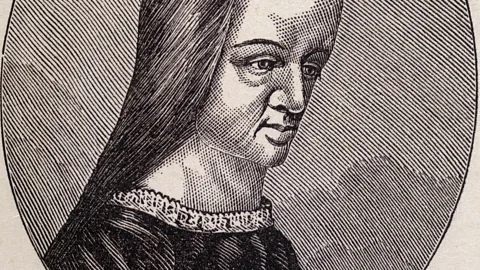
AlamyHow did a charismatic but impoverished British woman become the leader of the progressive religious sect known as "the Shakers" – taking it to America and inspiring thousands to follow her?
The 18th-Century Christian sect known as the Shakers is best known today for its influential contributions to furniture, design, and architecture. What is less well known is how incredibly radical the Shakers were. Way ahead of their time, they espoused gender parity, communalism, pacifism and sustainability. They also pioneered social services in America, provided shelter to abused women, and freed enslaved African Americans. And then there was their insistence on celibacy and the abolition of marriage.
Even today, the Shakers' ideals seem daring – and many of them can be traced back to the religious movement's unlikely leader, British-born Ann Lee. She was an illiterate woman who grew up in poverty, and yet she convinced thousands to follow her teachings. How did she do it?
While she left behind no writings, testimonies from her followers describe her as an enormously charismatic and persuasive figure. "All the accounts of [Lee] speak about this fierce dedication to [her cause]," says film-maker Mona Fastvold.
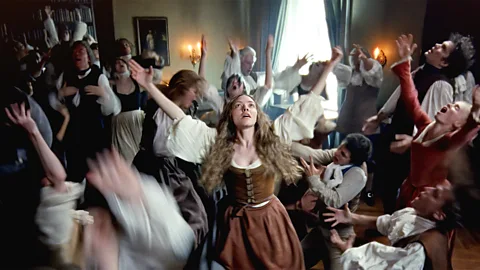
Now Fastvold has co-written and directed a historical musical, The Testament of Ann Lee, which stars Amanda Seyfried as Lee. Described by Fastvold as a "speculative retelling" of Lee's story, the film charts the life of the charismatic figure, from her impoverished childhood in Manchester, England, to becoming leader of the Shakers and taking the movement to America, to her death at the age of 48.
Lee's progressive ideals intrigued Fastvold from the beginning. "I was just truly fascinated that there was this woman with these radical ideas and that it was part of American history," Fastvold tells the BBC.
 Searchlight Pictures
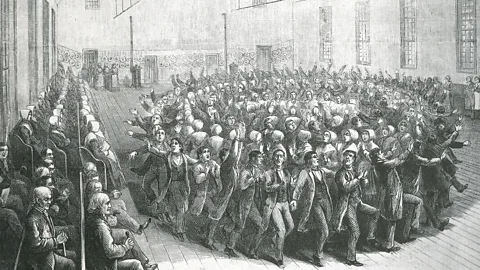
Born in 1736 in Manchester, the second of eight children, Ann Lee had no formal education. After several jobs, including a stint in a textile factory, at 22 Lee joined an English sect called the Wardley Society. Nicknamed "the Shaking Quakers" for their ecstatic dancing and singing during worship, the group later became known as "The Shakers". A Protestant group, the Shakers believed the second coming of Christ would be in female form, and that Lee embodied this second coming. They also believed that men and women share the same responsibilities to each other and the world.
In 1762, Lee married Abraham Standerin, a blacksmith. They had four children, all of whom died in infancy. Following the death of her fourth child, Lee became more active in the Wardley Society. As Lee's involvement increased, the Shakers became more fervent and began attacking rival church services. Lee believed the people of Manchester were being corrupted by the Church of England, and at one point referred to the Church of England as damned.
In 1770, Lee was imprisoned for 30 days in Manchester for disrupting another church service. While incarcerated, Lee had a premonition that celibacy was the key to purity and would become the Shakers' cornerstone. Four years later, Lee had another premonition that she was to establish the sect in America. On 10 May 1774, Lee and a small group of followers, including her brother, William Lee, and her husband, sailed from Liverpool to New York. Two years later, the Shakers established a community in Niskayuna, near Albany.
Norm-breaking beliefs
When Lee and her supporters arrived in America, which was on the precipice of the Revolutionary War (1775-1783), their staunch pacifist stance soon aroused suspicion and controversy. Lee was accused of being a British spy, and she was imprisoned when she refused to take an oath of loyalty to New York State. Claiming that such an act contradicted her beliefs, Lee spent months in prison, until Governor George Clinton sought her release. Lee and other Shakers were also harassed and attacked by mobs for their beliefs.
Lee died in 1784, 10 years after arriving in America. Some believe injuries she sustained from being beaten contributed to her death. Yet, long after she died, the influence of "Mother Ann", as she was called by followers, continued to grow. By 1850, there were roughly 5,000 Shakers in the US.
 Alamy
AlamyOne of Lee's defining characteristics was her norm-breaking belief in gender and social equality. "All were seen as brothers and sisters to all," says Elizabeth De Wolfe, professor of history, University of New England, and author of Shaking the Faith: Women, Family, and Mary M Dyer's Anti-Shaker Campaign.
"Rethinking family structures and societal structure and creating this utopia where there's a whole new way of living together and coexisting… [Lee] had to be come up with something drastic to redefine that. Brother and sister are equal; husband and wife are not," Fastvold says. Yet, in the years after Lee's leadership, the Shakers maintained some traditional gender divisions. "Both within and between Shaker communities there was a hierarchy. The leadership and decision-making structure was hierarchical," says De Wolfe.
As Fastvold points out, Lee lived in a patriarchal society, where the abhorrent treatment of women was commonplace. "Obviously, being a woman in this period in history sucked," Fastvold says. "That's just how it is. You had zero autonomy. You were considered your husband's property; you were expected to give birth to 10 children, 14 children. My great-grandmother had 14 children. Basically, your purpose was to bear children."
Celibacy and pacificism
One of Lee's most controversial rules was her strict insistence on celibacy, believing as she did that sex was the root of all evil. Lee adopted celibacy "to live the life of Christ", De Wolfe says. "As it was believed that Christ was celibate, so too were the Shakers." It has been suggested that Lee's pivot towards celibacy was induced by her harrowing childbirths and the tragic loss of her children. "[Losing four of her children] surely increased her personal sense that sex was not a holy act that brought peace and joy, but one that resulted in suffering and sorrow," says Kathryn Reklis, assistant professor of modern Protestant theology at Fordham University.
 Searchlight Pictures
Yet Fastvold believes that Lee's aversion to sex partly originated from her traumatic upbringing. In an early scene, her film depicts Lee witnessing her parents having sexual relations and confronting her father. "It's been referred to in [the Shakers’ testimonies] that she had this aversion towards what they call 'fleshly cohabitation' since her earliest youth," says Fastvold.
More like this:
• Why Tam O'Shanter is a Robert Burns masterpiece
• How the Red Scare erased a US icon
• The 70s sex scandal that led to a dramatic trial
Another of the Shakers' major tenets was pacifism, a principle that was incredibly contentious in America. "They were such dedicated pacifists; that was very important to them," Fastvold says. "When [the Shakers] were pressured to partake in the Revolutionary War, [Lee] said, 'Absolutely not. We cannot harm anyone.' Which was also really radical at the time."
And some historians argue that Lee's radical beliefs meant that she was an early proponent of feminism. "I would say [Lee was] one of the [earliest feminists]," says Fastvold. "I'm sure there are many others we don't know about."
 Alamy
AlamyThroughout her life, Lee remained committed to her principles, despite being attacked, beaten, accused of being a witch, and imprisoned. "[There are] multiple quotes [of Lee] saying, 'I don't care if you take my life. It doesn't matter. I will never compromise on any of this,'" Fastvold says.
While the Shaker movement had thousands of followers at its peak, there are only three Shakers in the US today. The third Shaker, a woman from Maine, joined the sect in 2025.
Yet, Fastvold says she believes Lee is still deeply relevant today. "[Shakers] were the first people who provided social services in America. It was a place for women who were abused or hurt to seek shelter. It was a place they took care of orphan children. It was a place where you could bring your elders to be cared for. They provided all these services before there was a structure for it here."
Fastvold hopes the film brings attention to a forgotten figure who fought for equality. "The legacy that we knew before telling this story is truly in the design," says Fastvold. "That's what we know in America, internationally, the Shaker design. But [Lee's] true legacy is all of these ideas around equality and community. I think [these ideas] really speak to now.
"[Lee] was this beacon of light that existed [in a] chapter in American history that was quite dark."
The Testament of Ann Lee is in cinemas now in the US and will be released in the UK on 20 February.
--
If you liked this story, sign up for The Essential List newsletter – a handpicked selection of features, videos and can't-miss news, delivered to your inbox twice a week.
For more Culture stories from the BBC, follow us on Facebookand Instagram.
