'There's no other poem like it': Why this Robert Burns classic is a masterpiece

 Getty Images
Tam O'Shanter is a rip-roaring tale of witches and alcohol, but it has hidden depths. On Burns Night this Sunday – and 235 years after the poem was published in 1791 – Scots everywhere may well be treated to a masterwork with a unique, universal appeal.
If you're Scottish, or if you wish you were, then this Sunday is a red-letter day. Scotland's greatest poet, Robert Burns, was born on 25 January 1759, and Burns Suppers are now held every year, all over the world, to mark his birthday. The guests drink whisky (not "whiskey", please – that's the Irish and US spelling), they eat haggis, tatties and neeps (don't ask), and they hear some of the bard's many ballads and poems. Ae Fond Kiss, To A Mouse and Auld Lang Syne are usually on the bill. And somebody may well recite Tam O'Shanter, a rip-roaring yarn about witchcraft and heavy drinking that was first published 235 years ago in 1791. It's a poem that has even more to it than most Burns Supper regulars might realise.
 Getty Images
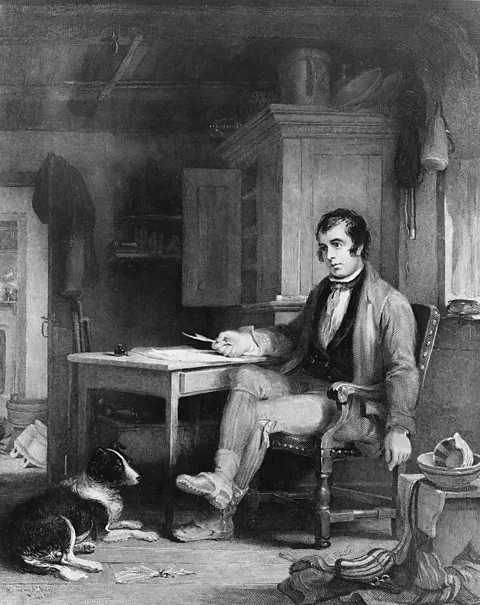
"Tam O'Shanter is Burns's masterpiece, it really is," says Pauline Mackay, professor of Robert Burns studies and cultural heritage at the University of Glasgow. "It's one of his most popular works, so when you say it's your favourite Burns poem, people say, 'Urgh, that's so obvious'. But actually, I've been studying it for many, many years, and it's so multifaceted. Burns brought all of his considerable talents to bear on capturing what inspires him, what motivates him, and his own perception of humanity and human nature."
And that's not all. Robert Irvine, the editor of Burns: Selected Poems and Songs, notes that there is a darkness to the poem that goes beyond its spine-tingling descriptions of the devil and his minions. "There's some weird stuff going on there," he says.
The poem tells the mock-heroic tale of Tam O'Shanter, a farmer who spends as much time drinking as he does working. At the end of one market day in Ayr, he retires to the pub with his "ancient, trusty, drouthy crony" Souter Johnnie (ie, Johnnie the shoemaker), never mind that his wife Kate is waiting at home. It's only after hours of boozing and flirting with the landlady that Tam finally sets off on his horse, Maggie. But it's a dark and stormy night, so he has to hold on to his hat, and sing songs to keep up his spirits. "Whiles holding fast his gude blue bonnet; / Whiles crooning o'er some auld Scots sonnet." This reference to a "blue bonnet", incidentally, is why beret-like flat hats with pom-poms are called Tam O'Shanters.
 Getty Images
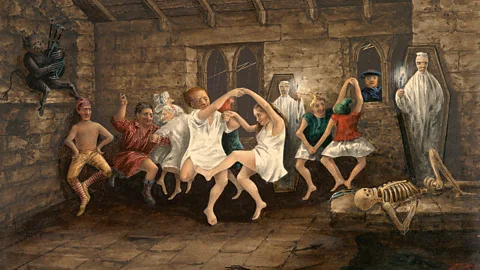
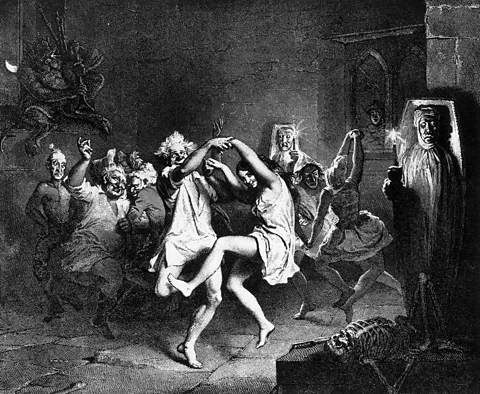
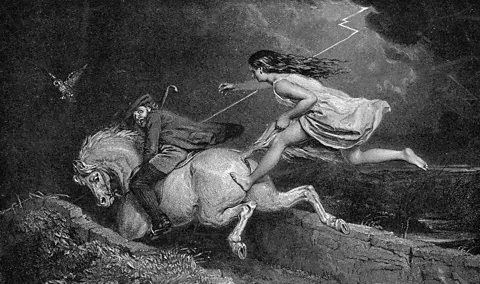
When he approaches Alloway's Auld Kirk, Tam notices that a diabolical party is underway inside: witches and warlocks are dancing, and the devil himself, Auld Nick, is playing the bagpipes. Most of the revellers are "rigwoodie hags", but one witch, Nannie, is so young, attractive and scantily clad that Tam yells out the only words he speaks in the poem: "Weel done, Cutty-sark!" This cat call would later lend its name to the Cutty Sark, a 19th-Century clipper ship that can be visited in Greenwich, London. Roughly translated, it means: "Well done, Short Dress!"
More like this:
• Why a poem outraged 1980s Britain
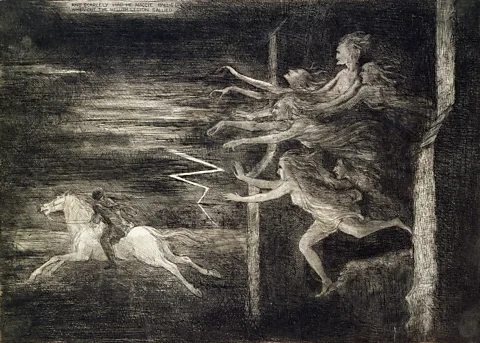
Nannie and her cohorts aren't pleased to hear it: Tam has to flee on horseback with a crowd of screeching witches in hot pursuit, "Wi' mony an eldritch skriech and hollo". Luckily for him, witches can't cross running water, and the River Doon is nearby. Tam manages to race over the bridge to safety, but Maggie the horse isn't quite so fortunate. Nannie grabs hold of her tail just as she steps on to the Brig O' Doon, and – spoiler alert – she is left with "scarce a stump".
Rude jokes and chilling imagery
Carruthers calls it a "fairly hackneyed ghost story plot", but the way Burns tells his story means that "there's no other poem like it in Scottish literature". Tam O'Shanter is "incredibly rich, so visual, so carefully crafted and so well-paced", Mackay tells the BBC. "There's just so much in there: everything from the way Burns has absorbed and assimilated the landscape and folklore of Ayrshire where he was born, and Dumfriesshire where he was writing the poem, to his keen interest in the supernatural, to the various comments that he makes on the complexities of human relationships and gender. All of this is so fascinating."
There are lines in Scots, and others in English. There are rude jokes, and there is chillingly macabre imagery. There are tributes to the joys of getting drunk with friends in a cosy pub: "Kings may be blest, but Tam was glorious. / O'er a' the ills o' life victorious!" And there are rueful philosophical musings on how transient those joys are: "But pleasures are like poppies spread, / You seize the flower, its bloom is shed." Sometimes the narrator will address Tam himself: "O Tam, hadst thou but been sae wise, / As ta'en thou ain wife Kate's advice!" At other times, he will address another character or the reader / listener – one reason, says Irvine, why the poem "lends itself to performance", and has become a Burns Supper staple.
 Getty Images
In fact, there isn't much that Burns doesn't do in Tam O'Shanter – and he does it all in rhyming iambic tetrameter. "He's showing off," says Irvine. "He's doing one thing, and saying 'Hey, look, I can do this other thing as well.' In his first volume of poems, he does that between one poem and the next. He adopts different verse genres, he switches from Scots to English, he borrows from all sorts of different traditions – both what we think of now as the folk tradition, and the literary traditions of England and Scotland. It's a virtuoso display of all the different things that he can do. And in Tam O'Shanter, he's doing all that within one poem."
Appropriately for a Burns Supper centrepiece, Tam O'Shanter is a feast, its most satisfying ingredient being its fond and insightful portrait of a character described as "the universal everyman" by Prof Gerard Carruthers, the editor of The Oxford Handbook of Robert Burns. Burns is admired for his egalitarian politics, and even in his rollicking horror comedy, his sympathy for the common man shines through. "Tam O'Shanter is a poem of misdirection," Carruthers tells the BBC. "Burns is saying: 'Look at this! Look at the witch! Look at the horse!' Whereas in fact the real thing that he is talking about is the way in which we're incorrigible as human beings." The poem glows with "ridicule and affection at the same time for Tam, and by extension for the human psyche in general".
Burns – a notorious womaniser – is especially sharp on masculine foibles. "Burns knows the male mind," says Carruthers. "He knows that men in a lot of ways are stupid wee boys." On the other hand, says Mackay, women may recognise themselves in Tam O'Shanter, too. "It's a poem about humanity – the pleasures and the appetites, the challenges and the frailties – and I think that's one of the reasons why Burns is so universally popular. He talks about what it is to be a human being – and everything that we see in different places throughout his poetic oeuvre is somehow represented in this one poem."
 Getty Images
Still, alongside its compassion, there is devilry of more than one kind in Tam O'Shanter. "The weird and disturbing thing about this poem is that Burns's father, William Burnes, was a very pious and serious man who despaired of the libertine tendencies of his son," says Irvine. "He organised repairs to Alloway Kirk when Burns and his brother were boys, and one of the reasons for that is that he wanted to be buried there – and he was. So, in 1784 Burns's father was buried in Alloway churchyard, which Burns then makes famous as the site of a witches' orgy. Was he getting revenge on his father for his disapproval of his eldest son?"
As well as everything else Burns is doing in Tam O'Shanter, it could be argued that he is almost literally dancing on his father's grave. Anyone who hears it at a Burns Supper on Sunday will have plenty to chew on.
--
If you liked this story, sign up for The Essential List newsletter – a handpicked selection of features, videos and can't-miss news, delivered to your inbox twice a week.
For more Culture stories from the BBC, follow us on Facebookand Instagram.
