I stowed away on a trawler and spent 32 years at sea

 BBC
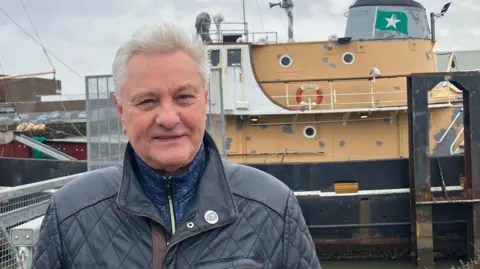
BBCWhen Tony Roach was 14 years old, he stowed away on a trawler at Grimsby docks. Today, he retains his life-long connection to the industry by volunteering on the Ross Tiger, a trawler and museum ship moored at the Grimsby Fishing Heritage Centre.
"We went aboard at night, got in the lifeboat and then when we woke up in the morning, we were just sailing," the 74-year-old recalls.
"I got seasick. And then they put us ashore in Aberdeen and set us back to Grimsby.
"That was my 15 minutes of fame, because we were in all the tabloids, we were on the TV news."
When he eventually arrived back home, Tony was in trouble. He got the cane at school, but escaped a "good hiding" from his father, who was about to leave on his own trawler voyage.
 Getty Images
It did not put him off and the following year, he left school and went straight to sea with the company he had stowed away with.
"And after that, I did 32 years," he has been telling the Secret Lincolnshire podcast.
Tony is retired now, using his spare time to retell stories of the town's rich seafaring past.
"Grimsby was built on fishing," he says. "It's called Great Grimsby.
"It was fishing that put the great into Grimsby. That's what I think.
"We've got to preserve this heritage. There's not a lot of us left, ex-fishermen.
"Maybe 10 to 20 years' time, there won't be any of us left. So who's going to tell the story then?"
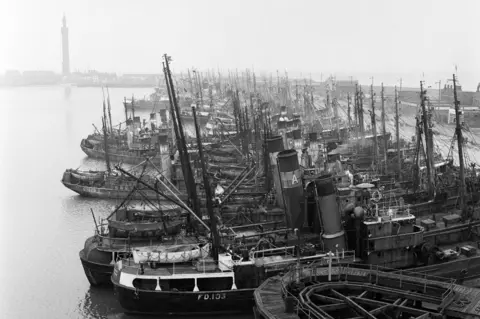
In the middle decades of the 20th Century, Grimsby was at the peak of its fishing power and known as the world's premier fishing port.
For Tony, fishing was in the blood: his father and brother both went to sea and, even before stowing away, his dad had taken him on trips on trawlers as a boy.
"I spent a lot of my time down the docks when I should have been at school.
"My father, he was my role model. He was a lovely guy."
'Way of life'
Working in the fishing industry often ran in families. Fishing communities, especially in Grimsby and, across the Humber, in Hull's Hessle Road, were deeply interconnected.
Tragedies at sea, unfortunately frequent, affected virtually every family.
"It was just a way of life and everybody did it," Tony recalls.
"My father was actually shipwrecked, I think twice, because obviously he fished during the war.
"He didn't have to go into the services, but he carried on fishing on armed trawlers.
"I said, 'Dad you were shipwrecked twice and you can't swim'.
"And he said, 'when you've got to swim son, you do.'"
Tony says he was lucky at a time when, sadly, deaths at sea were common.
"I was once on a ship where a guy did get killed, but that was down the engine room. After that happened, we couldn't think to catch a fish. It was terrible.
"But that was the only time I've ever experienced any sort of fatality on the ship.
"You were constantly keeping an eye out for yourself and your friends."
The strong family links and moving true stories of life and loss at sea are central themes at the Fishing Heritage Centre.
Researchers and family members can access extensive archives to trace their ancestors' connections to the industry.
Meanwhile, the Ross Tiger offers a hands-on experience for visitors.
When it was launched in 1957, the trawler – built by Cochrane and Sons of Selby – was one of a new generation of modern, powerful vessels.
Her Ruston diesel engines, built in Lincoln, gave her strength and stability that impressed everyone who sailed aboard.
But the ship also offered comforts few trawlermen had ever known, including central heating, flushing toilets, baths and even a shower. For men used to washing with a bucket and using the ship's rail as a toilet, it was a revolution at sea.
"She's a 70-year-old, you know," says Tony, who sailed on the ship in its heyday. "She's just a little bit younger than me.
"One trip, we were fishing up at the Orkneys and were getting a lot of haddocks at night-time and I can remember me being up to me waist in haddocks, thinking, I'm never going to get to sleep again. But we did.
"It's not a job. It's a calling.
"Fishing has been a big part of my family, and sadly I'm the last one to have anything to do with the fishing.
"It was a hard job, but we seemed to like it in a weird sort of way. We must have been mad.
"Then obviously we got our three days in the dock, you know three-day millionaires," he adds, referring to the term used to describe young men flush with cash and ready to let their hair down after weeks spent at sea.
"We weren't millionaires, but everybody thought we were."
The Ross Tiger survives as a rare example of progress in the fishing industry and yet, for all her innovation, she was built for a dangerous trade.
Today, the vessel stands as a memorial to Yorkshire shipbuilding skills, Lincolnshire's engineering heritage and, above all, to the courage of generations of trawlermen who sailed from Grimsby and never came home.
Listen to highlights fromLincolnshire on BBC Sounds, watch thelatest episode of Look Northor tell us about a story you think we should be covering here.
Download the BBC News app from the App Storefor iPhone and iPad orGoogle Play for Android devices
