Walking St Patrick's Way: The 82-mile trail behind the world's biggest Irish celebration

 Alamy
AlamyEach year on 17 March, St Patrick's Day is celebrated across the world, from dyeing the Chicago River green to parades through New York, Sydney, Paris and Munich. But in Northern Ireland, there is a quieter way to mark the occasion: on foot.
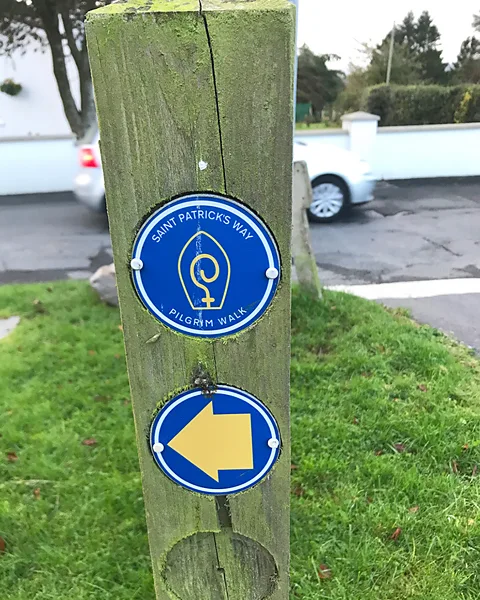
Saint Patrick's Way is an 82-mile walking trail running from Armagh to Downpatrick, linking places associated with Patrick's life and finishing at his burial site. While much of the world celebrates St Patrick's Day with raucous parties, this routetraces the landscapes where the real story of Ireland's patron saint unfolded.
Established in 2015, Saint Patrick's Way was inspired by Spain's Camino de Santiago. "The initial idea came from a man called Al Graham who had done the Camino and suggested we create something like that in Ireland," said Tim Campbell, director of the Saint Patrick's Centre in Downpatrick.
"Saint Patrick's Day is one of the biggest cultural events in the world, but often Patrick himself gets lost in the revelry. Our aim is to put Saint Patrick back into Saint Patrick's Day; to reconnect the celebration with the story."
The man beyond the legends
The saint turns out to be a more complex figure than the familiar legends suggest. The first surprise is that he was not Irish. Born in Roman Britain in the late 4th Century, he was kidnapped as a teenager by Irish raiders and sold into slavery. He escaped to France, later returning to Ireland as a missionary.
 Lizzie Enfield
For Martina Purdy, a former BBC correspondent who became a nun and now guides reflective walks on Saint Patrick's Way, it is his extraordinary life that keeps Patrick relevant.
"Patrick's story is painfully modern," she says. "He was a young man taken into slavery, displaced and trafficked. When people hear his own words – 'I'm not perfect, I messed up' – they recognise themselves in him. His story doesn't stay in history, it meets people where they are now."
Following Patrick through Northern Ireland
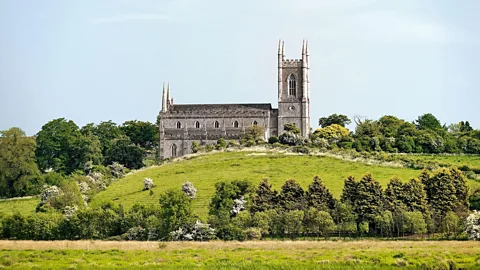
One of Patrick's earliest converts was the chieftain Daire, who granted him land to build a church on a hill just outside Armagh. The route begins there, in a small city where two St Patrick's cathedrals – one Roman Catholic and one Church of Ireland – sit less than half a mile apart on opposing hills, an architectural reminder of Ireland's divided history and shared inheritance.
From here, the route slips south through orchard country known for tangy ciders and apple tarts, before passing through Banbridge, once a centre of linen weaving. A long, easy stretch follows along the Newry Canal to the eponymous city, whose coat of arms depicts Patrick flanked by yew trees he is said to have planted above the Clanrye River.
Much of this landscape lies close to the border with the Republic of Ireland, through places that were once considered no-go areas during the Troubles.
"Saint Patrick's Way has become one of the key pillars of tourism in Northern Ireland since the signing of the peace agreement," Campbell explains. "After decades where tourism simply wasn't possible, there has been a deliberate effort to build something that was about more than just visitor numbers. Patrick sits at the intersection of faith, history, culture, landscape and peace-building, and he doesn't belong to one community or tradition."
 Alamy
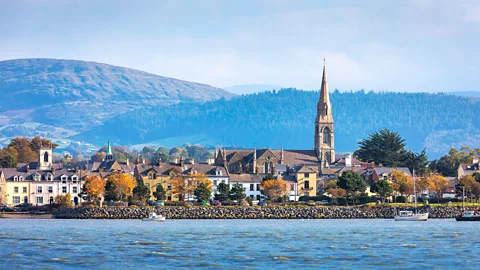
AlamyFrom Newry, the route follows quiet country lanes to Carlingford Lough. Rostrevor sits on its shores, a handsome coastal town backed by the Mourne Mountains and known as the birthplace of Robert Ross, the British major-general who burned down the White House during the War of 1812. Rostrevor was also a favourite retreat of Belfast-born writer C S Lewis, who found inspiration for Narnia in the snow-dusted Mourne Mountains.
More like this:
• How Northern Ireland is reclaiming its story
• Inside Ireland's most unusual ball sport
• Ireland's time-warped island of Owey is the perfect place to disconnect
It is in the mountains themselves that Patrick is said to have preached to local communities. On the summit of Butter Mountain, I meet Maureen Scallon, a keen hiker from Boston.
"My great-great-great grandparents set sail from Carlingford Lough to New York in the mid-19th Century," she tells me. "I've always felt my Irish roots were part of my identity, but I'd never been. When I heard about Saint Patrick's Way, it felt like the perfect way to explore what that ancestry means, by doing something I love."
We walk together for a while as the route drops through the magnificent beech avenues of Tollymore Forest Park, familiar to millions as a filming location for Game of Thrones, before descending to the seaside resort of Newcastle, where a sandy beach and seafood restaurants offer a gentler end to the day.
 Alamy
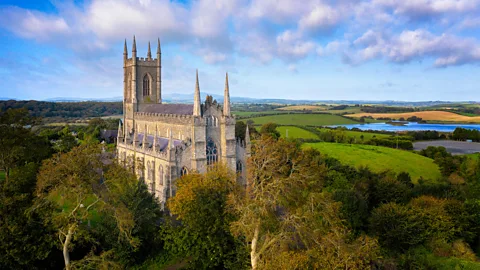
AlamyThe final stretch leads inland to Downpatrick, where Patrick is believed to be buried in the grounds of Down Cathedral beneath a simple granite slab carved with a single word: Patrick. He died on 17 March; in Christian tradition, a saint's death day marks their entry into eternal life.
More of Patrick's story is told through a series of interactive displays at the modern glass-and-granite Saint Patrick Centre. Here, the familiar legends quickly fall away. I have already discovered that Patrick was not Irish. I also learn that he was never formally canonised – in the early church, saints were recognised through popular devotion rather than a Vatican process – and Ireland never had any snakes to banish. The famous tale is thought to be a later metaphor for the spread of Christianity over pagan belief.
Patrick's importance, Campbell says, lies in something far more fundamental than myth. "Ireland's written history begins with Patrick's own words. He did not just bring Christianity to the island, he wrote down its story."
From Ireland to the world
That story would eventually travel far beyond the Emerald Isle. The earliest recorded St Patrick's Day celebrations took place not in Ireland but in colonial America, in cities such as Boston and New York, when people of Irish origin gathered to assert a shared identity in colonial society.
By the mid-18th Century, Saint Patrick's Day parades had taken on political significance, used in recruitment drives first for the British army and later, during the American War of Independence, for revolutionary forces. Irish identity became increasingly associated with ideas of liberty and resistance, and Patrick emerged as a symbolic figure for migrant communities seeking visibility and belonging.
 Alamy
AlamyToday there are more than 450 churches dedicated to Saint Patrick in the US alone, and hundreds of thousands of children named after him. For communities shaped by migration and displacement, Patrick's story – of exile, endurance and return – continues to resonate across borders and generations. Walking Saint Patrick's Way brings that global story back to its source.
"People think they come because they want a good walk or some scenery, but very often something else is going on," says Purdy. "I always say it's a kind of invitation. Patrick draws people back, and moving through the landscape where his story actually happened, in a place that once had so many divisions, is powerful in itself."
--
If you liked this story, sign up for The Essential List newsletter – a handpicked selection of features, videos and can't-miss news, delivered to your inbox twice a week.
For more Travel stories from the BBC, follow us on Facebook and Instagram.
