Italy's hidden mountain museums in the clouds

 Messner Mountain Museums
The Dolomites hold immeasurable thrills for travellers – now, the opening of a new mountaineering collection from one of the greatest climbers of all time, Reinhold Messner, is adding new meaning to their story.
The Dolomites, located in north-eastern Italy near the Austrian border, are hard country for an easy life. Full of stark pinnacles, stone cathedrals and fiercely savage vertical cliffs, the mountain range is characterised by landslides, avalanches and geology that has been in a constant battle with itself for more than 250 million years. Edges, crags and plateaus support little other than cable cars and via ferrata (iron roads) – climbing paths of steel cables, ladders and bridges built during World War One as improbable escape routes.
All of this makes the mountains an unlikely location for a collection of museums. Yet tucked away at high altitude, they have become gathering spots to reflect on nature, modern alpinism and climate change. What's more, they all have one thing in common: record-breaking climber Reinhold Messner.
Messner has been confronting extreme challenges for much of his life. In 1980, the Italian made the first solo ascent of Mount Everest. By 1986, he'd conquered the world's 14 highest mountains before anyone else, and without supplementary oxygen. In the years that followed, he dragged a sled unaided across both Greenland and Antarctica. His triumphs are enough to stir anyone's inner explorer.
Messner might be regarded as one of history's greatest climbers, but he's also a keeper of stories. Since summiting his first mountain aged five, he has written 80 books about his white-knuckle expeditions, and, even at 81 years old, the German speaker from Brixen in South Tyrol in the north of Italy is not preparing to slow down. If anything, he has many more stories to tell.
 Mike MacEacheran
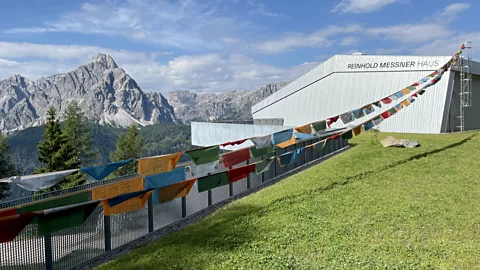
His latest project, located in the 3 Zinnen Dolomites region, was developed with his wife, Diane, amid rising interest in the area among travellers. The number of visitors to South Tyrol is consistently growing, according to the tourist board, and its mountains are a neat synthesis of two different worlds: a setting for entry-level hikers and a fantasy land for mountaineers.
When I met Messner, he was walking with small steps to his latest venture, Reinhold Messner Haus, which opened this summer. "It is my dream and challenge to keep the original spirit of mountaineering alive," he said, as if batting away any suggestion of retirement. "To pass my knowledge onto the next generation – that is why we have created this new house."
On the face of it, Reinhold Messner Haus is both a collection of trusted mountaineering tools and a timeline of the Italian's extraordinary feats. The building is not in a town centre like most traditional museums, but hidden away across a plateau atop Mount Elmo above the village of Sexten. It isn't located in any regular structure, either; it is inside a former cable car station that had previously been earmarked for demolition. "Sustainability in action," as Diane told me. "Everything was already here, so we didn't use new materials or resources." Now, the bulk of this depot-turned-visitor-centre is open to the public; the other rooms, where the Messners have a one-bed apartment, remain private.
While the spaces are filled with curios from the Messners' private collection gathered from decades of travel, the presence of Tibetan prayer wheels and Mahakala masks, Hindu figurines and uplifting paintings makes it feel closer to a cultural and artistic meeting place. "We wanted to provide a platform for a better understanding of our relationship with nature," said Diane. Inside, I keenly felt this sense of spirituality. Outside, meanwhile, the Dolomites beamed, baring their teeth back at me.
 Mike MacEacheran
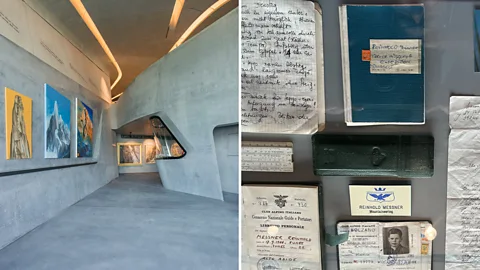
Down a stairwell rigged with inactive cables and cogs, we arrived in a room designed as a traditional adventurer's study and archive. Here, the golden age of mountaineering comes to life through maps, charts and boxes of black-and-white photos, all of which Messner has never sorted through, until now. "You need to understand that I would go away on an expedition, come home, write a book, do a few lectures, then leave on another trip – I never cared what was going on with all my materials," said Reinhold. "I wasn't worrying about yesterday or the past. I was living in the future."
From there, the couple led me through a gallery filled with ropes, ice axes and a polar sled into another room hung with Himalayan paintings, then up a stairwell and out onto a vast balcony hanging off the building like a theatrical dress circle. The reward was a god's-eye view of the Dolomites: the mountains like great stone waves; ramparts of limestone cut with steeples and sawtooth ridges rising over forest-green skirts.
More like this:
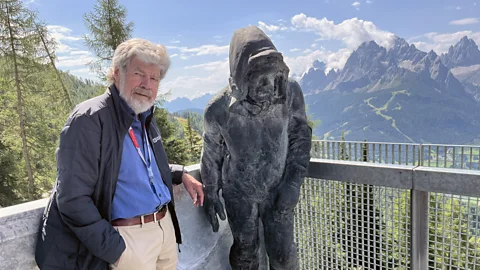
In a corner of the balcony stood a 1.9m (6ft 2in) carving of Reinhold caught in a moment of time – hooded, gloved, stooping, stoic – based on a photograph of his second solo ascent of Nanga Parbat in 1978. It was unveiled by Slovakian artist Štefan Papčo as a tribute to the climber when he was in his prime.
Was that his proudest achievement, I asked? "Perhaps, but the Dolomites are the most beautiful mountains in the world and have given me the greatest joy," he replied, pointing to the summits he knows so well. It seemed to me as if the alpinist was still moving through the landscape in his head – testing out finger grips and rock holds, forging new lines through these limestone walls. Maybe, I thought, it was a chill he could not shake.
 Mike MacEacheran
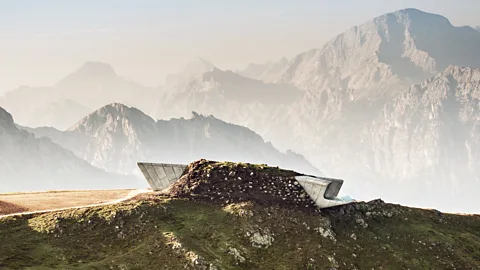
Reinhold's legacy in the Dolomites is hard to avoid. While Reinhold Messner Haus is the octogenarian's highly personal ode to his life, there have been other attempts to make sense of the highs and lows of both mountaineering culture and his career. Between 1995 and 2015, he founded six museums across South Tyrol, with several of these attractions tucked away in the same manner on windswept mountain tops and in fortified castles from Bolzano to Bruneck. The difference is Reinhold has cut ties from these completely, even if they still retain the weight of his family name.
Now collectively branded the Messner Mountain Museums, these museums house broader themed exhibitions on mountain culture, alpinism and anthropology, and are now overseen by Reinhold's daughter, Magdalena Messner, who runs what must be some of the world's most dramatically situated galleries.
The most impressive I had visited earlier that same week was Messner Mountain Museum Corones, designed by the late British-Iraqi architect Zaha Hadid. Perched on a natural balcony at 2,275m (7,463ft), near the summit of Kronplatz in the Puster Valley, it is a masterpiece of non-linear cast concrete architecture, with cavern galleries and fragmented geometries that mimic the rock and ice formations of the Dolomites where Reinhold frequently played. Strangely, the achievements of the man whose name was on the museum's door are little more than whispers throughout the galleries.
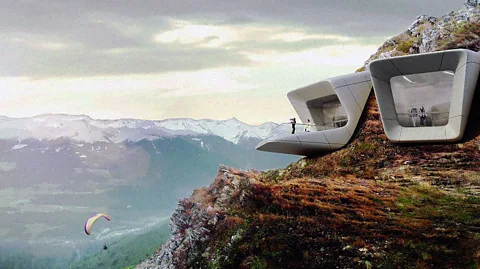 Messner Mountain Museums
While these attractions are now relics of the past for Messner, the mountains remain his lifelong passion, as does his fight to help the next generation stay tethered to wild places. "Adventuring is not so old, maybe only 200 years," he explained, as we continued our tour. "But the relationship between man and nature has changed, and it's important the historic traditions of mountaineering are not forgotten."
From the balcony, it was up another level to the house's focal point: the old cable car platform that's been transformed into a gorgeous, liminal space between the mountains and the climber's most prized mementoes. Outside, a 180-degree panorama unspooled. Inside, climbing boots and cameras, harnesses and helmets enjoyed well-earned retirement on metal racks. In a series of glass cabinets were letters, diary entries and pictures of frozen fingertips and frostbitten toes, as well as expedition documents, many revealing details about his close relationship with his younger brother, Günther, who was killed in an avalanche while the pair descended Nanga Parbat in 1970. It was a life-changing event that has haunted the climber every day since.
"So many bitter memories," he mumbled, tailing off. Above, on a vast steel gantry, Italian, German and English phrases carried messages of hope. "Endless thought, open mind." "Ever onward with a slow step."
It's the kind of inspirational, yet emotive, space where new adventures are plotted and schemed, I thought. A place to strong-arm the dramatic landscape of the Dolomites into submission. Maybe, even, to detail the possible future moments of Messner's extraordinary life story and his grand finale.
--
If you liked this story, sign up for The Essential List newsletter – a handpicked selection of features, videos and can't-miss news, delivered to your inbox twice a week.
