NHS boss denies he was 'fed up' of attacks inquiry

 The Nottingham Inquiry
The boss of a mental health trust told staff he was "fed up" as he prepared to give evidence to a public inquiry into the Nottingham attacks.
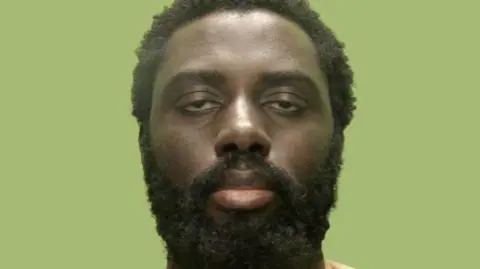
Valdo Calocane, who was diagnosed with paranoid schizophrenia in 2020, was discharged by Nottinghamshire Healthcare NHS Foundation Trust nine months before he killed Barnaby Webber, Grace O'Malley-Kumar and Ian Coates on 13 June 2023.
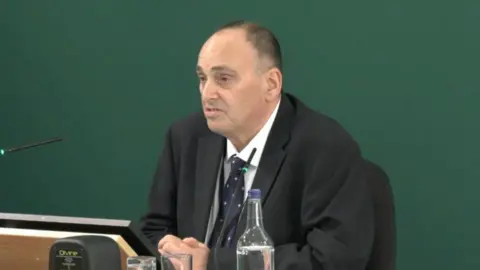
The Nottingham Inquiry - which is examining the attacks - heard the trust's outgoing chief executive, Ifti Majid, sent an apology to staff saying he had to cancel visits ahead of his evidence and he was "fed up of needing to do this".
Majid said he did not want that to be interpreted as not being committed to the inquiry.
Calocane, who also struck pedestrians Wayne Birkett, Sharon Miller and Marcin Gawronski with a van on the day of the attacks, was under the trust's care from May 2020 until September 2022.
Majid, who has been the chief executive of the trust since 2022, announced his retirement in November 2025.
He had intended to leave in October last year, but said he would remain in the post for the public inquiry hearings, and leave in June.
The inquiry has heard on 17 October 2025, in an email, Majid said he needed "to make an apology" as for the next few weeks he needed to respond to a set of questions from the Nottingham Inquiry team.
He wrote: "Sorry but this means many of the sessions I had planned to come out to teams and services need to be postponed.
"Fed up of needing to do this, but I'm afraid needs must."

On Monday, Majid said he wanted to make it "absolutely clear" when he was talking about being "fed up", he was referring to letting colleagues down by cancelling clinical visits.
Addressing the chair of the inquiry - retired senior judge Deborah Taylor KC - he said: "Chair, I want to make it absolutely clear in no way am I talking about being 'fed up' with the inquiry and recognise the importance of the inquiry.
"I don't want this to be interpreted in any way as any non-commitment to the inquiry.
"I put an awful lot of effort in our organisation, delayed my retirement to ensure the organisation knows the importance of the inquiry."
Sophie Cartwright KC - the barrister representing the survivors - told Majid in a meeting with Wayne Birkett and his partner Tracey Hodgson following the attacks, it was their impression he was "distracted".
Cartwright accused Majid of being "more focused" on getting his lunch.
In response, Majid said he was "really saddened" by that description.
"Those who know me know that would never be my intention," he added.
 Nottinghamshire Police
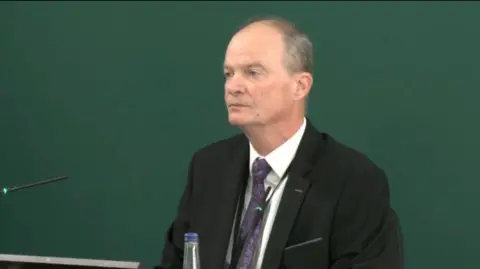
The inquiry also heard from Dr John Brewin, who was chief executive of the trust from January 2019 to August 2022 - covering the majority of the time Calocane was under the care of the trust.
Calocane was sectioned under the Mental Health Act four times in that period.
In that time, the trust had been rated as "requires improvement" by the healthcare watchdog, the Care Quality Commission (CQC).
Separate inspection reports published in 2019 and 2022, found common concerns, including issues around staff not completing risk assessments, the inquiry heard.
Brewin accepted that in terms of CQC reports, not much had changed during his tenure, but said the healthcare watchdog's report in 2022 suggested there had been "some quite significant improvements".
He added the coronavirus pandemic had a major impact on trust performance.
Inquiry team barrister, Craig Carr, asked: "How would Covid contribute to staff not completing risk assessments for instance, or not completing comprehensive risk assessments?"
Brewin said there had been a focus on keeping wards open and that people, including staff, were "very frightened".
He said: "I don't know if you've ever been on an acute psychiatric ward... they can be quite alarming places to be.
"And I think that one is one of the reasons that [what] you would ordinarily regard as a fundamental - completing a risk assessment - may not have been people's highest priority."
 The Nottingham Inquiry
In October 2021, the inquiry heard that Brewin had a meeting with acute ward managers, which he described as a "sobering and at times a very harrowing conversation".
Managers had raised concerns about not having enough senior staff on wards, high volumes of administrative work and an "over-emphasis" on agency staff, the inquiry heard.
He subsequently wrote to trust leaders: "We have reached a point where the services are not safe and we need an immediate response to help support them.
"There is a sense of despondency that despite flagging this since at least June, nothing has happened and that if the CQC arrived, we would be threatened with closure, so let's work on the principle that this has happened."
As part of an improvement plan in November 2021, the trust stopped investigations into serious incidents.
When it was suggested to him that this took away monitoring and learning within the trust, Brewin said "this was crisis point" and added the decision "wasn't just done on a whim".
The former trust boss said there had been a backlog of investigations and the decision would have been agreed in a bid to "free up" clinical front-line staff.
The trust - which has remained under close scrutiny since the attacks - was placed in "Segment 4" by NHS England in February 2024.
That meant concerns around the trust's performance were such that it needed "enhanced oversight" and mandatory intervention to support improvements.
A subsequent review by NHS England found staff felt "unsupported" and were "frustrated" by the trust's pace of change.
In March, it was announced that Mark Axcell had been appointed as the new CEO of the trust.
The inquiry continues.
Listen to BBC Radio Nottingham on Sounds and follow BBC Nottingham on Facebook, on X, or on Instagram. Send your story ideas to eastmidsnews@bbc.co.uk or via WhatsApp on 0808 100 2210.
