Our live updates have endedpublished at 17:00 GMT 23 March
Our live coverage has ended for the day.
You can read more about today's evidence here.
Temporary Deputy Chief Constable Rob Griffin, of Nottinghamshire Police, has given evidence to the public inquiry into the Nottingham attacks of 13 June 2023, which saw Barnaby Webber, Grace O'Malley-Kumar and Ian Coates stabbed to death by Valdo Calocane
Ian's body remained at the scene where he was killed for 15 hours, which Griffin said "seemed like a long time"
At the time, Griffin was assistant chief constable, and assumed the role of gold commander - the senior officer with overall strategic command
He has apologised for a "lack of empathy" after he gave a press statement that said he "wouldn't have looked to have changed anything", and denied a press release that stated "91 minutes from calls to cuffs" was published to make the force look good
In another draft press release, it was suggested Calocane could not be found and arrested due to his "nomadic lifestyle", something Griffin admitted was "not true"
It has also emerged that police staff were viewing material related to the case "inappropriately" one week after the killings - with the victims' families not told of any misconduct for months
Our live coverage has ended for the day.
You can read more about today's evidence here.
And here are the key lines from Griffin's testimony at Mary Ward House in London this afternoon:
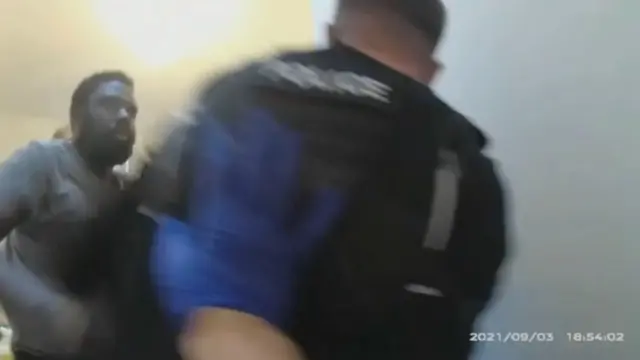 Image source, Nottinghamshire Police
 Image source, PA Media
Temporary Deputy Chief Constable Rob Griffin, who was assistant chief constable at the time of the killings, gave evidence on the 19th day of hearings as part of the Nottingham Inquiry.
Here's what we heard this morning:
The hearing has now concluded for the day.
We will continue hearing evidence tomorrow at Mary Ward House in London.
Solicitor Kirsten Heaven, who is representing Valdo Calocane's mother Celeste and brother Elias, showed the inquiry a document that stated Nottinghamshire Police's communications strategy was "not to mention he [Calocane] was not an illegal immigrant or asylum seeker on advice from Home Office comms".
She asked Griffin if that information should have been put out to calm tensions.
However, Griffin said the force was already engaging with communities and "successfully calming tensions with other means".
The inquiry has been told the policing watchdog, the Independent Office for Police Conduct (IOPC), investigated Nottinghamshire Police after complaints made by the bereaved families.
Cartwright KC raised questions about the information that was passed on to the IOPC by Nottinghamshire Police.
That information included an account in which Ch Insp David Mather was said to have given permission for an officer to follow the white van Valdo Calocane was driving in pursuit.
Cartwright KC said that was "in fact not at all what officer Mather did".
She asked Griffin: "So in your role as ACC, had you noticed that either incorrect information had been given to the IOPC or that the IOPC proceeded on the basis of incorrect information?"
Griffin said he was not aware of that.
Rob Griffin has told the inquiry he was not surprised that an hour had passed between the first attacks and him being contacted.
"I don't think I would expect to be contacted immediately," he said.
"I expect to be contacted at a sensible time. What I mean by that is, the silver who is contacting me has to have enough of an understanding to brief me and have decided what it is they want from me."
He was asked by Sophie Cartwright KC, representing the survivors, why he did not make notes when he was initially contacted by Ch Insp David Mather at 05:01 BST on 13 June 2023.
He replied: "I didn't feel the need to make any notes."
In a statement made by police about the force's previous interactions with Valdo Calocane, details of the incident involving the woman who fell when she attempted to escape him from her first-floor window had not been included, the inquiry has heard.
Calocane had been released from custody following an earlier incident on 24 May 2020 when he started to break down the door of the woman's flat.
The woman, known in the inquiry only as Feven, attempted to escape through a window when she slipped and fell, breaking her spine in several places. She needed metal work and screws surgically fitted.
Asked by Cartwright if he accepted that information was omitted from the force's statements, Griffin said: "I can see that there is a significant omission here, yes, and I can see that it is a missed opportunity to share that information, yes."
Cartwright KC said: "Do you accept and agree that this account lacks candour?"
"I think I can only go as far as to say that it’s incomplete. What I don't know is why it's incomplete," Griffin said.
Earlier today Griffin said in his opinion, the incident involving Feven was the only one in Calocane's known history that amounted to "serious violence".
Sophie Cartwright KC, representing the survivors, asked Nottinghamshire Police Temporary Deputy Chief Constable Rob Griffin if he had failed in his duties to be open and transparent, as no-one from the force had updated survivors on Valdo Calocane's warrant and previous incidents.
Calocane is being referred to as "VC" throughout the inquiry.
"I completely agree," Griffin said. "The fact that the surviving victims were not given information about previous contact with VC is a fundamental failing."
Griffin told the inquiry that he and former Chief Constable Kate Meynell had written to the survivors to request a meeting on 29 January 2024, following Calocane's sentencing.
He admitted he was not aware that a meeting took place between the chief constable and the survivors in the following March.
Moloney KC has asked Griffin if officers could have used local authority cameras to zoom in, during the search for triple killer Valdo Calocane.
The inquiry has heard Calocane was captured on CCTV cameras walking across the city at the time, but they were not seen by officers.
Griffin said: "It would have required somebody in the control room to have frankly guessed which way he'd gone from Hopedale Close and within a minute or two of him having reached Birkin Avenue to have picked the camera and to have spotted him and to have zoomed in."
Moloney KC said: "So if they'd been, as it were, quickly scanning available cameras in the area, [they could have zoomed in]?"
Griffin: "Yes."
Tim Moloney KC, representing bereaved families, told Griffin that Valdo Calocane's attack on PC Pritchard in September 2021 had been recorded at the time by Sgt Louise Ellis as "extreme violence to male officer - assault without provocation".
"He tried to hit officers with handcuffs, headbutts, and officers had to press an emergency button," Moloney said.
Griffin said it was a "serious police assault", but repeated an earlier opinion that "on a broader spectrum, it's not what I would describe as serious violence".
Police arrived at Magdala Road in Nottingham, where Ian Coates was killed, at about 05:40, the inquiry has heard.
Tim Moloney KC, representing the bereaved families, has raised the issue with Rob Griffin that a forensic tent had not arrived to cover Ian's body until 07:55.
"Until then, he lay in the street with a blanket or blankets over him," Moloney said.
Asked if he could imagine the distress of that notion for the families, Griffin said: "I actually can't imagine it, it's awful."
He added he did not know the circumstances in sufficient detail to know if Ian's body had to stay at the scene for that long.
Julian Blake KC, counsel to the inquiry, told the hearing that a statement from Insp Peter Shaw said there was a "complete lack of major incident training" at the force at the time of the attacks.
In response, Rob Griffin said training had now been improved as part of its "Proud to Lead Academy".
He said improvements had also been made in the force's contact centre, and it was being debated whether an officer would be deployed to the city council's Woodland CCTV Control Centre during an incident like this.
The inquiry has heard after he was stabbed to death, Ian Coates's body remained at the scene in Magdala Road until 20:30 on the day of the attacks.
Ian was fatally attacked by Valdo Calocane at 05:14 and police were called to Magdala Road by a witness at 05:30.
Asked why Ian was left for such a long time, Griffin said: "It does seem like a long time. And for Ian's family, that is particularly traumatic."
Darren Coates, one of Ian's sons, muttered "damn right" in the hearing room.
Griffin added it was only this past weekend that he had been made aware of the length of time Ian's body was left at the scene.
Griffin said: "I have to trust those who say that that amount of time was necessary in order to ensure that all forensic opportunity was maximised."
He said he could not go into any further detail than that.
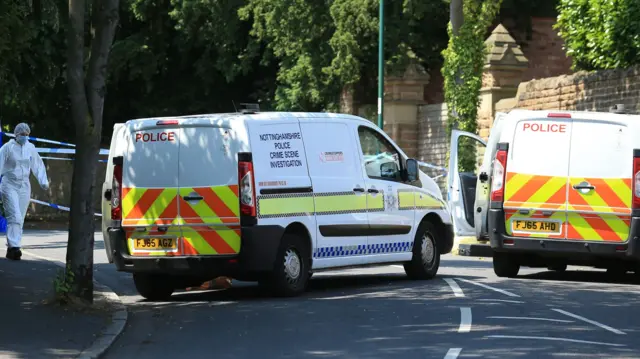 Image source, EPA-EFE/REX/Shutterstock
Griffin told the Nottingham Inquiry it was the senior investigating officer's responsibility to inform families of misconduct - but conceded he should have ensured such matters were shared.
"I should have ensured he shared those matters with them," he said.
"I did belatedly... but I missed an opportunity to have stepped into that space.
"When I reflect on all the additional pain the bereaved families and surviving victims suffered because of that... I regret that then and I regret that now.
"I'm really sorry about that."
PC Matthew Gell was handed a final warning for accessing files on Valdo Calocane without authorisation.
A misconduct hearing was told Gell used systems to look up Calocane following his arrest.
Two days after the attacks, the Nottinghamshire officer used the police system to look up custody records despite having "no role whatsoever in the investigation".
He admitted that his "lapse of judgement" amounted to gross misconduct.
Although Griffin was specifically informed of police staff looking at distressing images and footage of the attacks inappropriately in September 2023, the victims' families were not told of this until January.
The inquiry has heard in December, Griffin was informed of three specific misconduct matters by then senior investigating officer Leigh Sanders. They involved:
By that point, the families affected had still not been informed of any misconduct. Griffin said at the time he did not believe incidents involving the first two people needed to be disclosed, which he said was "regrettable".
He said he wanted the matter involving the other PC to be disclosed to the families, but it was suggested to him this should be done after Christmas.
Sanders informed the families in January, however Griffin said he was not happy about how it was handled.
"It transpired that although Leigh had told them, he had not told them in the detail that I thought they ought to have been told, which was hurtful and as upsetting as it was going to be," he said.
"It was my view that the families deserved and had the right to know."
The inquiry heard there was no investigation into whether any further information was shared after PC Matthew Gell was disciplined over a WhatsApp message that was described as "crude and distasteful".
Julian Blake KC asked Rob Griffin if he could be satisfied that there were no more inappropriate messages on that group.
He replied: "I don't think we can be satisfied."
Griffin told the inquiry officers were given guidance on their use of WhatsApp and were told to treat messages as if the public were viewing them.
Rob Griffin's evidence is now continuing at Mary Ward House in London.
So far, on day 19 of hearings as part of the public inquiry into the Nottingham attacks, we have heard from Temporary Deputy Chief Constable Rob Griffin, who was assistant chief constable at the time of the killings:
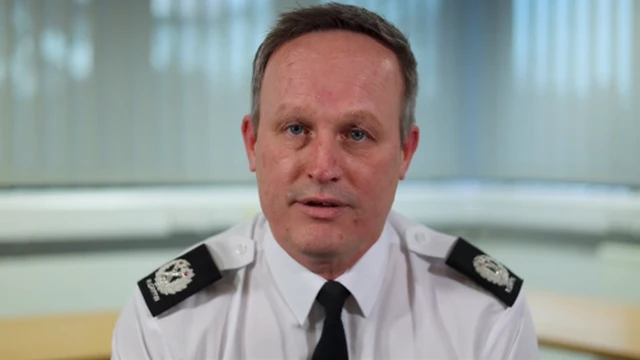 Image source, Nottinghamshire Police