Flying Scotsman returns to heritage railway line

 BBC
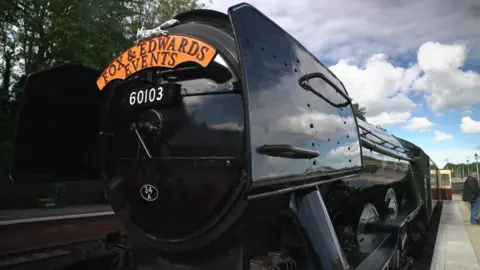
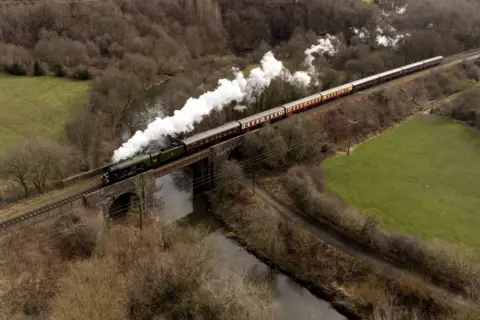
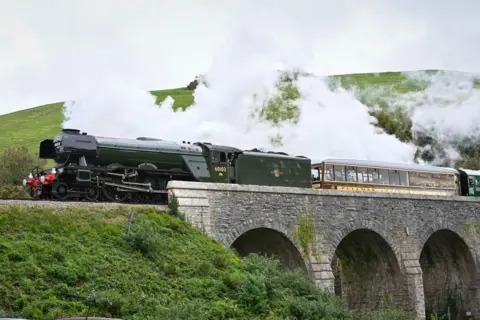
BBCThe world-famous Flying Scotsman has returned to the railway line where it hauled passenger services more than 70 years ago.
The legendary locomotive will pull trains on the Great Central Railway Nottingham in a series of events towards the end of May.
The heritage railway was previously part of the Great Central Main Line, which Flying Scotsman pulled trains on in the early 1950s.
The locomotive now resides at the National Railway Museum in York, but travelled down to Nottinghamshire on Friday in readiness for the special services.
 Getty Images
Flying Scotsman's visit follows a temporary closure of the heritage railway, firstly due to the Covid pandemic and then repair work.
Andy Fillingham, chairman of Great Central Railway Nottingham, said: "We are thrilled to be welcoming Flying Scotsman back to the East Midlands.
"We're very proud of the work of our volunteers in reopening the railway to visitors and this should bring awareness of our superb attraction to new people."
Flying Scotsman has strong ties with the East Midlands region as it was based in Leicester for several years, saved from scrap by a Nottinghamshire businessman, and later restored in Derby.
 Getty Images
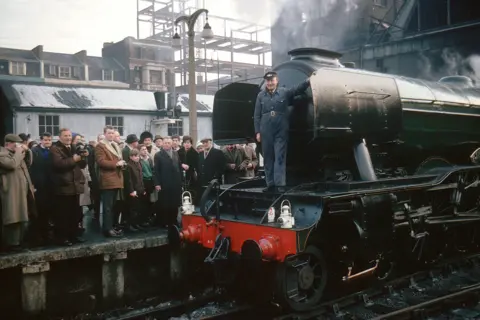
It originally went into service in 1923 and was given its name the following year, after the Flying Scotsman passenger service between London and Edinburgh.
It became famous when it was featured in the British Empire Exhibition in 1924, then in 1934 it became the first locomotive to officially reach 100mph (160.9km/h).
Flying Scotsman was mainly used by the London and North Eastern Railway (LNER) to pull trains on the East Coast Main Line.
However, British Rail later used it for services on the Great Central Main Line, following the nationalisation of the railways.
 Getty Images
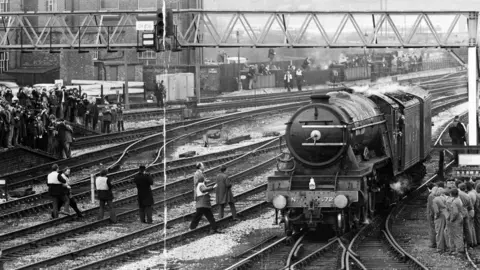
It was based at Leicester in the early 1950s, and this was when Flying Scotsman worked on what is now the Great Central Railway Nottingham, before returning to the East Coast Main Line.
Flying Scotsman was retired by British Rail in 1963 and had been destined for scrap, but was saved by Nottinghamshire businessman and eccentric Alan Pegler.
It then became stranded in the US for several years after heading there for a tour in 1969, which was a financial disaster and forced Pegler into bankruptcy.
Another businessman, William McAlpine, then paid the debts and brought it back to the UK in 1973, where he had it restored in Derby.
 Getty Images
The Great Central Main Line was closed by British Rail in the 1960s, but the stretch between Ruddington and Loughborough was restored by volunteers in the 1990s and now operates as a heritage railway.
Flying Scotsman will pull services on the line on Saturday and Sunday, as well as on 25, 30 and 31 May.
The services are part of a 2026 tour of Flying Scotsman.
Andrew McLean, head curator at the National Railway Museum, said they wanted to "ensure as many people as possible have a chance to see and be driven by this incredible locomotive".
Listen to BBC Radio Nottingham on Sounds and follow BBC Nottingham on Facebook, on X, or on Instagram. Send your story ideas to eastmidsnews@bbc.co.uk or via WhatsApp on 0808 100 2210.
