Our live updates have endedpublished at 14:10 GMT 24 March
Our live coverage has concluded for the day.
You can read more about today's proceedings here.
The sons of Ian Coates - one of three people killed in the Nottingham attacks of 13 June 2023 - became the first of the bereaved families to give evidence to a public inquiry into the killings
Ian was killed - as well as 19-year-old students Barnaby Webber and Grace O'Malley-Kumar - in a spate of attacks by Valdo Calocane
James Coates said he learned of his father's death through a family friend on Instagram, while his brother Lee explained he decided to go to the crime scene
The sons criticised the support given to them, including therapy in a yoga studio with their shoes off
It emerged on Monday that Ian's body remained at the scene for 15 hours, with his body only covered by a blanket for more than two hours
Giving evidence earlier on Tuesday, Ian's partner Elaine Newton said she was initially told Ian had died in a road traffic accident, and then hours later informed he had been stabbed, making her feel like he had been "killed twice"
Elaine told the inquiry she was unhappy at advice from police that included encouraging her to "buy a dog"
Our live coverage has concluded for the day.
You can read more about today's proceedings here.
Two of Ian Coates's sons, James and Lee, were the first of the bereaved families to formally give evidence to the Nottingham Inquiry.
They told the hearing of learning their dad had died - with James saying he first thought it was a hoax when messaged by a family friend on Instagram.
James said they had already pieced together what occurred - with police only contacting them 10 minutes before a major press conference was held.
Lee decided to leave the family house where they had gathered to visit the scene in Magdala Road.
The following day, they visited to lay flowers and spoke of the huge press interest.
The brothers were not invited to a vigil being held in the city centre but after learning of it through a journalist, they called the council to attend.
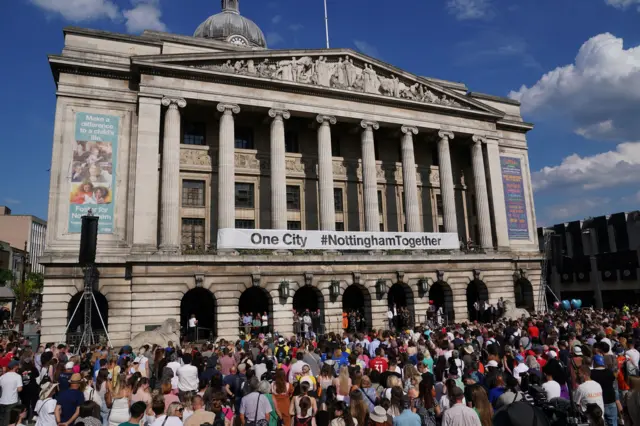 Image source, PA Media
James explained that the way the police contacted the family via emails was "impersonal".
And, with few updates, James said he turned to social media for information, which he called "a mistake".
Both Lee and James spoke of their anger at murder charges against Valdo Calocane being dropped.
James said he was asked to explain the decision to his brothers - but refused.
 Image source, PA Media
The Coates brothers also praised the support of the other families of Calocane's victims.
Lee said throughout they had felt like "second-class citizens" with the way they had been treated by the authorities.
Both an "astounded" James and then Lee gave statements explaining how they now felt since the inquiry had begun.
James added victim support had been lacking, with them left doing therapy barefoot in a yoga studio.
Outside of the inquiry's evidence, the mother of 19-year-old victim Barnaby Webber has today formally complained to Nottinghamshire Police after the hearings were told bodyworn camera footage was unnecessarily accessed by its staff.
Hearings into the killings of the student, his friend and fellow University of Nottingham student Grace O'Malley-Kumar and school caretaker Ian Coates were previously told there had never been a wider investigation into which members of police staff had looked at images and footage from the attacks without a policing purpose.
Emma Webber said there should be a full investigation and for the breaches to be "considered as a criminal matter".
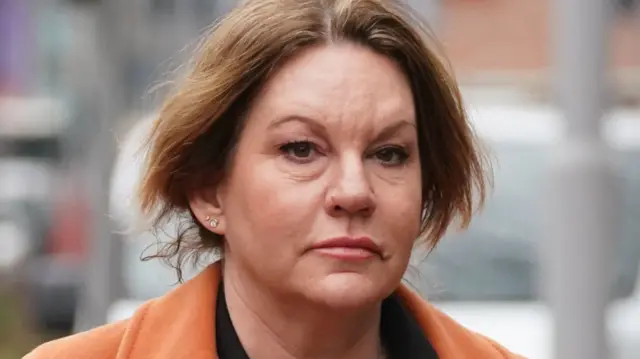 Image source, PA Media
School caretaker Ian Coates, 65, was stabbed to death by Valdo Calocane in Magdala Road near his home, four months before he was due to retire, and his partner Elaine Newton has spoken about hearing of his death at work.
Elaine was told for hours that Ian had died in a road traffic accident but no further details were provided.
The officers who explained that he had been stabbed were shocked Elaine had not been told, and Elaine said it felt like her partner had been "killed twice" on hearing the news.
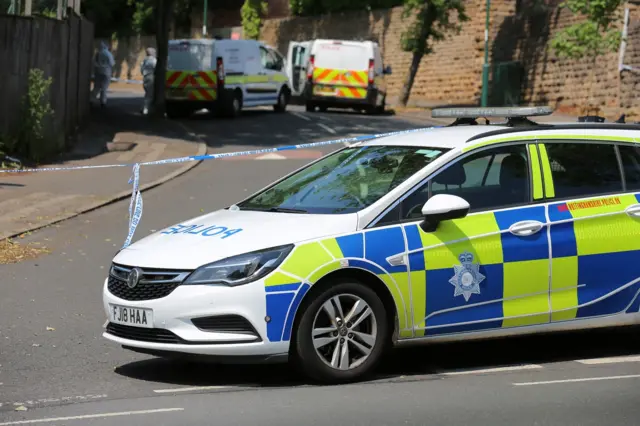 Image source, Nottinghamshire Police
Elaine explained she and Ian had been "private" people, and after the death she shut herself away.
She told the inquiry of her meetings with senior police officials as details began to emerge of mistakes within the force.
She said she was "unhappy" when she found out that after Calocane was sentenced, a warrant was out for his arrest at the time of the attacks.
She explained she did not understand the sentence when Calocane was handed an indefinite hospital order.
 Image source, Supplied
Elaine added she met the healthcare trust, which had been responsible for Calocane, but said "it wasn't a very nice meeting".
She told the inquiry she blames a lack of communication between the police and the NHS for her partner's death.
She added she was given "condescending" advice by police to sell her house and buy a dog.
James Coates said victim support services were not helpful to cut through the jargon, which was left to their solicitors to help with.
He added his father's three sons were not offered therapy until nine months after his death.
He said: "We were given the opportunity to talk to a professional, and the therapy we were offered was a full-time yoga instructor, part-time therapist - and we had to do therapy at a yoga studio with our shoes off, which I felt wasn't good enough for what we'd been through."
The evidence from today's hearing has now concluded.
Lee Coates has spoken about his anxiety before the inquiry, but said it was "an opportunity to get answers".
"What I have heard has left me with many questions," he said.
Lee added: "The people of Nottingham deserve far more from the agencies we have heard from so far. I have not felt reassured, and I suspect the people of Nottingham share this lack of faith and confidence."
He said all of the deaths were "preventable", but in his father's case, "officers had a significant period of time and so many resources, and did not take action".
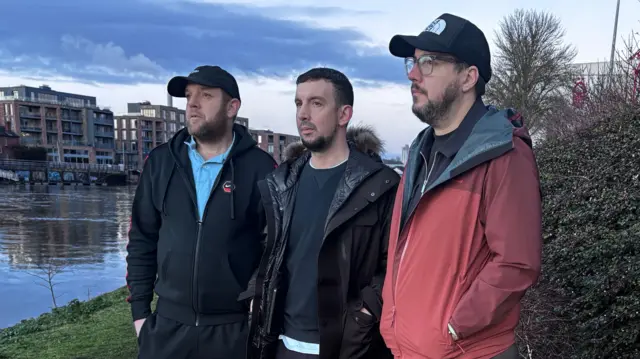
Lee said his dad was treated as "an afterthought".
He said: "From the failings in relation to the search, to the length of time my dad was left at the scene, it is clear to me that he was not treated with the respect or dignity that he deserved.
"His life mattered, he deserved better than what happened to him, and I will not stop saying that until it is acknowledged, not just in words but in meaningful change."
James Coates has read a statement to the inquiry.
He said: "Since the inquiry began just over four weeks ago, the amount of new information that has surfaced astounds me.
"Over the last two and half years, I thought I'd heard it all - from missed opportunities, misconduct, clerical mistakes, institutional laziness, but unfortunately more revelations are coming out each week."
He said he believed "we should have a fair trial, and that my dad's killer should answer his heinous crimes in a court of law".
"My innocent father isn't here to see justice and it's a hard pill to swallow knowing his attacker won't spend any time behind bars," he said.
"I feel for the people of Nottingham who put their trust into police, the NHS and the mental health [services] who have continued to fail them."
James said since his father's death, he had continued to struggle, now suffering from post-traumatic stress disorder (PTSD), and was undergoing therapy.
He added becoming close to the other bereaved families over the last few years had been a huge help to him.
Nottingham University Hospitals (NUH) NHS Trust, the inquiry heard, contacted the Coates family about Ian Coates's medical records being accessed.
His son James said: "Let's say, for example, my dad had been diagnosed with cancer like two months before the attacks, and I had not been told, and then that to come out, it would have been very hard to hear."
James added he attended a meeting with the trust about "missed opportunities".
James said: "When people say that, I've heard it too many times over the last two and a half years."
He added he also worried about evidence like footage captured on a video doorbell he had viewed at a police station being leaked.
On a wider issue of mistakes caused by poor communication, Lee said: "There was a lot of apologising, but I don't think anyone, even to this day, has really held their hands up.
"It was just an endless kick in the teeth."
The inquiry has heard how Nottinghamshire Police officers were disciplined over "offensive" messages in a WhatsApp group.
Police staff had also accessed information about the attacks on police systems unnecessarily.
James Coates told the inquiry he was aware officers had accessed information, but was given "very, very little information about the WhatsApp [group]".
"It was only because of fighting from the other families to get more information, more answers and the actual context of the messages that, over time, we've learnt more about what was said and who said what," he said.
James said there was "no place" for the kind of messages being shared in the WhatsApp group, adding "there should be punishments for that kind of action".
James Coates said the court outcome was not explained on the day of Valdo Calocane's sentencing to a hospital order, in January 2024.
He said: "The judge started giving out all these words that I wasn't familiar with, and then everyone just seemed to stand up and start walking away.
"I turned to the FLO [family liaison officer] and was like, 'what's going on?' She was like 'we're finished. He's being sent to hospital'."
He wanted the Crown Prosecution Service (CPS) to explain the sentence, but they had left and were not able to meet him.
Letters were later sent to the family summarising medical evidence and explaining the outcome from the CPS, while other correspondence came in from the policing watchdog, the Independent Office for Police Conduct (IOPC), Nottinghamshire Police and more.
James said: "At this point I was working full-time, I'd only taken three weeks off for bereavement and felt under pressure to go back to work.
"I was the point of call for the family and I was trying to organise getting married, and then obviously going through the sentencing as well, a lot of it was going through one ear and out the other, especially when it came to things I didn't understand, like the courts or police."
In his statement to the inquiry, Lee Coates said: "I do feel strongly we were perceived as second class, in comparison to others."
He added: "I think I'd already had a bad taste in my mouth from the get-go of the day of 13 June, having to forage for information ourselves, having to contact the police rather than them contacting us.
"It just felt that the saga had continued, I suppose, and also getting the information that this guy was pretty clearly getting away with murder."
Calocane was initially charged with murder, but pleaded guilty to three counts of manslaughter on the grounds of diminished responsibility, and three counts of attempted murder.
James Coates told the inquiry he did not feel he and his brother were getting enough information from the police.
"I think that everything was kept to a minimum, and I don't know if that's because they didn't want to obviously lift the lid on everything that had gone off previously - but we were sort of drip fed information from various sources," he said.
He added during a brief conversation with the Crown Prosecution Service and the senior investigating officer Leigh Sanders, he was "still under the assumption" Valdo Calocane would "possibly [get] a hybrid order", meaning he would eventually, once well enough, be transferred to a prison.
Both brothers said they felt "angry" at finding out how the NHS and police had handled Valdo Calocane's case.
Lee Coates said: "How it came across, it felt we were being told something and we couldn't even give a response.
"When we asked the questions of how we've come to this, it was a case of 'we'll find out later'."
James added he was "distraught" at the news.
"One of my massive worries, with Elaine [Ian Coates's partner], I promised her this guy will go away for the rest of her life," he said.
"We got this information that he's potentially not going to go away for the crimes he's committed. You're reading he's not safe to go into a normal prison - of course he is.
"He's a monster. This is why we have prisons, so we can put people like this away."
By November 2023, the inquiry heard the decision was made to move the case from murder to manslaughter, and Nottinghamshire Police rang James Coates to explain.
James said: "I was at work at the time, and it was an extremely hard call to take.
"I just had so many questions of why and how it got to this point."
He said the officer asked him to speak to brothers Lee and Darren about it - and James said he refused.
He added: "How can you expect me to call my brothers and tell them he's getting away with murder?"
Lee and James Coates (pictured below) told the inquiry how the O'Malley-Kumar and Webber families had been a great support to them since the killings.
Lee added: "I'll always say I wish I'd never met them and my dad was still alive, that Grace and Barnaby were still here, but to go through this with the other families... I don't know if I would personally manage without them."
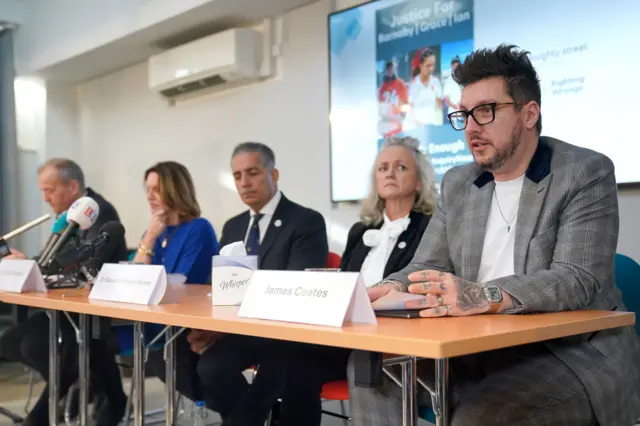 Image source, Jonathan Brady/PA Wire
The inquiry has heard how Ian Coates's family and the families of Barnaby Webber and Grace O'Malley-Kumar were kept separated in court.
It was during an interval, James said, that they swapped numbers.
Counsel to the inquiry, Rachel Langdale KC, said: "Were you never made aware of [Emma Webber's] attempt to reach you directly in that way?"
James said: "No. We had also made the same queries. We wanted to reach out to the other families and obviously not knowing the best place to do it, we would then ask the FLO [family liaison officer] and were told that they wanted to be kept private.
"And we've also obviously heard since then, that they were given the same message, that we didn't want to speak to anyone."
Lee Coates said he should have been told that Valdo Calocane had paranoid schizophrenia, a condition he was diagnosed with in 2020 - three years before his killings.
He said: "I remember it was a bit of a whirlwind. We were expecting it to be - the guy's been caught, bang to rights, there's not too much needed for these court proceedings going forward.
"And then all of a sudden, the mood sort of changed."
He said the family liaison officer had asked James to pass on to his family the updates about Calocane's mental health likely changing the outcome, which he refused to do as he did not want to be the one to inform them.
Lee said: "I had been told police had enough evidence for a murder conviction. For me personally, it felt a bit of a cheap get out clause, that defence barristers tend to go for."
James added the Coates brothers were not invited to a meeting with the Crown Prosecution Service (CPS) and other families about this.
He said: "It was never relayed to us how important it was."
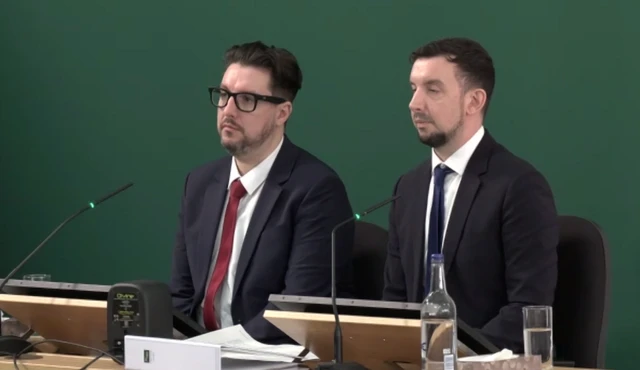 Image source, Nottingham Inquiry
James Coates told the inquiry he "made the mistake” of turning to social media for information, as he said police were not providing enough detail to him.
"I felt that because we were still struggling to get information on who he was and what had happened, that if someone knows who he is they might say something," he said.
"I was going on Twitter, probably the worst place to go for any credible information."
James said he learned false stories, such as hearing Valdo Calocane had fallen out with his girlfriend before the attacks.
He added the police could have provided a clearer picture of what they believed had happened.
"They could have easily told us, it would have put my mind at ease a lot," he said.
James told the inquiry he heard Valdo Calocane had previously attacked a police officer, but that he was not going to be charged over it because the severity of the Nottingham attacks had superseded the offence.
But he was not aware at first there had been a warrant out for Calocane's arrest because of it, and was not told until later by members of other victims' families.
"It would have built more of a picture of who he was, and more of a history, with the lack of information we were given about his mental health until later on," James said.
"It might have explained a little what had happened to my dad and why it happened."
James Coates explained he initially learned of his father Ian's injuries after the vigil.
He said: "I didn't want to feel those sorts of feelings again because I'd sort of put a protective barrier up in my head."
However, he added it was not until the sentencing of killer Valdo Calocane, in January 2024, they found the "true extent" of the injuries.
James said: "It's even worse in hindsight - the fact that the failings and the lack of information we got, it feels like now it's such an easy thing to just pick up the phone and contact me."
He said being sent emails felt "impersonal", particularly from Meynell, adding he had explained to the family liaison officer he would prefer to take a phone call.
