Killer was 'skilled at hiding' psychosis symptoms

 Nottinghamshire Police
A nurse has told a public inquiry a mentally ill man who went on to kill three people in a spate of attacks was "skilled at hiding" his symptoms.
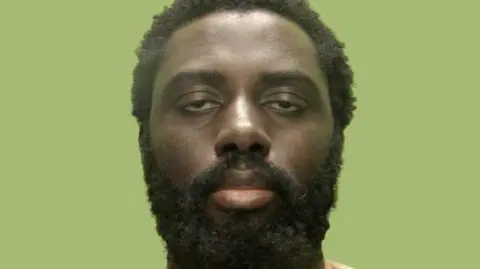
Valdo Calocane, who was diagnosed with paranoid schizophrenia in 2020, stabbed to death Barnaby Webber, Grace O'Malley-Kumar and Ian Coates, and tried to kill three others in Nottingham on 13 June 2023.
Calocane was under the care of Nottinghamshire Healthcare NHS Foundation Trust in the years leading up the attacks, until he was discharged due to a lack of engagement in September 2022.
In evidence to the Nottingham Inquiry - examining the attacks - Claudia Birtles, a mental health nurse, said Calocane was "harder than most [patients]" to assess.
Calocane had a total of four admissions to hospital under the Mental Health Act between May 2020 and February 2022.
Birtles was responsible for co-ordinating Calocane's care in the community for almost two years, from June 2020 to April 2022.
She was his care co-ordinator on the Early Intervention in Psychosis (EIP) team, which he was referred to after a first admission to a psychiatric ward in May 2020.
 Supplied
The inquiry heard in September 2021, following a third admission to hospital, there was a "breakdown" in Calocane's relationship with Birtles.
Calocane had appealed against his detention to the Mental Health Tribunal for which Birtles completed a report outlining his circumstances.
In that report, which Calocane was able to read, Birtles outlined Calocane's non-concordance with medication and his denial of mental illness.
The inquiry heard Calocane - referred to as VC throughout the inquiry - told Birtles he would no longer share anything with her after reading the report.
During a meeting with Calocane, following discharge from his third admission in February 2022, Birtles recorded "no evidence of overt symptoms of psychosis" but that he was reluctant to share information.
Challenged on her view of Calocane's presentation during that meeting, she said: "I've always said it's been so difficult to assess those symptoms with VC, harder than most, because I believe he was quite skilled at hiding them - but again this was my impression on the day."
'Everyone suspected it'
Birtles also said she was wrong to describe Calocane in the same report as being "polite" and "law-abiding", despite knowing he had violently attacked a police officer and broken into his neighbours' homes.
The inquiry heard throughout Calocane's care, he had a history of non-compliance with medication and a lack of "insight" - an understanding and acceptance - of his illness.
Calocane admitted he failed to take his medication from about two weeks after discharge from his first admission, the hearing was told.
However, a depot - long-acting, injectable anti-psychotic medication - was never administered.
Following a second admission to hospital in July 2021, Calocane's mother, Celeste, asked if depot medication was an option, the inquiry heard.
During that discussion, Birtles said she was happy with the plan for Calocane to take tablets.
She told the hearing: "I think we focused a lot on his opportunity to take the tablets again, to demonstrate that he can do it."
She added he was "still quite early on" in the care pathway.
However, Birtles later suggested the consideration of using a depot during Calocane's third admission, but said she could not recall a discussion about it.
"Everybody knew there was an issue with concordance, everyone suspected it, and then it was confirmed, so it could have been [discussed]," she said.
Birtles said although she felt administering a depot "was the right thing to do", it would not have "necessarily solved all the issues", adding some patients would still be symptomatic.
The inquiry heard Calocane would have to consent to a depot unless he was subject to a Community Treatment Order under section 3 of the Mental Health Act.
 Nottinghamshire Police
Calocane was discharged by the NHS trust back to his GP, the Cripps Health Centre in Nottingham, in September 2022.
A letter was sent to the GP, but there was no discussion with the surgery or an individual from the surgery about Calocane, the inquiry heard.
Birtles agreed that was "extraordinary" and agreed a discussion with the GP would have been "vital".
Rachel Langdale KC, counsel to the inquiry, said: "And it did need fresh eyes didn't it?
"Because it's frankly absurd that he was discharged in these circumstances, unmedicated and into the community, isn't it?"
Birtles replied: "I think - I wasn't there for the decision - but I can appreciate that that certainly seems to be the case."
Calocane is currently serving an indefinite hospital order at a high-security facility after pleading guilty to three counts of manslaughter on the grounds of diminished responsibility, and three counts of attempted murder.
The inquiry continues.
Listen to BBC Radio Nottingham on Sounds and follow BBC Nottingham on Facebook, on X, or on Instagram. Send your story ideas to eastmidsnews@bbc.co.uk or via WhatsApp on 0808 100 2210.
