'It's overwhelming': Plastic from 1960s Canada washes up on Orkney beach

 Sanday Community Craft Hub
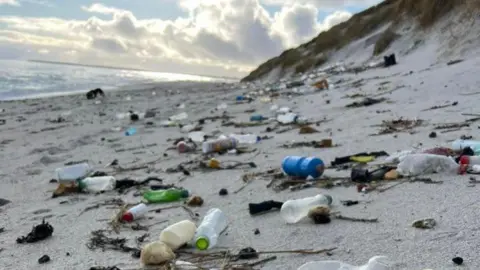
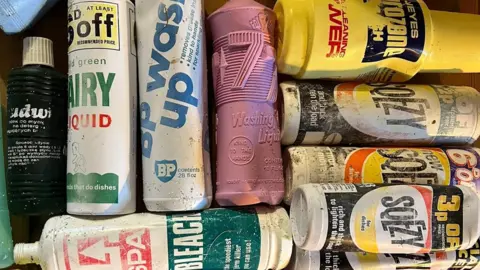
Plastic bottles and debris that appear to have originated in Canada and date back to the 1960s and 70s have washed up on an Orkney beach.
Litter pickers say they are "overwhelmed" by the amount of plastic they have found on the shoreline at Howar Sands in Sanday over the last few weeks.
David Warner, who organises beach cleans, said he gathered 42 plastic bottles from the shore last year - yet already this year he has found hundreds.
Experts blame "fairly extraordinary weather", with strong south-easterly winds, for the increase in "retro rubbish".
Warner, 35, said some of the plastic bottles he has discovered on Sanday appear to have originated in Newfoundland and Labrador in Canada.
He worries that even more detritus will wash up on the beach in the future.
"We haven't hit rubbish from the nineties and noughties, so that's going to be extortionate amounts," he said.
 David Warner
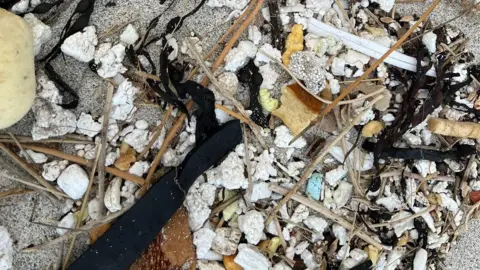
Based on the amount of polystyrene particles in one square metre, David estimated that there were over 300,000 pieces lying across 70 square metres.
Warner told BBC Radio Orkney that the sheer volume of rubbish on the beach was "quite overwhelming".
"It's the first time since cleaning the beaches I've been overwhelmed by it," he said.
"Usually I clean the beaches with a group of volunteers and we'll make a good go at it and it'll seem clean after it.
"Then we'll go three months later and the rubbish is back and we're like 'OK, that's fine, it is what happens at least we'll get it out the sea'.
"But this time, the sheer amount, and the fact that there were so many polystyrene pieces that were so tiny meant that it was impossible to pick them up."
As the beach is a site of special scientific interest for nesting birds, the litter can also prove a hazard for wildlife.
 Sanday Community Craft Hub
 Sanday Community Craft Hub
The Marine Conservation Society said historic litter often washes up at this time of year due to the seasonal storms - and that eroding coastal landfill sites are releasing a lot of "retro" rubbish too.
Spokesperson Catherine Gemmell said: "Litter, especially plastic litter, never disappears and can last a very long time in the marine environment and also travel across oceans."
Meanwhile John Berry, of the Scottish Islands Federation and Greener Orkney, said he was not surprised by the increase in litter on Sanday.
"We've got the really clean beaches [in Orkney] but we've got some really dirty beaches as well," he added.
"I'm really not surprised to see that, with a slightly different weather pattern, we're getting a lot of the old legacy material."
He added: "But we will clean it up in spring. And next year, it will be back. So we will do the exercise again."
While the situation is disheartening, Warner is looking to spearhead a positive outcome.
The sustainability coordinator hopes to form an official beach cleaning group where people can share interesting finds.
Rubbish washes up on the island from many faraway places, with a decapitated doll from Japan once rearing its plastic head.
As a member of the Sanday Community Craft Club, he is also considering using the plastic to create an artistic sculpture to make a statement about the problem.
Warner said: "We can't escape plastic. I use plastic, it's inescapable. I just want people to be aware when they do buy plastic, think where it's going to end up.
"Even if this rubbish isn't our rubbish per se, it's somebody's rubbish, and then where is our rubbish going? It's just more about awareness, and trying to buy less if you don't have to."
