Adoption breakdown ended my career and relationship – we're told to get on with it

 Getty Images
An adoptive mother says she is reaching "breaking point" caring for her daughter who has "significant trauma", and has called for more support for adoptive families.
The woman, who we are calling Anna to protect the identity of her child, said she had been physically attacked by her daughter and spent much of the last 15 years "living in crisis".
Anna, from north Wales, has spoken out after a BBC report found adoptive parents struggling with children who had often suffered abuse and neglect before being removed from their birth families.
The Welsh government said it valued the commitment of adoptive families and took seriously "any concerns raised about access to support".
What do the figures show?
The BBC investigation found 1,000 adopted children in the UK had been returned to care in the past five years.
In Wales, between 250 and 300 children are adopted each year.
Freedom of Information (FOI) requests sent to all 22 councils in Wales asked for the number of adoption disruptions - when adoptions don't go ahead - and the number of adoption breakdowns, where an adoption collapses after a child is placed with an adoptive family.
Fourteen councils provided the total number of adoption disruptions, which amounted to 22 in the past five years.
Only seven councils provided figures on adoption breakdowns, which amounted to 16.
National Adoption Service Cymru said adoption disruption in Wales has remained consistently low - at around 2% - for the last 10 years.
 Getty Images
'It's incredibly difficult for her - but also for us'
Anna said the breakdown of her daughter's adoption was something she was "trying desperately to avoid" but said she could understand how, without support, it could happen.
She said day-to-day life was "tough" and had affected her health, led to the loss of her career and the breakdown of her relationship with her daughter's adoptive father.
Anna's daughter has a number of diagnoses including pre-verbal trauma and a dissociation disorder, which manifests as multiple personalities. She also has autism with a Pathological Demand Avoidance (PDA) profile.
"We do have some lovely, connected moments," said Anna.
"She didn't ask to be born in a chaotic life. She didn't ask for what she's got. It's incredibly difficult for her, but also for us as a family."
Anna said some individuals she had worked with over the years had been "brilliant", and her daughter had taken part in therapies which had been beneficial.
But she says she had to fight for support from her local authority and Child and Adolescent Mental Health Services (CAHMS) and says she has often been "blamed" for her situation.
"What I'm finding is that professionals around me are looking at me [and asking] is my parenting good enough?
"I've been told to have firmer boundaries, that I don't have boundaries.
"There's a lot of parent blaming and I know that that feels very real for me and it does feel very real for other adoptive mums and dads, that I know.
"We're just literally keeping our heads above the water... we're overlooked and told just to get on with it and, you know, you've got on your boat now, row."
'Broken system'
Another adoptive mother from a different part of north Wales said she had similar experiences trying to get the right help for her teenage daughter, who she described as being " a ball of anger" and constantly "in survival mode".
The woman, who also wanted to remain anonymous, said she was regularly physically attacked by her daughter and had locked all the sharp objects in the house away.
She said she and her husband had been offered parenting courses.
"We love her to bits," she said, adding that with the "right support" they would not be in this position.
"The system is broken," she said.
"We just go round and round in circles."
'More specialists needed'
Anna's local authority responded to her concerns and said some childrens' services offered had been extended to support adopters and adopted children. It also said that parents are listened to.
Betsi Cadwaladr health board said it did not comment on individual cases, but said that though there are no specific pathways for looked after children, CAHMS provide trauma-informed assessments and interventions for all children and young people referred to its services.
A recent Care Inspectorate Wales (CIW) report into the North Wales Adoption Service (NWAS) highlighted a lot of good practice in the region, but said some families were not receiving the specialist help they required once a child had been placed with them.
It found waiting lists for therapeutic support were "common" and said "delays in interventions have, in some cases, placed adoptive placements at risk".
The report found a need for more specialists, such as psychologists and occupational therapists.
NWAS said recruitment to increase capacity in post-adoption support, including therapeutic support, was ongoing.
It said it was continuing to work with funding bodies to "improve services so it can respond to families at the point of need".
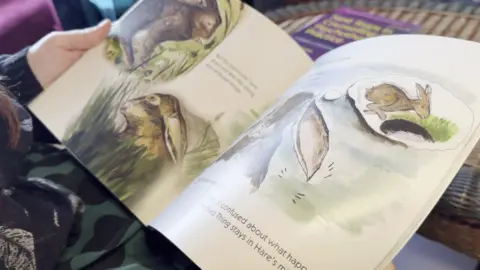
Lilith Gough, a registered art psychotherapist based in Torfaen, said there was no one-size-fits-all therapeutic solution for trauma but getting the right help when needed was important.
"Trauma is something which overwhelms our ability to cope," she said.
"It can develop into more problems as [children] grow into life.
"In school they might find it difficult to focus because they may be experiencing flashbacks or they might be consumed with thinking about what's happened in their life.
"It can come across as acting out or misbehaving, but it isn't acting out or misbehaving. It's just literally not feeling safe in their own body."
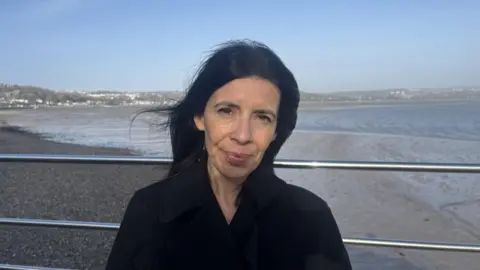
The Children's Commissioner for Wales, Rocio Cifuentes, said it was "deeply concerning" to hear reports that adoptive parents were still not receiving the support they needed, and said she would raise the concerns with the current Welsh government and the next.
She said her office had previously raised the need for "greater focus" to be given to post-adoption support.
"While corporate parenting duties technically end once a child is adopted, I believe there is a continuing moral duty on the state to ensure that it provides for any on-going needs of that child. It is not only more resources that are required, but also better join up of the services that do exist," she added.
The Welsh government said it had invested £13m in the National Adoption Service since 2019, and said "joined up working" across services was key to ensuring families got the right help.
"Parenting children who have experienced trauma can be complex, reinforcing the need for timely, coordinated support grounded in trauma understanding," a spokesperson said.
"It is essential that adoptive parents are listened to, treated with empathy, and respected as skilled and committed carers in their children's lives."
Reform UK Wales said the next Welsh government "has to work with families to ensure that gaps in support are addressed", while a Plaid Cymru spokesperson said: "We believe support after adoption should be improved to ensure children's needs are met and families are better supported."
The Welsh Conservatives said: "We need properly joined-up, trauma-informed support across education, health and social care so vulnerable children are not let down again."
The Green Party's Ian Chandler said his party in the Senedd "will ensure everyone can access rapid early help, not just crisis care", while the Liberal Democrats said: "When families are forced to battle for therapy or left with patchy provision that does not meet a child's needs, that is a failure of the system, not of the parents."
