Children taught about debt bondage to tackle county lines

 BBC
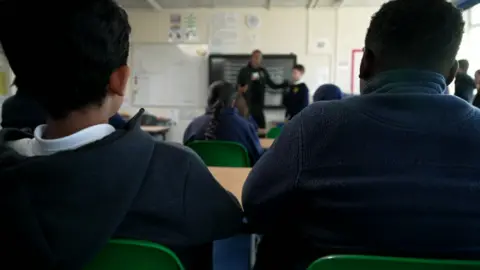
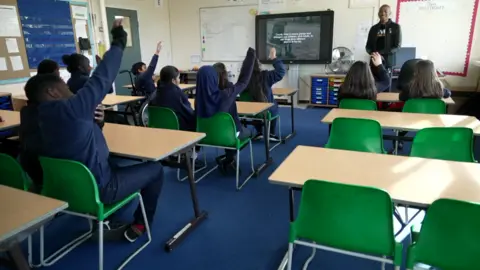
BBCIn a classroom at Wilbury Primary School in Edmonton, north London, a group of 10-year-old children is being taught not to accept food from strangers.
Free food can be appealing to hungry young people - but can also be a gateway to becoming caught up in drug dealing.
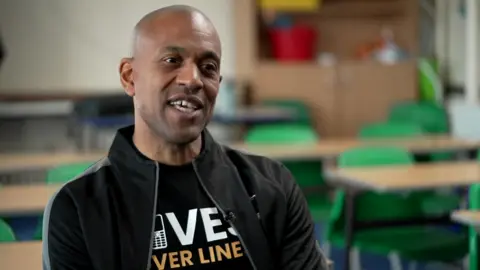
"County lines is where strangers, or gangs, or those involved in criminal activities try to use children for their own benefit," explains Leo Powell, a county lines educator.
He was carrying out a role play with the children about grooming.
"I've bought some food for him, he thinks we're friends, so now I say, "you owe me money'," explains Mr Powell to the class.
"That's called debt bondage."
There is high poverty, lower than average income and more families in temporary accommodation in this part of capital, and it can make children here susceptible to grooming by organised crime gangs.
Mr Powell explained to the class how children who accepted food or gifts from older people were often set up to be robbed.
They then owe money, and are told they have no choice but to pay off the debt by being sent away to sell drugs in other areas of London or in nearby counties.
They may be given a phone to take and deliver drug orders in different counties, known as a "line".
These phone lines are run by gangs who exploit vulnerable adults and children, even as young as these children, who often face threats and violence.
"We need to get in there early," Mr Powell told BBC News. "They are in shallow water at this age, 9,10,11 years old. But if we get to them too late, by the time they are 15,16, they can be too involved in this activity."
It is a problem that many head teachers are all too aware of.
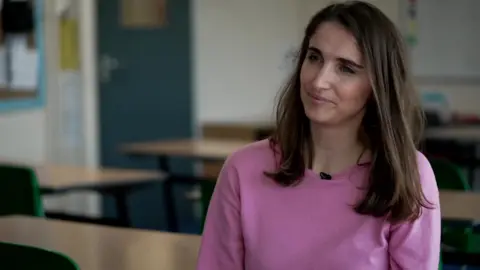
"We have had children who have been involved in county lines before, and where the parents have completely lost track of those children," Wilbury Primary School's head Lisa Wise says.
"Having people like Leo coming in to talk to the children at a very young age, to prepare them for what is out there, is important because this is happening to children earlier and earlier."
It is easy to approach young people with promises of food, money and even attention, through social media, Mr Powell explains.
"Most primary schools that I've been to, if I say, 'Who's got a mobile phone?' and if they are in Year 5 or Year 6, at least 90% of them will put their hand up.
"'Who has got social media apps?' 99% of them have social media apps. 'What's the guideline for social media apps? 13. Who is 13?' No-one puts their hand up."
The message has clearly sunk in with these students.
"They could slowly but gradually gain your trust, and deceive you," says 10-year-old Taki about what he had learnt in the session, "and then you'll end up selling drugs which you don't want to do."
"If I don't want to do it then I don't have to," says 10-year-old Recarta, "and if they force me then that is peer pressure."
In the past two years the Metropolitan Police has made about 2,500 arrests and safeguarded more than 1,000 children and vulnerable people.
But as fast as they close a line down, there is always another criminal ready to set another one up.
"They're using social media, technology, phones, and that is why we're investing in a team that are social media experts," says Det Supt Sean Lyons, county lines taskforce lead at the Metropolitan Police.
"We're making sure that we are educating children around the dangers, and working with our partners and people like Leo Powell to work out what those dangers are and stop the dangers of exploitation."
Message for parents
A passionate advocate and mentor for young people, Mr Powell runs the Lives Over Lines community interest company and has made three short films about young people involved county lines, each with a moral about the violence associated with it.
His fourth film is due out next year.
Mr Powell continues to work in the community, giving talks to young people, to schools and to parents about the dangers of county lines drug gangs, and how they can protect children against them.
While children are often approached in person, he says, the internet is also where many are being groomed.
"How many parents are checking what their kids are doing online?" asked Mr Powell.
"I've asked kids, how many of them use their phone in their bedroom without their parents knowing they are using their phone?"
"99% of the room put their hands up.
"We've got to know what our children are doing in order to keep them safe."
Listen to the best of BBC Radio London on Sounds and follow BBC London on Facebook, X and Instagram. Send your story ideas to hello.bbclondon@bbc.co.uk
