London's rubbish problem: Can the city finally clean up its act?

 BBC
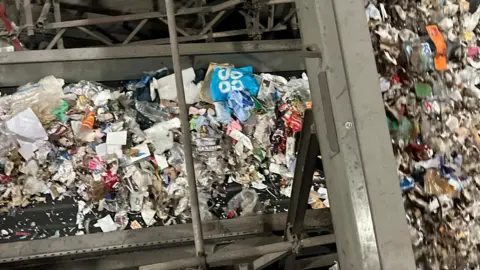
BBCIt is noisy, dusty and smells, unsurprisingly, like your bins.
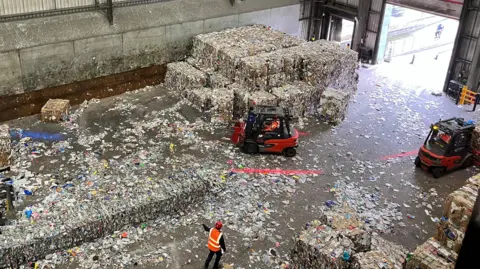
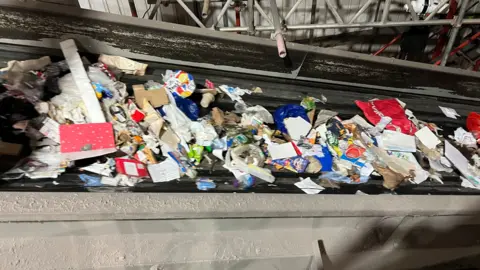
Conveyor belts carry cans, bags and cardboard all around us. Machines scrape and shake thousands and thousands of bits of rubbish.
We are inside Veolia's huge recycling site in Southwark.
This is where rubbish from five London boroughs comes to be recycled. They process 100,000 tonnes a year and it runs 24-hours a day, five days a week.
This is the front line of where your recycling goes.
A lot of the sorting is automated - an AI robot picks out bits of tissue from the conveyor belt of cans - but there are also lots of workers expertly sorting through the rubbish. It looks hard work and it is not without danger.
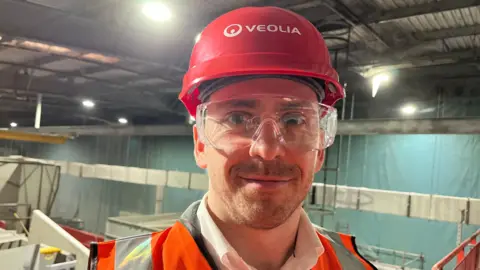
At the side of the sorting area there is a bin full of things people try and recycle.
On the top is a frying pan. There are also coat hangers and big chunks of metal.
They call this "wish" recycling - people having put it in their bins hoping it will get recycled.
It doesn't and must be taken away.
Now and again you recognise some of the rubbish which whizzes by on the conveyor belts; fragments of lives that have been discarded, like A-level papers and prawn cocktail crisp packets.
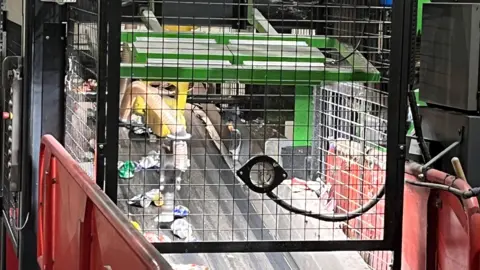
Oliver Peat, one of the bosses at Veolia, shows us around the site.
He says there is no silver bullet to increasing recycling in London, but it's up to everyone, where possible, to play their part.
"Londoners should make use of all of the recycling bins that they've got at home. But you also want to make use of the food waste bins as well.
"If you can separate out food waste as best as possible, that is the best way to live sustainably and really boost recycling rates in London," he explains.
Recycling bins being contaminated with items that should not be there is "a big issue", Peat says.
"We do come across problems of people who want to do the best they can, and they think that anything that they put in their recycling bin can be recycled - which unfortunately just isn't the case in London.
"What we want to see is people just putting the correct items into their recycling bin."
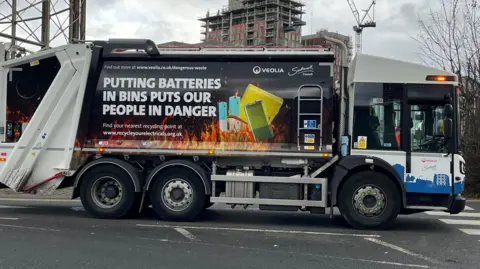
Another big problem for those at the recycling centre is people putting batteries in recycling bins.
Veolia has one fire a day from batteries.
Peat says the lithium battery fires are really difficult to put out.
"The key thing that we want people to leave out of their recycling bins are things like electrical items, and anything with a battery, because they cause real disruption at our facilities, and are a real hazard to human health," he says.
Around seven million tonnes of waste is produced each year from homes, public buildings and businesses in London.
Mayor of London Sir Sadiq Khan is the strategic authority for waste.
He sets the targets and the policies, but the Greater London Authority is not a collection or disposal authority. That job falls to the various London councils and they all do it differently.
The mayor has said he wants London to be zero waste city and in his Environment Strategy, published in 2018, he set targets including:
- 50% of local authority collected waste to be recycled by 2025
- No biodegradable or recyclable waste to be sent to landfill by 2026
- 65% of all London's municipal waste to be recycled by 2030
The 2025 target was missed and with no punishments or incentives in place for councils to meet the goals, boroughs have very different results when it comes to recycling.
The most recent data showed Bromley was the only borough to recycle half of its household waste, with a rate of 50.9% in 2023-24. Meanwhile, Tower Hamlets had the lowest recycling rate in the whole of England that financial year at 15.8%.
As for London's overall recycling rate, that has been stalled at around 33% for more than a decade, while other cities like Bristol and Manchester have improved and are doing much better.
Caroline Russell, a Green Party member on the London Assembly, thinks "consistency" is key and that the whole of London should have the same recycling scheme.
"You can see in a region like Wales where they've managed to get up to 68% recycling rate - there they seem to have understood what needs to be collected, what goes in what bin, and they've managed to get their recycling rates right up.
"I think the most important thing is having consistent messages across our city. If you go on to a council website, every council has a different way of telling you what can and can't be recycled and how to recycle different things," she says.
London's 32 boroughs all follow very different policies when it comes to waste and recycling.
In west London, a typical house in Hounslow will have three boxes to separate out dry recycling, as well as a wheelie bin for general waste, which is collected fortnightly, and bins for garden and food waste.
Yet those in neighbouring Hillingdon have just one sack to fill with all dry recycling, with another for general waste that is picked up every week, along with a bin for food waste and a sack for garden waste.
Residents living in flats also follow different rules to people in houses in numerous boroughs.
"I think the rules are so complicated in London, and so various, and with people moving from one private rental to another... I think people zone out so it actually makes it really difficult," adds Russell.
"I think if we had a unified system across the whole of London, that would make real difference."
Change is supposed to be coming. From April, new legislation is being introduced by the government called Simpler Recycling.
The law sets out that all residents will be able to collect glass, metals and plastics in one bin, paper and cardboard in another, with food waste having its own receptacle.
It's hoped this will reduce the number of collections needed and create straightforward recycling instructions.
The proposed changes are intended to standardise recycling and waste collection systems, although local authorities will be given some flexibility over how items are collected.
London Councils, an umbrella organisation representing the capital's local authorities, says the city's "diverse built environment makes recycling more complex than in many other parts of the country", with different housing types affecting how easy it is for residents to recycle.
Nevertheless, it adds that "recycling is only part of the picture" and "reducing waste in the first place saves money and has an even greater environmental impact".
"We want to work with the government on Simpler Recycling reforms while placing greater emphasis on waste reduction, alongside supporting repair, reuse and food waste initiatives across London."
Mete Coban, London's deputy mayor for the environment, agrees that waste in London is complicated but believes the new Simpler Recycling rules should have a "positive impact" on rates.
"What people want to see is consistency in terms of how they manage their recycling and obviously how they sort their waste.
"We're going to be working across London to make sure that we coordinate the boroughs and the waste authorities to really make sure that we drive our recycling rates across our city.
"The mayor has a huge ambitious plan on recycling 65% by 2030 and that's a big part of how we achieve it."
Achieving that will be a challenge. Critics say at the moment, recycling is falling through the cracks of different authorities and there needs to be a simple system across the whole of the capital.
Listen to the best of BBC Radio London on Sounds and follow BBC London on Facebook, X and Instagram. Send your story ideas to hello.bbclondon@bbc.co.uk
