Why will I get a food waste bin and when will it be delivered?
 Paul Moseley/BBC
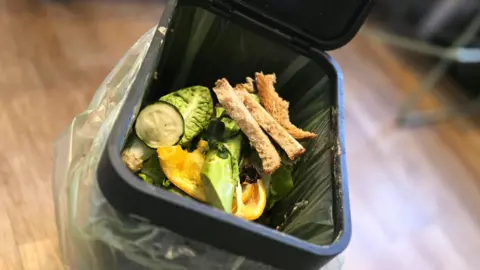
Food waste collections are being rolled out across Norfolk, and residents are set to get new bins.
The government said all councils should deliver the service from 31 March, but not all local authorities said they would meet that deadline due to a shortage of bin lorries.
Find out what is happening where you live below.
 Martin Giles/BBC
Why are we all getting food waste bins?
The decision to bring in a uniform system was made by the previous government, which wanted all local authorities to collect the same recyclables, such as paper, card, plastic, glass, metal and food waste.
Under the plan, the Department for Environment, Food & Rural Affairs (Defra) was supposed to cover the costs of purchasing new waste bins for households, along with vehicles to collect the food scraps.
However, councils, including South Norfolk and North Norfolk, warned that the funding they were set to receive was not enough.
They also said that, with so many councils all needing new vehicles at the same time, they could face delays in getting bin lorries.
How much of a delay are we talking about?
Defra said standardising waste collections would "end the postcode lottery of bin collection and help keep our streets cleaner".
However, depending on where you are, you could have quite a wait.
Breckland, North Norfolk and South Norfolk councils said they expected to start food waste collections this year, whilst Great Yarmouth said its could be delayed until January. More on this below.
Food waste is already collected in Broadland, Norwich and West Norfolk.
Blaming problems with "demand in the supply chain for vehicles", Breckland Council said it was set to miss the deadline.
"We anticipate vehicles arriving in time for roll out of the service in summer 2026", a council spokesperson said.
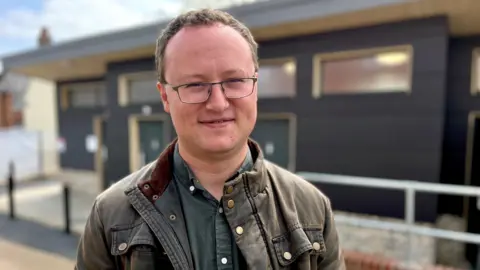
North Norfolk said its service was likely to start running in the autumn, with its Liberal Democrat leader Tim Adams arguing there should have been "a staggered approach" for rolling it out across England.
"We want to deliver this service, but it has to make sense," he told the Local Democracy Reporting Service.
"We are all under pressure to source the same equipment."
Adams added that collecting food waste in rural areas will mean there will be more vehicles on the road, producing emissions, which he said would counter the benefits of collecting scraps.
 Great Yarmouth Borough Council
Martyn Hooton, the Conservative councillor responsible for the environment at South Norfolk Council, said it hoped to launch its food waste service in June.
He admitted that recruitment had also been a challenge as "everybody's going to be looking for the same kind of operatives or HGV drivers".
"Some of those jobs have been provisionally filled, but we're still looking for staff," he added.
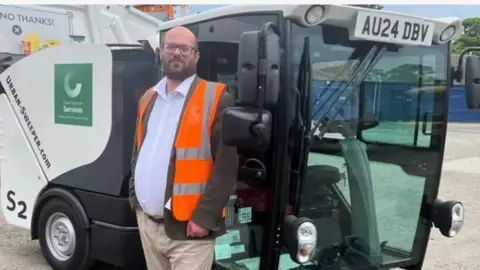
People in Great Yarmouth will face the longest wait for collections to start – the council expects to begin them in January next year – as work to upgrade recycling facilities at Caister-on-Sea to accommodate the waste will not be completed until late 2026.
The authority said it has also had to find more than £400,000 to implement the collections, due to the government's £1.15m funding not covering all of the costs.
"Ultimately, that means that we have had to not spend that money on other services," said Paul Wells, Conservative cabinet member for waste.
What happens to collected food waste?
The Waste and Resources Action Programme charity estimated that 6.4 million tonnes of food waste was generated from UK households in 2021/22, with 4.7 million of that classified as "edible waste".
The remainder was deemed "inedible or unavoidable".
Food scraps can be turned into energy at bio-digestion plants, creating biogas to generate heat and power, as well as fertiliser for agriculture.
This helps to reduce the amount of methane released into the atmosphere through food waste being dumped in landfills.
Follow Norfolk news on BBC Sounds, Facebook, Instagram and X.
