Hull of 16th Century cargo ship washed up by gales

 Shaun Whitmore/BBC
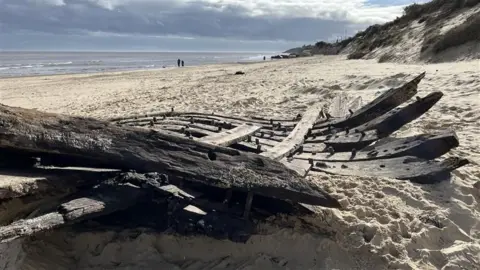
Gales lashing the East coast have washed part of an old ship ashore.
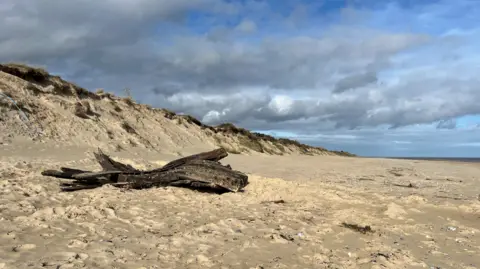
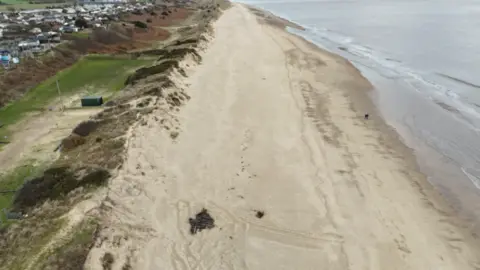
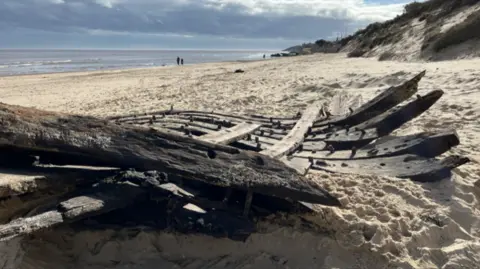
Hull timbers thought to date from the 16th or 17th Century were found on Hemsby beach in Norfolk a week ago.
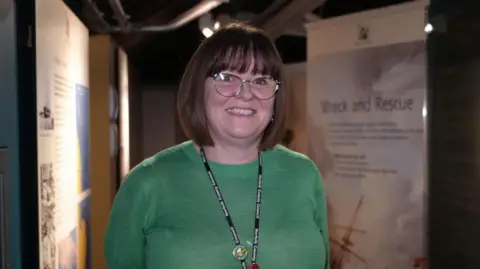
Natalie Fairweather, of the Time and Tide Museum in Great Yarmouth, said that despite the exciting find, a lack of records made it difficult to track down any official details abut the vessel.
Retired fisherman Kenny Chaney, who has seen about 25 shipwrecks surface along the Norfolk coastline over the years, said he believed this one, buried for possibly hundreds of years, had served as a cargo ship.
 Shaun Whitmore/BBC
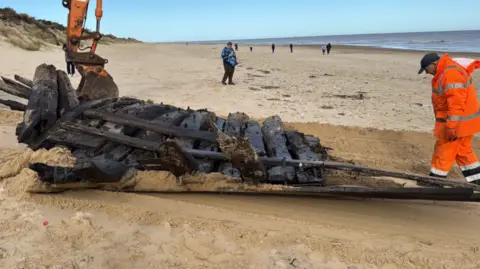
On Sunday, Chaney helped the local lifeboat service move the wreckage away from the shoreline.
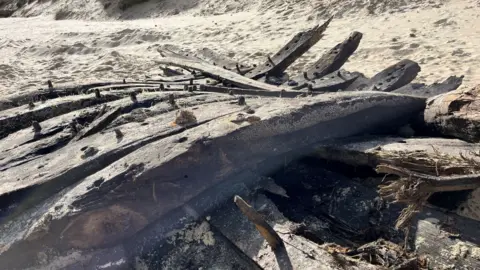
It is covered in barnacles, measures about 20ft (7m), but is thought to be part of a much larger ship measuring almost 100ft (30m).
 Shaun Whitmore/BBC
"I think it's a bit of a cargo boat by the size of it," he said.
"I think it's a bit too big to be a fishing boat for that era, namely 16[00] or 1700," he said.
 Shaun Whitmore/BBC
The relic offers a glimpse of how vessels were once built using wooden pegs to connect parts together.
"There's very little in the way of metal on it, no metal bolts, just one through the keel bit, but other than that, very little," said Chaney.
"I marvel at how how they used to make those boats with the gear they had.
"That would take a very skilled person, even today, to make that with the gear they've got nowadays."
 Shaun Whitmore/BBC
The Time and Tide Museum keeps records of hundreds of local shipwrecks, but said identifying the Hemsby wreck would be impossible.
She added that the non-existence of sonar made sailing pretty dangerous in the 16th and 17th Centuries.
"We know where a lot of modern wrecks are, obviously, because of the shipping lanes and things, but no, no clue, unless it's got a name on it," said Fairweather.
 Shaun Whitmore/BBC
Navigation at the time could not detect sandbanks, she added, so a ship could more easily run aground.
"It's a treacherous coast, the sandbanks move all the time," she said.
"You've only got to have a big storm. You've only got to look at Hemsby and how much damage there is there.
"Yarmouth itself is a sand spit. It changes all the time.
"It's a horrid, horrid coast. If you hit a sandbank you were sunk, quiet literally."
The wreckage will remain on the beach until the next high tide takes it out.
 Hemsby Lifeboat
 Shaun Whitmore/BBC
Follow Norfolk news on BBC Sounds, Facebook, Instagram and X.
