'It's a nightmare' - The London borough with England's lowest recycling rate

 BBC
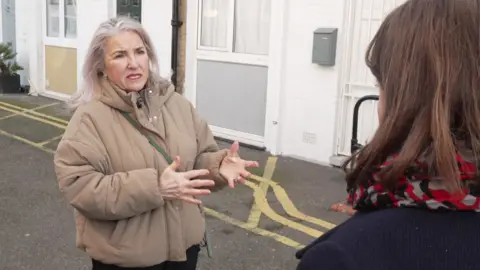
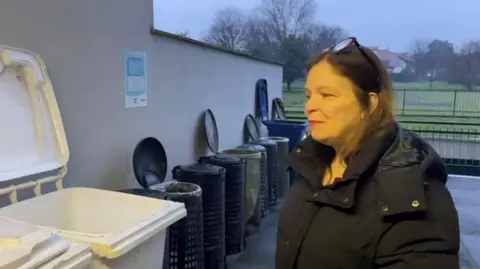
BBCLeaseholder Jackie Warner has lived on her estate in Bow for 26 years. She is a keen recycler but describes the waste situation in Tower Hamlets as confusing and "a nightmare".
The east London borough is the worst local authority at recycling in England with just 15.8% of its waste being recycled, according to the most recent figures from the Department for Environment, Food and Rural Affairs.
Jackie says residents like her must go to the trouble of collecting a roll of clear pink bags from the local library, which is only open at specific times and on certain days.
They are then supposed to use them to dispose of their recyclables in one of two large purple containers outside.
"The bags are extremely thin so you can only put so much in there, and you can only put certain things in, but no one seems to adhere to that," explains Jackie.
General waste for Jackie's flat is sent down a chute into a large container in the bin store at one corner of the block.
Food waste is not separated or recycled, but instead is put down the same chute.
"As far as I know, there is nothing for food waste," she says. "There is no designated bin."
Tower Hamlets currently only collects food waste from street-level properties, with 8.3% of total organic waste in borough being recycled in 2023-24 - the lowest proportion nationally.
"In the summer it can be quite foul," says Jackie, of the smell from the communal bin.
Jackie says residents used to have plastic food waste containers on their balconies, but they were removed after the Grenfell Tower Fire because they were seen as a potential trip hazard if a blaze broke out.
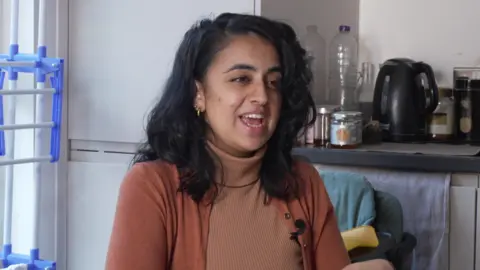
There's a different waste system on another estate in Bow and resident Hirra Khan Adeogun has her own issues when it comes to recycling.
"Me and my husband have rows about it all the time, about what goes in recycling and what doesn't go in recycling," says Hirra, who is a leaseholder in a new build block. "There are lots of rules."
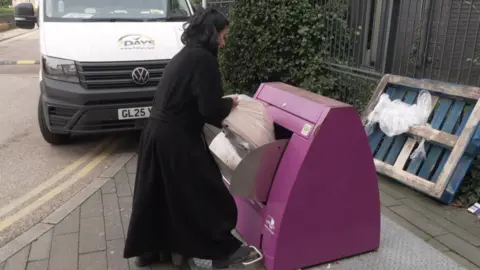
Hirra's rubbish has to be taken outside to two small futuristic-looking waste disposal units.
The ground-level containers hide a chute to underground bins, one for recycling and one for general waste, that Hirra says are meant to be collected on different days so one doesn't contaminate the other.
"I am a diligent recycler, I really try. But we've noticed that actually they seem to bung it all in the same van," she says.
"We've spoken to one of the operators and they've said to us it's being sorted out at the depot, which is very different messaging from what we are getting on the leaflets which says we must be separate it out."
Hirra says she tried to clarify what happens with the council, but without any joy.
"Either it's being sorted out at the depot which means we don't need to do it at home, or that is not what's happening and we do definitely need to sort it out at home. And that's what I was trying to raise with the council."
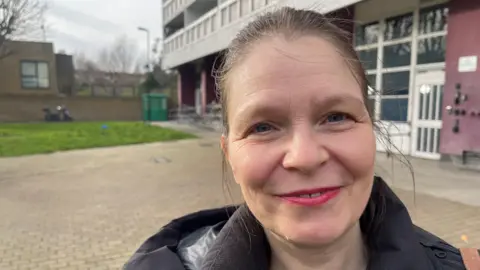
Another Tower Hamlets resident believes the borough should be looking to her country of birth for inspiration when it comes to improving its recycling rates.
Environmental artist Sylvietta is originally from Milan, where recycling has been taken seriously for decades.
There, instead of collecting all recycling together in one bag, people have various bins for the recycling of food, paper, plastic, metals and glass, as well as a bin for general waste.
Italy is one of the top countries for recycling in Europe, according to the EU.
At her flat in a local authority block in Bow, where she creates pictures and sculptures out of litter she has collected, she feels the council could learn a thing or two from the country.
"Italians are not famous for following rules, they are more creative. But if you're fined regularly you embrace it," says Sylvietta.
In Italy if one resident contaminates the wrong bin, the whole block can expect a fine, she explains.
"Unfortunately it requires a little bit of fear to respect the rules. Ultimately they are good for everyone."
In a statement, Tower Hamlets Council said it was aware of residents' concerns about recycling and that the low rates were largely down to the area's infrastructure and make-up.
"The borough is one of the most densely populated in England, with 88% of homes as flats, meaning most residents rely on communal recycling facilities rather than individual bins," it said.
"High-rise living and rapid housing growth make recycling structurally challenging."
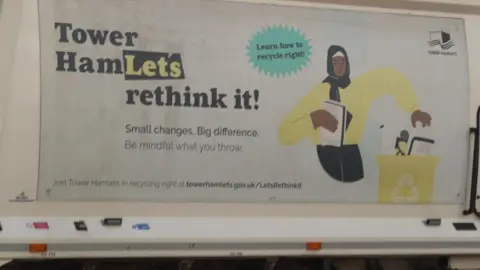
The council added it was working to improve recycling rates, with a number of trials in place including at "a small number of pilot blocks of flats [which] are currently receiving a separate weekly food waste collection", with plans to make this borough-wide before April 2027.
The council has also been "piloting ways to help people recycle more by delivering recycling sacks to people living in flats", and said it can "provide reusable bags [which] can be used again and again, complementing our investment in upgraded communal recycling facilities, clear signage, and resident education".
Such measures, it said, has helped improve the borough's recycling rate with Tower Hamlets recording a rise from 19.9% between July and September 2025, to 20.8% for October to December last year.
"Despite [the borough's] structural challenges, recent data shows measurable and sustained improvement," the council said.
Listen to the best of BBC Radio London on Sounds and follow BBC London on Facebook, X and Instagram. Send your story ideas to hello.bbclondon@bbc.co.uk
