Laughing gas canisters explode at waste centres hundreds of times a week, firms say
Discarded laughing gas canisters are exploding in waste facilities and risking injury to staff, several major companies tell the BBC.
The high-pressure nitrous oxide metal canisters, which are being used illegally by recreational users, are often discarded in household rubbish, causing significant damage to energy-from-waste plants.
Waste management and recycling companies say they are seeing hundreds of explosions each week, costing millions of pounds to repair damage, and threatening workers' safety.
The government says it is an offence to illegally dispose of canisters and local councils have powers to take enforcement action against offenders.
Possession of nitrous oxide became a criminal offence for recreational use in England and Wales in November 2023 but it is still legally used in medicine and catering, for example, in the production of whipped cream.
The canisters, which can explode when heated or crushed, are damaging furnaces in energy recovery facilities, where treated waste is incinerated and converted into energy.
The damage they inflict can cause plants to have to be shut down for unplanned repairs.


Nicola Henshaw, managing director for hazardous waste at Veolia, said: "At our facility in south-east London we've had 2,300 explosions in 2025. At our Newhaven facility we've had 200 explosions.
"We've also seen small explosions in the back of refuse vehicles and obviously this is very frightening for our employees."
Henshaw said: "We're really lucky no one's been seriously injured.
"The public is at risk too if they're near one of these collection vehicles."
Veolia is urging people to take the canisters to household waste recycling centres, where they can be safely sent on for treatment.
 Environmental Services Association
John Scanlon, chair of the Environmental Services Association, said: "We've seen a shift from people using small canisters to much larger ones holding 600, 700g of nitrous oxide, which become a ticking time bomb when they're disposed of and find their way into our waste and recycling facilities."
Scanlon, who is also UK executive vice president of the Suez Group, said these products are still too easy for the public to get hold of.
"We would call for licensing to ensure that only commercial businesses with a legitimate interest are able to buy, effectively banning these things being sold to the public."
The (ESA) is also calling for greater enforcement of the law, ensuring retailers are making the necessary checks.

Zeshan, who is 28 and is supported by the Kenward Trust, a Kent-based charity that helps people overcome addiction, says he used the drug before the law changed.
"It's very addictive and it's taken over a lot of young people's lives.
"I feel it's still happening but it's more hidden now - a lot of people I know are still using it," he said.
Heavy use can lead to a vitamin B12 deficiency which can damage nerves in the spinal cord.
The most common early symptoms of neurological damage are a tingling sensation and numbness in the hands or feet.
"I would feel funny in my body and leg, not being able to walk or remember things," Zeshan said.
"It affected me a lot, mentally and physically, the brain fog, the weakness and a lot of my friends have ended up in hospital, they've not been able to walk for weeks."
In April 2024, Berkshire's senior coroner Heidi Connor ruled extensive nitrous oxide abuse had contributed to the death of 24-year-old student Ellen Mercer in February 2023.
She died before possession of the substance for personal use was made illegal.

As well as the impact on the waste industry, there are also concerns about drivers being at the wheel while impaired by laughing gas.
Det Sgt Chris Wade, from Kent Police says: "It's becoming fairly common place.
"If it's not reports from members of the public that a car is driving erratically and that person's got a balloon in their mouth, or sadly the result of a serious or fatal injury collision where we find evidence within the vehicle.
"If we find evidence of drug use in that vehicle, especially with nitrous, or anything illicit, then that will be an aggravating feature the court will be told about."
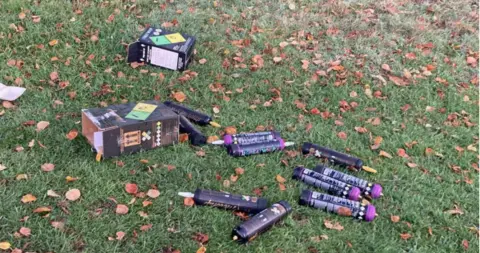
Discarded laughing gas canisters are "a blight to society", says Spelthorne Litter Pickers, whose volunteers have been finding a growing number of the larger canisters.
Insp Matt Walton from Surrey Police, said the force's work had led to 15 successful prosecutions over the last year.
"The majority of the possession offences we find are with those who are teenagers or young adults," he said.
"Since the ban came in we have seen canisters that are now significant in size.
"Often the individuals will go to a location to take the nitrous oxide, in parks and car parks with their vehicles," he said.
"There's the littering and anti social behaviour with drug use of any type."
Unlimited fines
Nitrous oxide is a Class C drug under the Misuse of Drugs Act 1971, making possession and sale for recreational purposes a criminal offence.
The previous government said the ban would combat anti-social behaviour and reduce damage to users' health.
Those caught with it for unlawful use face a caution, community service or an unlimited fine with repeat offenders facing up to two years in prison.
The maximum sentence for production or supply of the drug for unlawful purposes is 14 years.
According to data from the Office for National Statistics (ONS), 1.3% of people aged 16 to 24 used the drug in the year ending March 2025, a decrease from (3.3%) the previous year.
The government says "reckless" producers and suppliers who don't check the purpose of any sale are breaking the law.
A spokesperson said: "Suppliers have a clear legal duty to ensure products are not sold for recreational use.
"The abuse of nitrous oxide is dangerous to people's health."
