How to fix a pothole from the best in the business

 Chris McHugh/BBC
"I reckon about 10 minutes".
That's how long Jonathan Ullmer thinks it will take to fix a small, but significant, pothole on a quiet cul-de-sac in Newbury.
Ullmer works for Volker Highways, which fixes potholes on behalf of West Berkshire Council.
The authority was recently given a 'green' rating for its effectiveness at tackling potholes by the Department for Transport's new system.
 Chris McHugh/BBC
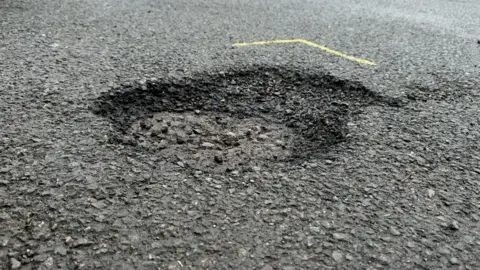
As we approach the pothole in question, inches from the kerb, at first glance it doesn't appear be one that needs urgent attention.
"This one isn't that deep, but it could cause problems to the local householder," Ullmer says.
"Every pothole has an intervention level. [That] depends on the criteria of where it is in the carriageway and whether it's causing the major concern or not.
"We have to react to any potholes which are picked up by the council and they put a timescale on when they need to be fixed."
 Chris McHugh/BBC
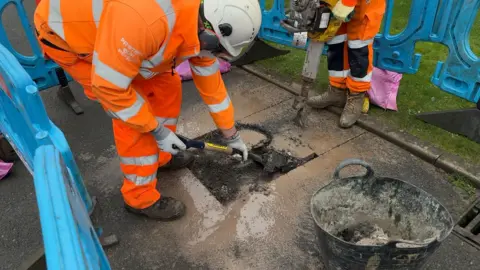
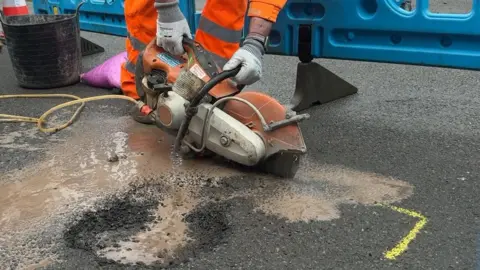
After putting up barriers around the pothole, one of Ullmer's team uses a stone saw to cut a rectangular-shaped border around it.
"You have to try and minimise dust as much as possible," says Ullmer, "hence why you have water running into the saw."
Next, a pneumatic drill is used to break up the tarmac inside the square to create a neat, level 'hole' ready to be filled with fresh tarmac.
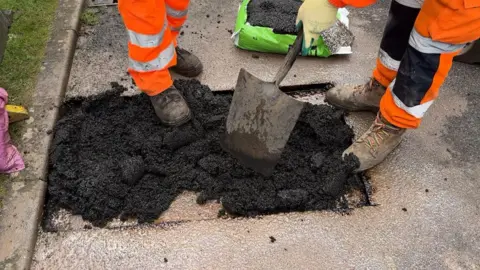
The type of cold tarmac they use - a 'permanent repair cold lay material' - is cost-effective in the winter, says Ullmer.
 Chris McHugh/BBC
"If you're going around with hot material we'd have to have another trailer or vehicle and there'd be a lot of wastage."
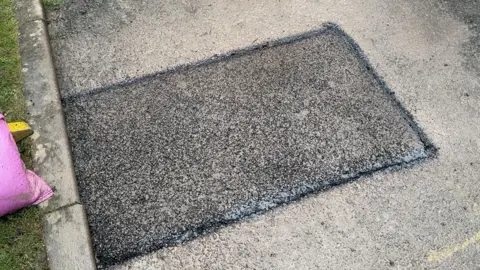
Ullmer says it contains a combination of chemicals and cement which, when levelled and then compressed, triggers bonds in the tarmac and solidifies.
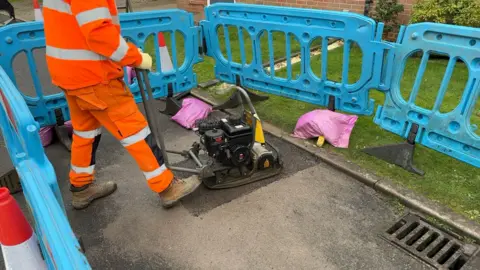
After two technicians use shovels - and their boots - to mould the tarmac into place, it's time for the final piece of heavy equipment: the 'whacker plate'.
Also known as a compactor, it's a heavy-duty, engine-powered tool with a vibrating metal plate that compacts asphalt to create a solid, level base.
 Chris McHugh/BBC
A far cry from how potholes used to be filled, according to Ullmer.
"It's not just the old days of turning up on site, chucking something in a hole and driving over [it] with a van," he says.
After the deafening 'whacker plate' is run over the top of the cold tarmac, a sealant is then sprayed by hand over the edges to prevent rainwater seeping inside.
And with that, another pothole is ticked off. Mr Ullmer is pleased with his team's work... albeit with one exception.
"There's nothing they've done wrong," he says, "other than Trev could pull his trousers up a bit while he's being filmed".
 Chris McHugh/BBC