Baby sleep: The five myths that cause unnecessary stress for parents

 Getty Images
From the idea that most infants sleep 12 hours to the suggestion that daytime naps can improve nighttime slumbers, we expose the biggest misconceptions that are troubling parents.
Few aspects of child development are as rife with misinformation as infant sleep – a space that's largely been taken over by companies and books aimed at selling sleep programmes, coaching and advice. From the idea that babies should "sleep through" by six months of age to the belief that motion naps aren't restorative, here are five common myths about infant sleep – and what the scientific research actually says.
1. No, most babies don't 'sleep through the night'
While an infant or toddler "sleeping through" might be the holy grail for parents, it is relatively uncommon, as large studies of young children frequently show. One study of more than 55,000 babies in Norway, for example, found that nearly seven in 10 six-month-olds woke at least once per night, while more than one in four 18-month-olds did.
A 2020 study of 5,700 children in Finland, meanwhile, found that, on average, babies that were three, six, or eight months old woke more than twice per night; 12-month-olds woke 1.8 times per night; and 18- and 24-month-olds woke around once per night.
 Getty Images
"Our data confirmed that one to three awakenings per night is common in early childhood. Almost all children woke up one-to-three times at night, while a minority slept through the night (16.5% at three and 22.3% at eight months)," the researchers wrote.
How frequently babies are waking, however, varies greatly. The Finnish researchers, for example, reported that at least one eight-month-old in the study woke up 21.5 times per night.
These studies were based on parental report, meaning that babies might have woken even more frequently – their parents just weren't aware. When more objective measures of sleep are used, such as using video recordings to analyse children's sleep patterns, they indicate that infants wake even more often. One small but authoritative 2001 study using this method found that the average number of wakings (defined as a wake that lasted longer than two minutes) was three wakes for 3-month-olds, 3.5 wakes for six-month-olds, 4.7 wakes for 9-month-olds and 2.6 wakes for 12-month-olds.
But there is good news: as babies approach the end of their first year, their wakes decrease on their own. The Finnish study, for example, found that while nearly eight in 10 eight-month-olds woke at night, just one-quarter of two-year-olds did.
Baby sleep
If you'd like to find out more about the science of baby sleep, you can read this indepth article by Amanda Ruggeri. She has also written about what happens to baby sleep when the clocks change and if letting babies "cry it out" is beneficial or puts them at risk.
2. But night wakes aren't always 'normal', either
Sometimes, you hear that children will continue to wake at night until they're taught not to. But this not only dismisses the fact that typically developing infants consolidate their sleep over time on their own (see above). It also can overlook any underlying health conditions that can impact sleep.
Iron deficiency, which affects some 15% of toddlers in the US, for example, can cause frequent night wakes, restlessness, and difficulty falling asleep in infants. (Read more about iron deficiency – and when supplements are the answer).
Many other conditions have been linked to unsettled sleep or frequent wakes in babies and small children, including food allergies, gastroesophageal reflux disease (GERD) and ear infections. Then there are sleep disorders themselves: up to 6% of children are estimated to have obstructive sleep apnea, for instance, a condition that also can cause frequent wakes, with a peak between two to six years old.
3. For most infants, 12 hours of sleep per night is quite a lot
Google "baby sleep schedule" online, and you might notice a theme: most will suggest that infants sleep about 12 hours per night. Ever since the "7-7" (19:00-07:00) schedule was popularised in Western and industrialised societies, anything less, particularly for babies and young children, has been seen as insufficient.
While it is true that some children do need 12 hours a night, many do not – and for those children, being put down too early can lead to bedtime "battles", frequent wakes, or an early start the next morning. One Australian study of 5,000 babies found that children from infancy up to almost five years of age slept 11 hours overnight on average, not 12. This was true even for the youngest babies studied, who were four to six months old.
 Getty Images
In other parts of the world, including many Asian countries, babies sleep far less. One study found that babies aged three and under slept, on average, 10.17 hours a night in Australia, 9.96 in Canada, 10.51 in the UK and 9.74 in the US, but 8.73 hours in Taiwan, 9.02 in Hong Kong, and 9.15 in India and Indonesia, for example.
Even in societies that tend to idealise 7-7 sleep, recommendations from sleep health associations indicate that a 12-hour night would be on the higher end of the spectrum. The American Academy of Sleep Medicine, for example, suggests that total sleep in a 24-hour period should be 12-16 hours for four-to-12-month-olds and 11-14 hours for one-to-two-year-olds. They do not make suggestions for how much of this should come from nighttime versus naps, given the lack of evidence. And some researchers question whether these recommendations have a strong underpinning.
4. Yes, on-the-go naps are 'restorative'
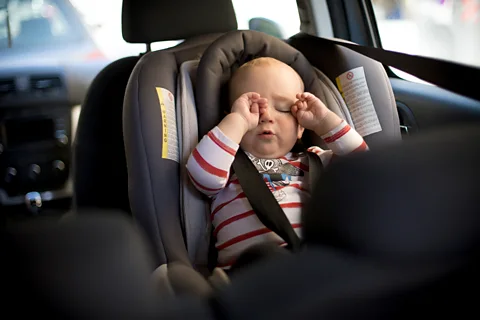
It's common to see claims online that motion naps – like being in a pram, carried in a sling, or driving in a car – keep babies in a light, less restorative type of sleep. But there's no scientific evidence to this effect, and some research indicates the opposite may be true.
A study of 64 two-month-olds found that the babies were more likely to fall asleep and less likely to cry when they were rocked at higher (but still gentle) frequencies. When babies with diagnosed obstructive sleep apnea were put on rocking versus non-rocking mattresses, meanwhile, it halved the number of obstructive events they experienced.
No published studies have yet examined infants' brain activity during motion naps, but some research haslooked at adults. These studies, which have used electroencephalogram (EEG) devices to monitor brain activity during sleep, have found that being gently rocked during a nap increases the amount of time in deep sleep stages, helps people transition into deep sleep faster, fosters the brain oscillations that help with memory consolidation, and decreases the amount of time in light sleep. Rocking even promotes sleep in mice.
Of course, it makes sense that motion naps wouldn't be detrimental to our brain development, since babies spent about 90% of their time sleeping while they were still in the womb – much of which, of course, happened while their mothers were walking or moving around, "rocking" them in utero.
5. No, sleep does not (usually) 'breed sleep'
It is true that, when some babies get too tired, they get more aroused and stressed – which can make it harder for them to settle at night. But the idea that the more sleep a child gets during the day, the more sleep they'll get at night, isn't usually borne out by the research.
In fact, in older toddlers and preschoolers, most studies have found it goes the other way: after two years of age, children take longer to fall asleep at night, and wake more overnight, on days they nap.
 Getty Images
But one study that compared days where young infants napped more, versus days when they napped less found something a little different. Notably, the study used actigraphy, which uses wearable devices to monitor movements to assess sleep-wake patterns – a more objective measure of sleep than parent report.
For babies at six or 15 weeks of age, napping longer than usual during the day didn't affect their nighttime sleep. But when babies were 24 weeks old, it did – with longer naps meaning more shut-eye overnight. It's important to note that this difference was slight: the six-month-olds had to sleep a full hour more in the day to get just 14 minutes more sleep at night.
More like this:
It's also not clear whether the longer nap could explain why the babies slept a little more at night; they may have napped longer because they were having a growth spurt, for example – which may have been the same reason they then slept more at night, too.
If it seems surprising that the research supporting "sleep breeds sleep" is underwhelming, it shouldn't be. That's because one of the main biological underpinnings for falling asleep is the sleep-wake homeostat. Also known as "sleep pressure", this rises the more hours babies (or adults) go without sleep. If a baby has slept too much in the day for their own individual needs, it will make it harder – not easier – for them to fall asleep at bedtime.
Sleep needs are individual and variable, and, like adults, infants can't be coaxed to get more sleep than their bodies need.
--
For trusted insights on health and wellbeing, sign up to the Health Fix newsletter by senior health correspondent Melissa Hogenboom who also writes the Live Well For Longer and Six Steps to Calm courses.
