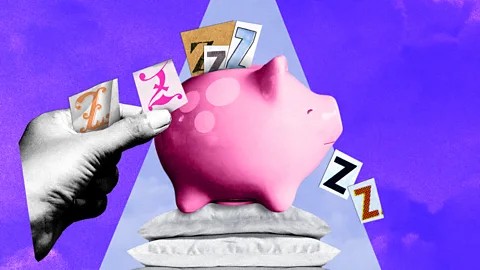
Is it really possible to 'bank' sleep for later?

 Serenity Strull/ BBC
From helping you to focus more to improving sports performance, some scientists believe "depositing" sleep for later use can bring a range of benefits.
It's the weekend. The perfect opportunity to switch off the alarm and spend an extra hour or so in bed. For those of us able to enjoy this luxury, sleeping in to catch up on lost rest from earlier in the week is a common tactic. But are we thinking about this the wrong way around? Might it be better to "bank" extra hours of slumber ahead of a busy period to help to counteract the effects of sleepless nights?
Sleep banking – where you snooze for longer over multiple nights ahead of a period where your sleep is likely to be restricted – could well be an effective tactic, according to some researchers. They say it helps the brain to stockpile crucial resources for later deployment, improving alertness and cognitive performance when sleep deprivation hits.
The idea is growing in popularity among wellness enthusiasts on TikTok, who extol sleep banking before long-haul travel or big work events to improve mental performance, or act as a "safety net" before a busy period. So does it really work?
Based on the analogy of topping up a bank account so that you avoid going into the red so quickly when you make withdrawals, the concept of sleep banking was introduced in 2009 by sleep researchers at the Walter Reed Army Institute of Research in Silver Spring, US. Led by Tracy Rupp, who is now at Utah State University, the team were looking for a way to help soldiers improve alertness before missions and wondered if extending the time spent asleep beforehand would help. Their study split 24 military personnel into two groups, with one group spending seven hours in bed a night and the others allowed 10 hours. The following week the participants were restricted to three hours in bed each night, before being allowed to revert to eight hours a night.
The results appeared impressive. Those who had banked an extra three hours of sleep showed less of a decline in their alertness and ability to sustain their attention during the sleep restriction phase. They also returned to baseline performance faster than those who hadn't banked.
Years of subsequent research in different settings have helped to underline how sleep banking can act as a mental and physical prophylactic ahead of sleepless nights.
 Getty Images
In 2023, a study of doctors at a hospital in Miami found that banking around 90 minutes of sleep for three nights led to improved performance during two weeks of subsequent night shifts. Other studies have found that the strategy appears to be beneficial for sport performance too. Sleep banking is a common strategy used by competitors during sailing races and appears to reduce the effects of sleep deprivation on errors and reaction times during short sailing regattas. Professional rugby players who extend sleep to 10 hours a night for three weeks have been found to experience lower levels of physical stress, while one week of nine hours' sleep a night improved serving accuracy among tennis players. Basketball players who extended their sleep over a five-to-seven week period saw their shooting accuracy increase and were able to sprint faster.
Piggy bank or credit card?
But the concept of sleep banking remains controversial. Not all researchers agree that it is possible to "deposit" sleep with the intention of withdrawing it later when we need to stay awake for longer. They say it is difficult to unpick whether the body really is "storing" hours asleep for the future or simply catching up on pre-existing sleep debt or need.
One scientific review of the evidence for sleep banking among shift workers has highlighted the risk of potential bias in the way some studies were conducted. They say the research doesn't prove that observed improvements in performance are a direct result of extending sleep in advance.
At the centre of the argument is why our bodies need sleep at all.
"There are many theories as to why we sleep," says Peter Polos, associate professor of sleep medicine at the Hackensack Meridian School of Medicine. "There are metabolic, hormonal, neurological and cognitive issues that are all addressed during our sleep. And it's thought that at least for the brain, it's a time to consolidate thoughts or prioritise important 'files'."
In physiological terms, sleep is essential for the trillions of cells in our bodies. "All your cells need healthy sleep to refuel and repair," says Michael Howell, professor of neurology at the University of Minnesota. "Throughout the course of the day, in our body and in our brain, we have a variety of waste products that build up. It's during sleep that our brain washes them out."
Most adults function best on around seven to nine hours a night, Howell says. "The short sleeper who can get by on four or five hours of sleep is very rare."
That's why a severe sleep deficit is so detrimental. "We can all cope with a lost hour here or there, usually with no consequences," says Polos. "The issue is if it becomes a chronic thing. The effects are cumulative over time and include reduced performance in work or social interactions, lack of motivation and cognitive issues where one feels slower cognitively."
Without sufficient downtime your brain can't sluice out waste, meaning you may struggle to focus and absorb important details in the day that follows, Howell says. "If you're trying to learn a language or a musical instrument, or maybe you're an athlete trying to learn a new skill, you're going to have trouble paying attention and taking the information in," he says. "But then you're also going to have trouble coding the information for long-term storage and use later."
Rupp and her colleagues believe that sleep banking works by giving the brain more time to clear out neuronal waste and replenish the glycogen stores that the brain relies on for energy when blood glucose drops, leaving our brains better able to cope when a bout of sleep deprivation occurs.
Banking at morning or night?
Proponents of sleep banking say the approach can make a difference for anyone who has a period of sleep disruption coming up – a long-haul flight, cramming for exams or working late to meet a deadline, for example.
"If you want to try sleep banking, what I would start doing is allowing yourself 30 to 60 minutes of extra sleep, if you can, for about one to two weeks leading up to whatever task you suspect you're going to be sleep deprived for," says Howell.
He believes it's easier to set your alarm for later in the morning because "as a general rule, it's easier for people to sleep in than to fall asleep earlier – but that's not universal for everyone".
Polos, by contrast, says that going to bed earlier could be a better strategy for some. "If your body's in tune to get up at 6am, you can set the alarm for 7am, but you may wind up waking up at 6am anyway."
"Napping is a highly effective way of paying into your sleep account if you're going to withdraw later," says Howell, as long as it doesn't impact your night-time slumber.
 Getty Images
One element researchers can't agree on is whether sleep banking can be effective if you're already in debt by being significantly sleep deprived. Rupp and her colleagues argue that it can, but state that "sleep debt should be paid off as soon as possible".
Elizabeth Klerman, professor of neurology at Massachusetts General Hospital and Harvard Medical School, refutes this idea. "In order to show that sleep banking occurs, you need to show that somebody can sleep when they're not tired, and there is no evidence for that," she says, citing experiments where participants were given more time in bed but failed to sleep for longer. That's why she argues that sleep is more like a credit card than a piggy bank. "In other words, you can build up a debt, but you can't build up a surplus."
Klerman is concerned that if people believe sleep banking is effective, they might feel it is ok to deprive themselves of sleep provided they have slept well previously. "That means they are depriving themselves now of something that is fundamentally important to their health and wellbeing," she says. She is, however, in favour of catching up on lost sleep, but cautions against afternoon naps longer than 45 minutes as they can cause sleep inertia, the technical term for that groggy feeling when you wake up after a deep doze.
More like this:
• How gut microbes control your sleep
• Why do some people feel tired all the time?
• The forgotten habit of communal sleep
Regardless of whether we are banking sleep for the future or simply paying off a debt we owe ourselves, it appears an extra half an hour or so of kip each night does appear to be beneficial (unless you regularly need more than 12 hours a night, as it could be a sign of an underlying issue, Howell says).
Polos says that even if sleep banking does work it shouldn't be seen as a long-term solution. "Don't rely on it as an answer to all your sleep issues or all the demands your work or society's putting on you," he says. Ultimately, changing your relationship with sleep will have a better long-term effect.
"Try to maintain a regular schedule of bed and wake times and get sufficient quality and quantity of sleep," Polos says.
(Want to improve your sleep? Get seven science-backed tips in this article on optimising your slumber.)
--
For trusted insights on health and wellbeing, sign up to the Health Fix newsletter by senior health correspondent Melissa Hogenboom who also writes the Live Well For Longer and Six Steps to Calm courses.
For more science, technology, environment and health stories from the BBC, follow us on Facebook and Instagram.
