'Catastrophe may overwhelm us all': How Winston Churchill's 'Iron Curtain' speech launched the Cold War 80 years ago

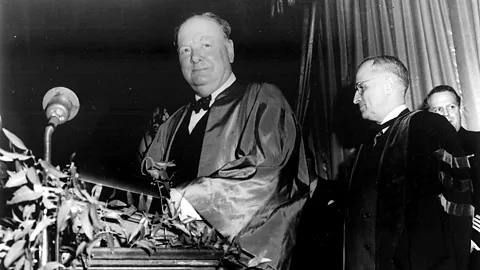 Alamy
AlamyIn 1946, less than a year after the end of World War Two, Britain's wartime leader sounded an urgent warning about the Soviet threat to the West.
"From Stettin in the Baltic to Trieste in the Adriatic, an iron curtain has descended across the continent." In a single sentence, Winston Churchill defined the division between two opposing ways of life: on one side, the capitalist West, on the other side, the communist East. In his speech on 5 March 1946, urging the US to look outwards and resist returning to isolationism, Churchill drew a metaphorical dividing line through Europe, from Germany's border with northwest Poland to Italy's border with the part of Yugoslavia that is now Slovenia. It captured a moment suspended between post-war euphoria and the unsettling sense that fresh dangers could lie ahead.
Not everyone realised it yet, but Churchill had identified how conditions were brewing for the Cold War, a struggle between the two new superpowers, the US and USSR, that would split the world into ideological camps for decades.
Churchill was speaking merely as a private citizen, not as the world leader who led the UK through most of the war years. While the major powers were still planning what shape a post-war world would take after victory, Britons voted Churchill out of office in the 1945 general election. Depressed and bewildered about the rejection less than two months after the VE Day celebrations, the 71-year-old pondered what to do next. But he already had something on his mind.
As the end of war approached, Churchill had noted how the Soviet armies were not withdrawing from the territory they had occupied while advancing across Eastern Europe to defeat Nazi Germany. Soviet‑backed regimes were emerging in these newly liberated countries and Moscow was signalling ambitions to further extend its influence. Yet after such a devastating global conflict, few nations, especially the United States, wished to confront their former wartime ally and risk World War Three. Churchill disagreed and even considered attacking the USSR, or Soviet Union. This explosive secret plan was codenamed Operation Unthinkable. British military advisors soon realised it was unrealistic – the name may have been a clue – and it was abandoned.
Now no longer prime minister, Churchill's words still carried weight internationally. In October 1945, an exciting opportunity came from an unlikely source when he received a bold invitation to speak at Westminster College, a hitherto obscure institution in the small midwestern town of Fulton, Missouri. Scrawled at the bottom of the letter was a presidential endorsement: "This is a wonderful school in my home state. Hope you can do it. I'll introduce you. Best regards, Harry Truman."
The US president had calculated how a Churchill speech could also benefit his government. From its earliest days, the US has wrestled with how to balance domestic priorities with ambitions overseas. With the troops arriving home, many Americans were looking inward and were focused on rebuilding. However, some felt anxious about the potential Soviet threat. Truman could use Churchill's speech to help gauge where American opinion now stood.
The forming of the 'special relationship'
Churchill seized the opportunity and spent weeks working on the speech, crystallizing his thoughts on the new world emerging from the wreckage of war. He travelled from Washington DC to Missouri with President Truman, who read its text on the train. Churchill described in a letter to Clement Attlee, his successor as prime minister, how Truman had given his approval: "He told me he thought it was admirable and would do nothing but good, though it would make a stir. He seemed equally pleased during and after."
Churchill was introduced by Truman as "that great world citizen"; a stage was erected in the college gymnasium, the only place on campus large enough to host such a major event. The speech was titled Sinews of Peace – a twist on the Roman orator Cicero's phrase "sinews of war".
In the speech, he urged the US to play its part in shaping the peace, having shaped the war. Calling for protection "from the two giant marauders, war and tyranny", he said that the recently established United Nations could not keep the peace alone. "Neither the sure prevention of war, nor the continuous rise of world organisation will be gained without what I have called the fraternal association of the English-speaking peoples. This means a special relationship between the British Commonwealth and Empire and the United States."
Churchill himself was half-American and he believed that Britain's security and prosperity depended on closer ties with the US. His newly minted phrase "special relationship" is still used widely to describe the countries' shared historical and cultural links, although the partnership itself has often proved a decidedly rocky foreign affair.
In History
In History is a series which uses the BBC's unique audio and video archive to explore historical events that still resonate today. Sign up to the accompanying weekly newsletter.
The speech's most famous phrase, the "iron curtain", entered the political lexicon as he cautioned how the "ancient capitals and states of central and eastern Europe" were falling under tightening Soviet influence. These Soviet satellite states were becoming "police governments", he warned, with communist parties attempting to "obtain totalitarian control".
While Churchill's speech popularised the phrase as a vivid description of the capitalist/communist divide, it was not coined by him. Indeed, he had used it himself several times before. Historian Prof David Reynolds told the BBC's Witness History: "The term 'iron curtain' had been used about the relationship between the West and Bolshevism since the Bolshevik Revolution, and he's used it in the House of Commons, but this is the first time at Fulton that he really exposes it to the world at a point where the world is listening."
Less than a year after VE Day, Churchill said that the hard-won peace remained fragile. "This is certainly not the liberated Europe we fought to build up, nor is this one which contains the essentials of permanent peace," he said. The safety of the world "requires a new unity in Europe", he said, while it was crucial for Western democracies to stand up to the Soviets. "From what I have seen of our Russian friends and Allies during the war, I am convinced that there is nothing they admire so much as strength, and there is nothing for which they have less respect than for weakness, especially military weakness. For that reason, the old doctrine of a balance of power is unsound."
More like this:
•The tiny island seized by Britain to foil the USSR
Churchill reminded people how he had warned in the 1930s against the appeasement of Hitler and Nazi Germany but "no one would listen and one by one we were all sucked into the awful whirlpool". He added that "surely we must not let that happen again". While he did not believe that the USSR sought another conflict, he said that they wanted "the fruits of war and the indefinite expansion of their power and doctrines". He warned that if Western democracies did not stand together in defence of the UN Charter, the founding document that outlines the major principles of international relations, "then indeed catastrophe may overwhelm us all".
Veteran BBC broadcaster Alistair Cooke recalled 50 years on in his long-running weekly Letter from America how much of the public reaction in the West to Churchill's warning had been muted. "Only 10 months after the Nazi surrender was surely no time to start warning everybody about the Soviet Union as a threat," he said. "Most people, I think, in most free countries either sighed at Churchill's words or got good and mad." Cooke said many saw Churchill as being "his old cantankerous self, the warmonger", but "unfortunately we were wrong and the old growler was right again".
The establishment of Nato
Soviet leader Joseph Stalin reacted to the speech by his former ally with outrage, comparing Churchill to the Nazis. He wrote in Pravda, the official Communist newspaper: "Hitler began to set war loose by announcing his racial theory, declaring that only people speaking the German language represent a fully valuable nation. Mr Churchill begins to set war loose, also by a racial theory, maintaining that only nations speaking the English language are fully valuable nations, called upon to decide the destinies of the entire world."
To calm the situation, both the US and British governments initially distanced themselves from Churchill's speech. But a year later, President Truman committed the US to the role of defender of global democracy, pledging to contain the expansion of the Soviet Union and the spread of communism. The Truman Doctrine, as it became known, led to the establishment of Nato and later US involvement in conflicts in Korea and Vietnam.
In the end, the iron curtain as described by Churchill would become a physical as well as metaphorical barrier, with the Berlin Wall going up in 1961. For 28 years, it separated not just family and friends but an entire country. After the wall finally came down in 1989, Westminster College was visited separately by the leaders of the two superpowers: a symbolic location chosen to signify that the Cold War was over. In 1990, US President Ronald Reagan marked the first anniversary of the wall's dismantling by dedicating a sculpture by Churchill's granddaughter, Edwina Sandys.
When former USSR leader Mikhail Gorbachev visited two years later, he was also, like Churchill, a private citizen after being ousted from power. Gorbachev acknowledged how Churchill's speech was interpreted in the Soviet Union as "the formal declaration of the Cold War". He noted how the world had changed so much since then. "In the major centres of world politics the choice, it would seem, has today been made in favour of peace, cooperation, interaction and common security," he said. Unlike Churchill's prescient speech, Gorbachev's words have not resounded through the years.
--
For more stories and never-before-published radio scripts to your inbox, sign up to the In History newsletter, while The Essential List delivers a handpicked selection of features and insights twice a week.
For more Culture stories from the BBC, follow us on Facebook and Instagram.
