How being 'the least obnoxious choice' brought the Royal Mint to Wales 60 years ago

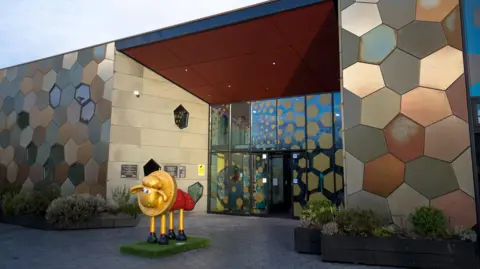 The Royal Mint
It was an unpopular quandary which successive governments dodged for over a century, but on 1 March 1966, Prime Minister Harold Wilson finally grasped the nettle... Britain would be going decimal.
£1 would no longer be worth 240d, but 100 new pence.
Nowhere was the upheaval felt more strongly than in the south Wales valleys where a 38-acre site was created in Llantrisant so the Royal Mint could meet demand for the new currency.
Since then, it has continued to adapt to the times, facing the challenge of an increasingly cashless society by diversifying into jewellery, commemorative coins and medals and even reclaiming precious metals from E-waste.
Once the decision was made, next came logistics - where would all these coins be made?
Chris Barker, Royal Mint historian, said Belfast and Durham were also frontrunners, but "in many respects, Llantrisant was regarded as the lesser of several evils".
"From a civil engineering perspective Llantrisant was hopeless - the ground was hilly and boggy, and really difficult to locate heavy machinery."
Importantly, it did have several things going for it.
These included its relative proximity to London by rail and the M4, experience of former workers from the tin and copper industries in south Wales and the backing of Chancellor and Cardiff MP, James Callaghan.
In a rare example of management and worker solidarity, Jack James – deputy royal mint master – opined that it would be difficult to entice overseas clients to Durham, while the London workforce, many of whom would have to relocate, called Llantrisant "the least obnoxious of all the sites under consideration".
Spades were in the ground by 1967 and Queen Elizabeth II officially opened the site in December 1968.
By decimalisation day on 15 February 1971, it was already producing 80% of all new coins.
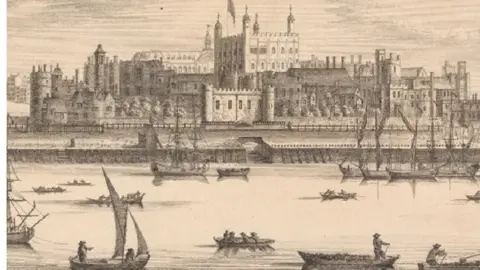 The Coins and History Foundation
The Royal Mint can trace its earliest roots back to Alfred The Great in the 880s and Barker said, in 1279, a number of medieval mints around the St Paul's area were consolidated into the Royal Mint within the Tower of London, protected by walls and a garrison.
In the 1810s it relocated to Tower Hill but by the time of decimalisation the lack of space in London and the need for more modern machinery necessitated a move away from the capital to cope with the increased demand for coins.
Probably the Royal Mint's most famous master was celebrated scientist Sir Isaac Newton, who engaged in a decade-long cat-and-mouse battle with notorious coin-clipper and counterfeiter William Chaloner.
It did not end well for Chaloner, who was sent to the gallows in 1699.
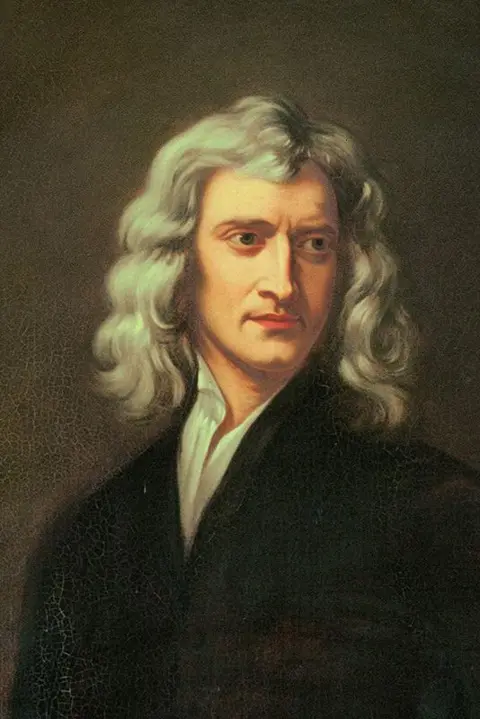 National Portrait Gallery
"Counterfeiting was such an issue because it undermined the public's faith in the coins they had in their pocket" said Barker.
"People such as Chaloner had to be seen to be put to death in order to uphold the value of the currency.
"But Isaac Newton also pursued preventative measures such as the Great Recoinage, whereby centuries-old flat silver coins were recalled in order to remelt them into thicker coins with milled edges, which were far harder to clip, or forge because of their distinctive designs."
The Royal Mint has continued to innovate, with the bimetallic £2 coin and 12-sided £1 coin both believed to be the hardest in the world to counterfeit.
Other unique Llantrisant inventions include the "equilateral curve heptagon" 50p proposed by Hugh Conway, managing director of aircraft manufacturers, Bristol Siddeley Engines.
Its end-over-end seven-sided design was specifically engineered to tumble through a vending machine.
Barker said it was based on rotary fighter engines designed by Felix Wankel, a German mechanical engineer "whereby when a point was facing down, there would be a flat surface on the opposite side to keep it perpetually rolling".
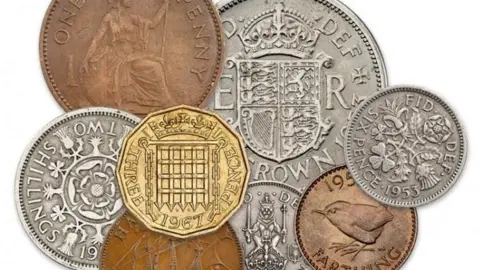 Copes Coins
One of the more unusual items to be seen at the Royal Mint's visitor centre are commemorative coins struck from bullion retrieved from the shipwreck of the SS Gairsoppa.
It was sunk by German U-boats off the coast of Ireland 70 years ago as it sailed from South Africa to the UK.
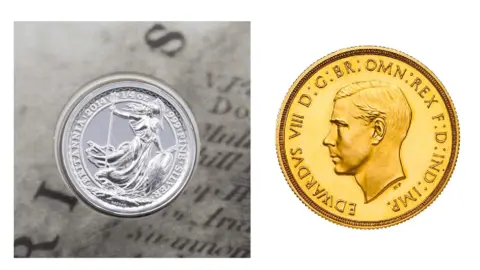
However, by far the rarest exhibits are 1936 Edward VIII coins - prototypes when the King abdicated after just 10 months, before they could ever go into circulation.
But what now for a society turning its back on traditional money?
 The Royal Mint
Even before Covid, the world had witnessed a dramatic decline in the use of coins.
Having previously provided currency for over 60 nations, in 2024 the Royal Mint manufactured no new coins for the British market for the first time in its history.
In order to survive, it has instead diversified into commemorative coins and medals, including the contract for the London 2012 Olympics.
"In common with other games, every gold medal was in fact silver, coated in gold-plating, but did contain 8g of pure gold," said Barker.
"The coins and bars we offer depend on the market. Investors, who are looking purely for the financial value can purchase once-struck gold and silver, but for those who place more importance on the designs of our brilliant artists, we offer coins of less purity, but of far more aesthetic appeal."
 The Royal Mint
It might surprise you to learn that the typical phone in your pocket may contain more precious metals than the nine-carat ring on your finger.
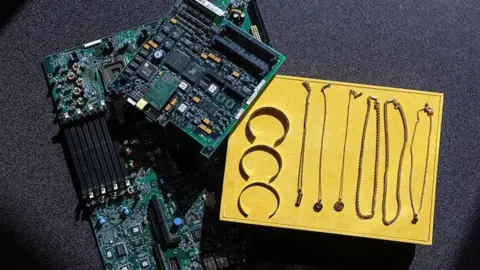
Working with a company in Canada, the Royal Mint extracts "huge amounts of precious metals from the electronic waste we all chuck out every day".
Barker said this "cold chemical process" means not having to melt down the metals, thereby avoiding the usual energy demands and associated pollution with traditional metal reclamation.
A jewellery range, named 886 after Alfred the Great's first mint is made from the wires of devices which might have otherwise gone to landfill.
"We hope it is the sustainable and profitable future of the Royal Mint," said Barker.
