The hidden vaults bringing a city's past alive

 Canterbury Archaeological Trust
A hidden vault discovered under a public square in Canterbury could be the resting place of an 18th Century vicar and poet, experts have said.
The brick‑lined chamber, found during improvement works at St Mary Bredman Square, may belong to the Reverend John Duncombe — but archaeologists stress the link is tentative.
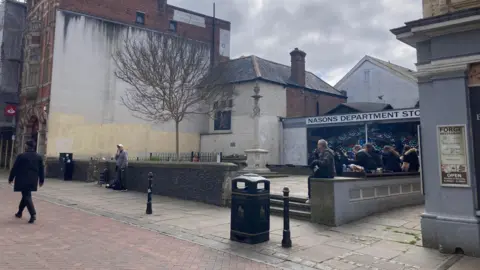
The "empty void" is one of at least 14 vaults investigated in the city at three church sites. It was found when paving stones were lifted near the former Nason's department store.
The find prompted the city council to call in Canterbury Archaeological Trust, who recorded the structure, but did not excavate it fully to protect what was there.
 Canterbury Archaeological Trust
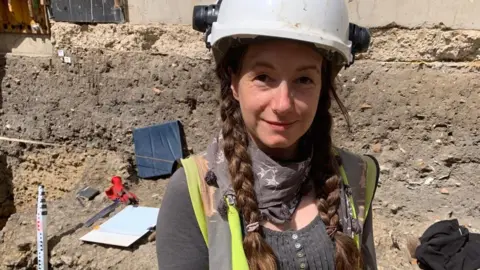
Archaeologist Jess Twyman said a late-18th Century description of monuments in the church recorded a ledger, or grave slab, dedicated to Duncombe, who died in 1786, aged 56.
Initial research has shown he was vicar of St Mary Bredman and a poet who also wrote about archaeology.
"We cannot say for sure that it is his vault, but it's possible," she said.
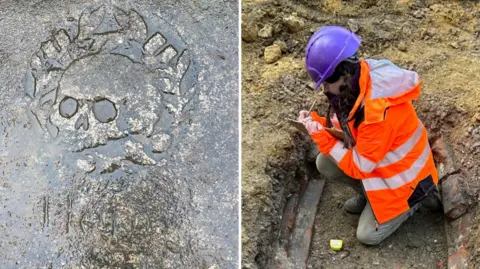
The team found the vault measured 2.5m by just under 1m and lay just in front of the altar, indicating it was for a prominent citizen.
A separate grave slab with a carved skull and laurel wreath - a "memento mori" design - was also found but is not linked to Duncombe.
 Canterbury Archaeological Trust
Twyman, who has worked for the trust for 25 years, said she was fascinated by burials, although her colleagues were not so keen.
"The most important thing to me is looking at people's lives, how they lived in the past," she said.
She was aged five or six when medieval skeletons were discovered at her primary school, prompting an excavation. It inspired her to follow the same career.
 Local Democracy Reporting Service
Fourteen vaults have been examined at three church sites across the city, and Twyman said there could be more.
Her colleague Mark Houliston said churches tended to "spring up" in cities from the late Saxon period, and Canterbury ended up with about 25 parish churches within its walls, with some, like St Mary Bredman and St Mary Magdalen, now revealing their pasts.
Canterbury City Council's Connected Canterbury project is using government cash to spruce up "unloved" areas, Houliston said.
The project includes work to tell Canterbury's story and Twyman has seen firsthand how people are still curious its history.
"If there's a hole, everyone peers in it," she said. "They want to know."
 Canterbury City Council
The church at St Mary Bredman Square took its name from a nearby bread market, and was once known as St Mary Fishman, because of a fish market that was held nearby, Houliston said.
It was demolished in 1900 after being declared unsafe.
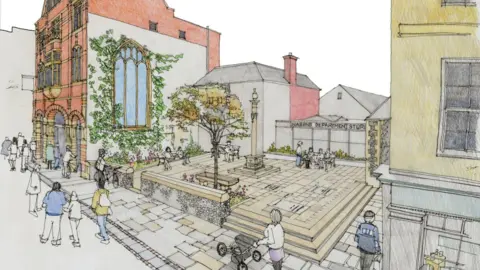
The square, currently home to a war memorial and flowerbeds, is to have its past brought alive with the creation of a mural showing a church window.
The revamp will see new flowers and trees being planted and benches erected to provide a place off the busy high street where people can have a moment of serenity and calm.
Follow BBC Kent on Facebook, on X, and on Instagram. Send your story ideas to southeasttoday@bbc.co.uk or WhatsApp us on 08081 002250.
