How I changed my personality in six weeks

 Emmanuel Lafont
Based on emerging research showing people can shift their core personality traits, Laurie Clarke tried tweaking hers. Here's what happened.
When I noticed a recurring itch in my hand a few months ago, I immediately remembered an article I'd once read about people with mysterious itches so maddening they scratch and claw until they tear through their own flesh – sometimes disabling or even killing themselves in the process. I thought, panicked, "that's probably about to happen to me".
I experience similar episodes on a semi-regular basis. So it wasn't entirely surprising when I scored higher than 85% of people on neuroticism in a personality test I took online. I've been neurotic since my teen years, when I suffered my first panic attack. It is dimming with age, thanks, I believe, to my own piecemeal interventions: reducing self-criticism, trying not to agonise over every social interaction and the multifarious ways in which I surely humiliated myself, and so on.
Then my editor offered me an intriguing assignment: would I like to try tweaking some aspects of my personality, drawing on emerging research from the field of personality change? (Given we've never met face to face, I didn't take this personally.)
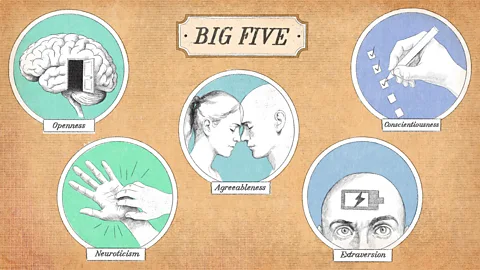
The psychological model for personality with the most scientific backing is the "Big Five", which breaks it down into five dimensions: openness, conscientiousness, extraversion, agreeableness and neuroticism. Each is further subdivided into traits, so neuroticism, for example, includes excessive worrying, rumination and emotional instability; extraversion includes assertiveness and gregariousness.
Psychologists once assumed personality was pretty intractable. "Some of my colleagues back in the 80s argued it was fixed by the age of 30 and things like that," says Brent Roberts, a professor of psychology at the University of Illinois at Urbana-Champaign in the US and one of the most influential personality researchers. "A lot of research has emerged in the last three decades that has moderated that position."
Psychologists have found that people tend to become less neurotic and more conscientious and agreeable over the course of a lifetime. Researchers now think these changes "result from both biological maturation and the accumulation of life experiences that encourage grown-up responsibilities", says Mirjam Stieger, a researcher in personality change at Lucerne University of Applied Sciences and Arts in Switzerland.
In recent years, psychologists have carried out more studies on personality change, and newer research indicates we can expedite this effect through conscious choices. A growing number of studies suggest that with targeted interventions, we can achieve the degree of personality change typically seen over a lifetime in just a few months. For my own experiment, I only had six weeks.
My first port of call was an online personality test to assess where I currently scored on the Big Five. It turns out that in addition to sky-high neuroticism, I'm also very "open", scoring in the 93rd percentile (meaning I'm more open than 93% of people). Openness indicates receptivity to new experiences and ideas, so I took this to be generally positive. My conscientiousness was also very high – little surprise since I was an inveterate striver at school and still exhibit an unfortunate tendency towards perfectionism.
My agreeableness wasn't bad, but it wasn't great. High scorers in agreeableness tend to be considerate, cooperative, trusting and well-liked. I scored in the 50th percentile. There were a few questions I wish I could've answered differently, but I wasn't quite there yet. I begrudgingly agreed that I was generally "suspicious of others' intentions'" and disagreed that I have "a forgiving nature".
 Emmanuel Lafont
My neuroticism might be the worst thing about my personality, but it's far from the only thing I'd change. Like many bookish introverts, I grew up menaced by the idealised image of the extraverted social butterfly, flapping its giant wings obnoxiously near my fragile self-esteem. At one point I thought I might eventually become one, but long ago acquiesced to the knowledge that this would never be.
Even so, a little more extraversion couldn't hurt – especially given that I recently moved to a new city where my partner and I don't know anyone and are keen to make friends.
Typically, people want to become more extraverted and conscientious, while being less neurotic. I wanted to become a little more extraverted, much less neurotic and a little less conscientious insofar as it pertains to perfectionism. I also wanted to become more agreeable, because I think a lack of trust in others is one of the things that sustains my neuroticism. Conversely, a lot of people say they want to become less agreeable because they associate the quality with being a pushover, says Roberts. (It's true that less agreeable people tend to earn more money).
Studies show that socially desirable changes to our personalities could transform our lives for the better. Lower neuroticism and higher extraversion in particular are linked to higher life satisfaction. But how to go about it?
A 2019 study led by personality psychologist Nathan Hudson from Southern Methodist University in Texas looked at whether an active intervention could shift target traits over time. The researchers asked student participants to pick aspects of their personalities they'd like to change and then complete weekly challenges "that would pull their thoughts, feelings and behaviours in line with their desired traits".
At the end of 15 weeks, the results indicated the students were able to effect small but statistically significant changes in their desired traits including extraversion, conscientiousness and neuroticism, but not openness or agreeableness. Those who completed more challenges underwent the greatest transformation.
Stieger conducted a similar intervention supported by a smartphone app in 2021, which also produced desired changes in extraversion, conscientiousness, neuroticism and agreeableness, but not openness. The alterations persisted at a three-month check in.
From Hudson's paper, I cribbed a set of activities to encourage change in each of my target personality dimensions. Here's a sampling from all of them:
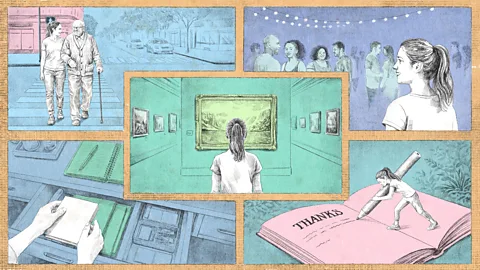
• Decreasing neuroticism: Start to meditate daily, write a regular gratitude journal, try to counter a negative thought with a positive one – or merely write the thought down and how it makes you feel.
• Increasing extraversion: Go to events to meet new people, say hello to a cashier at a shop, open up and honestly tell a friend how your life's going right now.
• Increasing agreeableness: Do a small kindness to someone close to you, when you intend to say something mean about someone say something positive instead, if someone does something irritating come up with three external factors that might explain their behaviour (e.g. "they were having a bad day") rather than internal factors (e.g. "they're a bad person").
• Increasing conscientiousness: Pay a bill as soon as you receive it, organise and clean up your desk, spend 30 minutes writing down a list of your short term and long-term goals.
• Increasing openness: Read a news story about a foreign country, go to a poetry reading, visit a museum or gallery.
The interventions rely on a mixture of adapting thought patterns and attitudes and testing out new behaviours. The overarching logic is, if you want to become somebody different, start thinking and acting like them. Put another way: fake it until you make it.
 Emmanuel Lafont
Researchers usually focus on interventions lasting a few months, so to speed things up for my six week timeframe I prioritised activities that ostensibly targeted several personality traits at once. By going to a yoga class or opening up to a friend, for example, I could improve my neuroticism, agreeableness and extraversion simultaneously.
I was frankly too afraid to try some of the activities. "Offer to get someone in line's coffee at a café" made me concerned the target would think I was clumsily flirting with them or covertly filming them for one of those insipid feel-good YouTube videos. I'd need so many drinks before striking up "a conversation with a stranger at a bar" that the deleterious health impacts would surely outweigh any lift to mental wellbeing.
And self-affirmations are always going to feel ridiculous if, like me, you hail from a long line of emotionally parsimonious Scots. I did say "I choose to be happy today" out loud, but not without a self-effacing smirk.
I tried out as many of the activities as I could. I'd dragged myself along to a few social activities in my new city in summer but was on the cusp of retreating into hibernation when I received this assignment, which encouraged me not to give up for the year. I made a renewed effort to attend local activities, as well as to see friends who live nearby and to arrange phone calls with those abroad.
I thought attending meetups with strangers would be enormously disruptive to my hermetic home-working existence, imagining I'd need days to convalesce after attending a new book club. In fact, the opposite was true. The more events I attended, the easier it became.
I went to a life drawing class that I'd enjoyed a few months prior but hadn't returned to. Last time, during the break, I had contorted myself defensively around my phone while people milled around with glasses of wine. This time, I adopted a friendly posture and found engaging with people surprisingly natural. At a yoga class near the end of my six weeks of experimentation, I found myself doing something almost unheard of: I spontaneously initiated small talk with the person one mat over.
I also began meditating and writing a gratitude journal nearly every day. The meditation turned out to be revelatory. At first it was near impossible to silence the din of thoughts. As well as the classic intrusions about what I needed to do that day, there was also a relentless rabbity commentary on what I was experiencing moment-to-moment while attempting to meditate.
The incontinent babblerer at the steering wheel of my mind seemed to fear being asked to step out of the vehicle for a while – scared, perhaps, that it wouldn't be allowed to return. But after my partner suggested I visualise it not as leaving the vehicle but simply cutting the engine, I stopped fearing the silence. I also began to see the merit of encouraging its spread to parts of my life that were otherwise characterised by a frenzy of nervous chatter.
To improve neuroticism, "you target people's willingness to experience emotions", says Shannon Sauer-Zavala, associate professor in psychology at the University of Kentucky in the US. Shesays that neurotics chronically avoid emotions, as well as lambasting themselves for feeling the way they do.
Sauer-Zavala is working on an intriguing approach to treating mental health conditions through personality-targeted interventions. "If we target neuroticism instead of general anxiety disorder, social anxiety, panic disorder, eating disorders etc, it's just more efficient," she says. So far, results indicate the approach is effective.
 Emmanuel Lafont
Neuroticism is not the only personality dimension that can cause psychological vulnerabilities. Sauer-Zavala says high levels of conscientiousness can tip into perfectionism, something I relate to. The interventions Sauer-Zavala suggests for this make my skin crawl: "Figure out what 80% of your best job is, do that and stop there and see what happens," she says. "Or send an email with a typo, or leave work at five o'clock every day this week. It's usually the most anti-climactic thing."
I compulsively check and re-check any bit of work or correspondence before I send it off. After Sauer-Zavala's comments, I try to stop myself before doing a final-final-final check on a bit of corporate work, and just send it. I can't help opening it once more afterwards and spot what I see as a glaring error, the close repetition of a certain word. I feel a pang – see! But of course she's right, it doesn't matter in the slightest, and I quickly forget about it.
By the end of my six weeks of experimentation, I didn't feel radically different, but I did feel pretty good. The moment had come to re-take the test. Early on, I sensed that I might evince some changes. In answer to a question about whether I was "outgoing and sociable", I felt sure I would have previously disagreed. This time, I had six weeks of unignorable data in front of me. Objectively, I had socialised, often with strangers, and had a not bad time. So maybe I was sociable after all. The researchers were right that acting in a certain way can change your perception of yourself.
More like this:
• Our 2,500-year-old mania for personality types
• How birth order shapes your personality
• How your personality changes as you age
Answering questions like this helped push me from the 30th percentile on extraversion to the 50th. On agreeableness, I also hugely improved, shifting from the 50th to the 70th percentile. It seemed that thinking nice things about people had indeed made me more positively disposed to humanity. On neuroticism, I showed a marked improvement, dropping from the 83rd percentile to 50th. I stayed roughly the same on conscientiousness and openness.
Throughout the six weeks, I was still frequently besieged by self-doubt and afflicted by a number of ridiculous health paranoias. But I felt more able to treat these for what they were – passing ephemera that didn't have to hold any grander significance. Sometimes clearly articulating the worry in my head was enough to render it untenably ludicrous. Keeping the gratitude journal reminded me that not long before I had found things to be positive about, and likely would do again.
This was, of course, a highly unscientific study of one, but I still feel compelled to highlight several potentially muddying factors in the results. For one thing, I had wanted to change for the sake of this article, which could obviously have influenced the results.
In addition, I re-took the test the day after I'd attended a new local meet-up for writers, and the evening before that I had met a friend for dinner. I was flying high off recent social successes; it was sunny and I was in a good mood. If I retreated back into monastic solitude and ditched the journalling, could I undergo backsliding over the coming months? It's certainly possible.
Still, my results were roughly in line with those obtained by personality studies to date. Stieger's study, for instance, found personality traits shifted in the desired directions by an average of half of a standard deviation, the equivalent of shifting from the 50th percentile to the 65-70th percentile.
In a limp gesture towards scientific rigour, I asked my partner to complete the test alongside me at the beginning and the end of the six weeks. He was my "control" subject; he hadn't done anything to try to change his personality. At the end, his results came out pretty much unchanged: very high neuroticism, high openness, middling agreeableness and extraversion, and low conscientiousness.
With even the most effective personality interventions, it's important not to overstate the impacts. The greatest changes recorded by studies to date are "huge…by researchers' standards" says Roberts. "Is it huge from a layperson's perspective? Probably not. It seems, generally speaking, most people stay mostly the same."
And although the vast majority of people profess to want to change at least one aspect of their personality, those who will put the effort in are surely far fewer. When my partner learns of my results, he is impressed. "So I could change if I wanted to?" he muses. He reflects for a moment. "I don't feel like it though."
--
For trusted insights on health and wellbeing, sign up to the Health Fix newsletter by senior health correspondent Melissa Hogenboom who also writes the Live Well For Longer and Six Steps to Calm courses.
For more science, technology, environment and health stories from the BBC, follow us on Facebook and Instagram.
