'She's a beast': Jennifer Lawrence's extreme new role is a radical portrayal of a woman on the edge

 Mubi/ Kimberley French
Die My Love features a full-throttle performance from the Oscar-winning actress as a young mother having a mental breakdown. It's an extraordinary depiction of the challenges women can face.
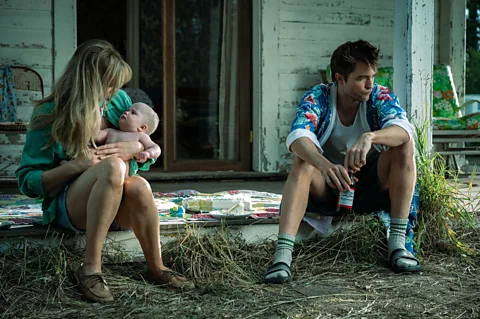
In subversive Scottish film-maker Lynne Ramsay's latest film Die My Love, Grace and Jackson are a young, seemingly loved-up couple who move from New York to the Midwest to take on a giant fixer-upper of a country house. At the start, they dance, they have sex, they talk about the writing Grace (a firecracker Jennifer Lawrence) will do and the music Jackson (Robert Pattinson) will make. And then, in an abrupt cut forward by six months, we see that they have made a baby boy instead.
A couple moving to an isolated house in the country, only for things to unravel in strange and terrifying ways, sounds like the premise of a horror movie. But Die My Love is only a horror movie in theory: it's actually a domestic drama about a young mother who is slowly having a mental breakdown, aided and abetted by a clueless, philandering husband, a steep drop-off in sex, and crushing writer's block which has left her glassy-eyed and sunken into herself.
 Mubi/ Kimberley French
But this isn't a solemn tale of a woman with fraying nerves; it's vivid, alive, sexy, and funny at times. Grace waves her bottom in her boyfriend's face as they fight; he buys her the world's most annoying dog. "With mental health films – people expect them to have this serious tone," Lynne Ramsay tells the BBC. "I think there are other things in this film. You wonder if Grace is more free than any other character in the end. Jennifer's a natural comedian, you know. So it brought this lightness to it that I loved – the character of Grace is really fierce and unapologetic."
A remarkable heroine
Zipping around the house in a state of manic boredom and misery, with one hand down the front of her shorts half the time, Lawrence is a ball of animalistic energy, unwashed and uninterested in politeness or feminine expectation. It's a remarkable, unselfconscious performance from the Oscar-winning actress. Based on Ariana Harwicz's slim, harrowing 2012 novel of the same name, Ramsay's film is a departure from the source material in several major ways, but her thesis of a specifically female kind of mental breakdown – one which feels brewed in the cauldron of social expectation, male obliviousness, and toxic heterosexual relationships – is the same. Miranda Christophers, a psychosexual and relationship therapist, tells the BBC: "It's important that there's mental health support for women after they've had children, especially. At specific points in a female's life, there's a need for more support in a way that might differ to men – around pregnancy, postnatally, or around menopause. There's a need for more tailored support." This is not, unfortunately, support that Grace receives.
Grace struggles with her formless countryside days at home while Jackson is away for work – she grows abrasive and erratic, masturbating constantly, keeping her baby awake at strange hours, living in squalor and thrumming, insistent rage. She eventually graduates to vicious fights with Jackson and to actual self-harm.
"You're not always sympathising with her, but you're with her," Ramsay says of her whirlwind protagonist. "She's insufferable, but he still loves her. And she doesn't feel sorry for herself. She's a beast. She's a punk. There were elements of that character in the book where instead of being apologetic, she's like a fierce wild animal."
Throughout the film, people around Grace keep offering her advice and opinions ("Babies are hard", or "If you get a screamer…"), to her total disdain. Even her kindly, well-intentioned mother-in-law, played by Sissy Spacek ("We all go a little loopy in the first year") cannot force this square peg to fit back into a round hole. Although some critics have seen Die My Love as a story about postpartum psychosis, Ramsay has strongly resisted that reading. For her, the film has a broader subject than motherhood: "They're not having sex anymore, she's not writing anymore, and that's related to this baby who changes everything. But it's also scenes from a marriage, from a relationship disintegrating. So I think it's about many things."
Anna Bogutskaya, film critic and author of Feeding the Monster: Why Horror has a Hold on Us, and host of The Final Girls podcast, agrees. "I think the film is about so much more than postpartum," she says. "It's about relationships, and creative relationships specifically, the tension that exists between the desire and need to create and the responsibilities that come with a house, a child, a partner…"
 Alamy
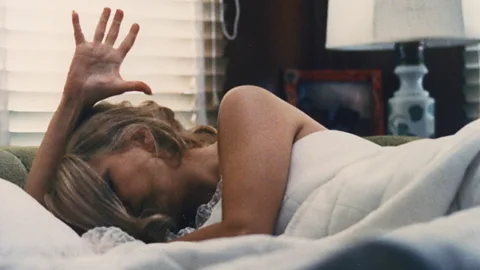
AlamyIndeed, in a scene where Grace speaks to a therapist and it's suggested that adjustment to motherhood is an issue, she snaps back with abrupt, solid certainty. "I don't have a problem attaching to my son. He's perfect," she says. It's "everything else" that's the problem, she adds.
Depictions of women on the edge
Grace's story represents, in an extreme fashion, the mental health pressures that can face women specifically. Across the West, there have been progressive moves towards reducing the domestic burden placed on women, but there remains a reluctance from men to take paternity leave, for example. Meanwhile, a 2022 US report found that the prevalence of mental illness is higher among women (26.4%) than men (19.7%), and women's hormonal disorders – PCOS, PMDD, and post-partum psychosis among them – remain understudied and underdiagnosed.
Die My Love emerges from a long legacy of artwork focusing on mental illness in women and how it is so often exacerbated by their relationships with domesticity, men, and family – from Sylvia Plath's 1963 novel The Bell Jar to John Cassavetes' 1974 film masterpiece A Woman Under the Influence. Starring Gena Rowlands as Mabel, a Los Angeles housewife who is "wacko", to use the expression of Peter Falk's helpless husband, the film reveals both a deep devotion and a total gulf in understanding between the pair. As the film suggests, the more men attempt to sculpt or "fix" their wives – who are failing to conform to what's expected of them – the worse it can be. It also depicts the male doctors treating Mabel as dismissive or glib, speaking to the long history of medical misogyny that has made women wary of seeking support.
But the thread of both medicine and marriage as twin oppressors of mentally ill women goes back much further, to the era of "melancholics" and "hysterics". In Charlotte Perkins Gilman's classic 1899 short story The Yellow Wallpaper, a young mother struggling with her mental health is locked away and forbidden even from intellectual activity by her male doctor and her husband. As a result, she slowly loses her mind entirely. Women writers from Anne Sexton to Sylvia Plath have charted their time in and out of psychiatric care, and the specificity of their womanhood within that experience. (That is to say: belittled, second-guessed, minimised, and treated like a problem to be solved.)
In AMC's beloved 1960s-set series Mad Men, "perfect" housewife Betty Draper (January Jones), depressed and demoralised by her inability to settle into what she is told is an ideal life, seeks a psychiatrist – only for her domineering husband to secretly listen in on her sessions. While in 2025, genuinely compassionate, female-led mental health services are increasingly prevalent, providing crucial and life-saving resources for women who are suffering, it is still a slow road to progress – as reflected by a wave of recent films.
"The last decade of horror is filled with anxious female protagonists," agrees Bogutskaya, citing Swallow (2019) and Watcher (2022) as examples. "As [1940s] women's pictures were in their time, the paranoid woman's horror is concerned with the drama of the domestic – and with giving validity to the emotional and mental toll placed on women by being forcibly folded into an image of perfection as defined by their partners or parents."
Die My Love depicts female "madness" as unhappy and dangerous, but also looks askance at the husbands and families who by turns either ignore these women, institutionalise them – or are simply embarrassed by them. Socially, Grace is a pariah. She snaps rudely at an overly friendly cashier; she asks her mother-in-law morbid questions about a family suicide; she can't behave at parties, chugging wine and stripping off her clothes at random. Jackson tells her she not only embarrassed him, but has embarrassed "us". Her response is to try to jump out of his moving car. As Grace's behaviour grows more noticeably outrageous, almost consciously "crazy", you begin to wonder if she is responding to how people are treating her as much as anything else.
 Getty Images
As Suzanne Scanlon, author of Committed: A Memoir of Finding Meaning in Madness, writes, sometimes such erratic behaviours are in direct response to feeling ostracised and pathologised to begin with. "When you don't listen to yourself, when you place your trust and authority elsewhere [...] this is what can happen: You are seen as mad, you begin acting mad."
More like this:
When it comes to Pattinson's Jackson, Ramsay points out: "He totally loves [Grace], but he doesn't know how to handle her… he wants to help her and doesn’t know how." Rather than taking a rancorous view of this useless husband, Ramsay presents him almost as a victim of his own obtuseness – someone who wants to do right by the woman he loves in spite of it being far past his capacity.
There's a sense that Grace is locked in a battle with herself and her role in her family; it makes for a love-hate situation where her biological, sexual or romantic urges are in direct opposition to her creativity and happiness. "Yes, she probably does need help. But she also finds a kind of freedom [in her erraticness]. Maybe that's sanity. It can be very sane to see the truth, or say the things that nobody else will say," Ramsay points out. "She may be spiralling, but it doesn't mean she doesn't see an essential truth. It doesn't mean she's not funny. It doesn't mean she doesn't have this essential, absurd laughter at life. I think it's more three dimensional." She pauses. "What is sanity? Who is sane and who is insane?"
For Grace, that's a pertinent problem – and the space Ramsay allows her makes for one of the most heartbreaking, funny and feral film performances from a woman in recent memory.
Die My Love is in UK and US cinemas from 7 November.
--
If you liked this story, sign up for the Essential List newsletter – a handpicked selection of features, videos and can't-miss news, delivered to your inbox twice a week.
