Hanoi's most popular street could kill you

 Alamy
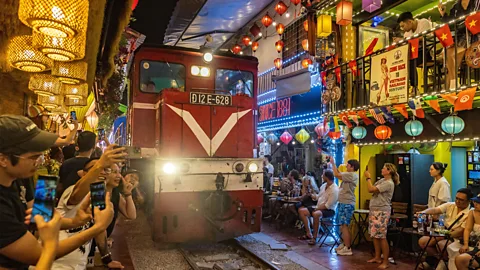
AlamyTrain Street started life as a razor-thin alley with a train rushing through it. Now, it's swarmed with Instagrammable cafes and tourists who can't stay away, despite the risks.
A train chugs through Hanoi, approaching a narrow passageway festooned with Chinese-style lanterns. Just as it screams into the station, a tourist jumps onto the tracks, attempting her most social-media friendly pose. Moments before the train strikes, its horn blaring into the humid air, she recoils to safety. Click, post.
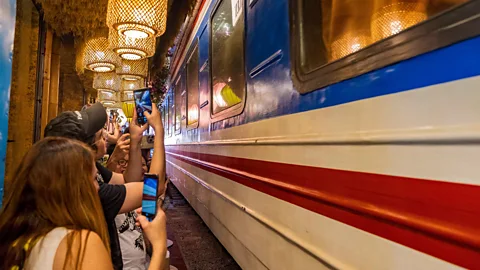
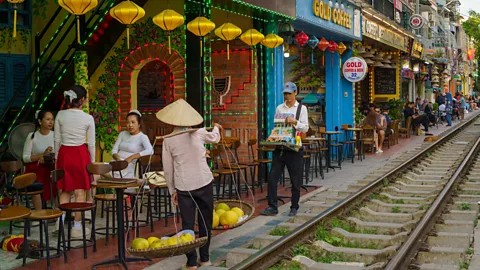
It's just an ordinary day on Hanoi's Train Street, a 400m stretch of railway flanked by cafes where tourists nurse beers and watch, mesmerised, as trains roar past them at dangerously close proximity; sometimes crashing into tables and chairs.
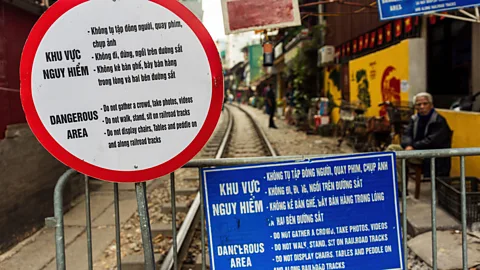
Fun? Evidently – in a few short years, Train Street has entered Vietnam's pantheon of "must-see" attractions, along with Ha Long Bay and the Cu Chi Tunnels. But the Vietnamese government is less impressed; since the site went viral in 2017, it has attempted various shutdowns, first in 2019, then 2022 and most recently further investigations and crackdowns in 2025 after an incident where a selfie-snapping tourist was nearly dragged under an oncoming train's wheels. Police barricades go up between train arrivals; edicts are issued to tour operators and bar owners.
The tourists come anyway.
 Alamy
AlamyFrom ordinary to unmissable
How did an ordinary street become one of Vietnam's hottest tourist attractions? It started innocently enough.
The North-South Railway was built by colonialist French forces in 1902, connecting Hanoi to Ho Chi Minh City. Fifty-four years later, the General Department of Railway erected a series of squat buildings straddling a stretch in central Hanoi to house employees. By the 1970s, the area was considered a slum; residents regularly roused out of their sleep by trains rumbling through, their houses quaking.
"It was just an ordinary street with train tracks running through it," said Minh Anh, a lifelong Hanoi local who works at local whisky distillery, Về Để Đi'. "When it started popping up all over social media, I was honestly surprised."
Nhi Nguyn, a tour guide for A Taste of Hanoi, used to walk tourists through, just before it exploded in popularity. "People were still living ordinary lives there back then and there weren't so many cafes next to the tracks," she said. "It had a much more authentic feel: scooters were locked up just meters from the tracks, laundered clothes hung outside, and people were cooking outside on small gas stoves."
 Alamy
AlamyIn early 2013, Colm Pierce and Alex Sheal, co-founders of Hanoi-based photography tours Vietnam in Focus, launched a Hanoi on the Tracks tour to show visitors how local residents had adopted to the locomotive-sized challenge of living on railway tracks. Serendipitously, in June 2013, Instagram launched its new video-sharing feature. A year later, the Travel Channel show "Tough Trains" featured Pierce walking down Train Street with a camera crew, further enticing travellers.
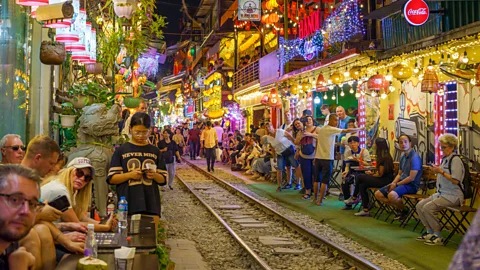
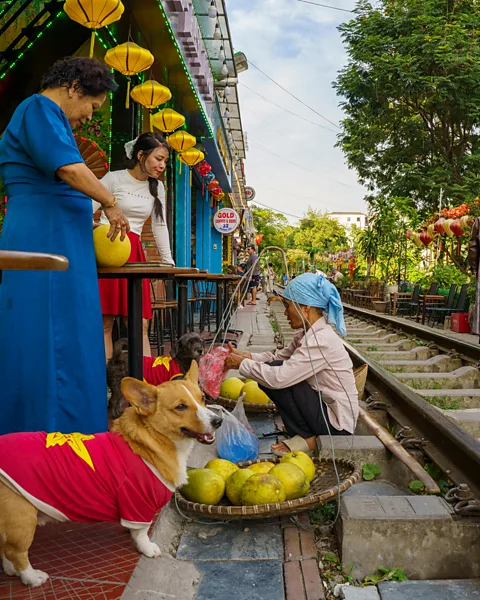
In 2017, an enterprising resident started selling beer and coffee, inviting curious tourists to stay to watch the train go by. Neighbours noticed the economic opportunity and cafes and bars rapidly spread. Soon, the formerly derelict alley, now dubbed Phố Đường Tàu (literally: "Train Street") became bedecked with colourful lanterns and Christmas lights. Visitors learned to time their arrival for 30 minutes before a scheduled train and the "classic" Train Street experience was cemented: upon entering the tracks, tourists were shepherded into rail-side bars by local merchants and plied with beers and coffee, until the train shrieked through, rattling plates and causing hearts to pound.
Julia Husum, a university student from Norway, visited Train Street in February 2026, and "loved" the experience. "We put our beer caps on the railway, and the train flattened it, creating souvenirs for us," she said. "I'd go back again."
Instagram star
Without the advent of social media, would Train Street have become popular? As a travel writer, I've witnessed dozens of would-be influencers' death-defying acts, like scaling down a rocky cliff above Dubrovnik and standing atop the side wall of 14th-Century Charles Bridge in Prague; wistfully looking off into the distance as the camera flashes. I've come to conclude that Train Street is no different; here, too, visitors risk their own safety for a picture-perfect opportunity.
 Ivana Larrosa
"Essentially social media has fuelled Train Street into what it is today, [where] tourists flock in droves to the area to feel the adrenaline of the passing train while sipping local coffee," echoed Michael Stanbury, the creative director for Vietnam in Focus. "Even without the train, the Instagrammable decorated street holds a very Hanoian charm."
Locals debate; the government proposes halting passenger trains for good. And each attempted shutdown, tourists climb past the barricades. There are, to date, more than 100,000 posts tagging Train Street on Instagram. Men's grooming blogger Adam Hurly visited because a friend had hyped it. "It felt more like an Instagram attraction rather than a neighbourhood street," he admitted, noting that once the crowds arrive, it becomes congested and less enjoyable, "Especially if you're just standing on the main sidewalk trying to get a picture."
He added: "It's one of those places that looks better in photos than it feels in reality."
But Matthew Tran, an artisanal footwear designer who visits Hanoi regularly, loves the pull of Train Street.
"The coffees were absurdly overpriced, yet I paid for them every time because I couldn't stop marvelling at how the place worked; how an entire economy could thrive in such an improbable space," he said. "These vendors built something real out of something most people would call chaos – that, to me, is worth coming back for."
 Ivana Larrosa
He offers advice for future visitors: "It's a unique experience you won't get anywhere else. Although I wish more visitors would stop for a moment and remember that while it's a tourist attraction to them, living beside those train tracks is someone else's daily reality."
The eternal human fear of missing out
Under more superficial reasons, visiting Train Street is similar to the appeal of visiting the Eiffel Tower during someone's first visit to Paris, said Charlotte Russell, founder of The Travel Psychologist.
"Humans are a social species and if we perceive that other people are enjoying an experience, it is natural for us to want to do it too," she said. "This goes back to our evolution, when we lived in small groups and it would be advantageous for us to emulate other people in this way. So the sense of fear of missing out that we experience when seeing other people visiting places like Train Street is part of being human."
More like this:
Bearix Stewart-Frommer, an American pre-med student, validates Russell's theory: "I found out about Train Street from my mum," she said. "I didn't have some deep motivation to see it, but I was curious because it's one of those quirky, very photogenic spots that people talk about on social media."
But there may be a more deep-seated reason why we're lured to such places, Russell notes: "With Train Street specifically, the risk element is part of what makes it so novel, especially those of us from countries like the UK… We are used to regulation and precaution, railings, barriers and painted lines that we must stand behind. In contrast, Train Street can feel unbelievable to see and experience… [it helps] us reflect on our own norms and realise that other perspectives do exist."
 Ivana Larrosa
Local tour guide Phuong Loan Ngo offers one such alternative perspective: "The economic boost is undeniable, giving families who live along Train Street financial opportunities," she said. "On the other hand, there are cultural challenges too. When an area becomes a 'spotlight' for social media, a place's historical and cultural heritage can get lost. Instead of learning about how this railway has functioned since the colonial era, people often leave with only a photo, missing the true soul of the neighbourhood."
The irony is that Vietnam in Focus has now moved their photography tours to another, far-less trammelled part of the railway, so they can show visitors that old, track-side way of life.
"As with all good things, the popularity of Train Street and the crowds it attracts are spreading," said Sheal. "Thankfully, we have scoured Hanoi and found a fantastic local market that runs along the Hanoian railway further out in the suburbs – a new attraction."
That is, until the social-media-obsessed travel masses find out about it. For better or worse, the unbearable lightness of Train Street is a permanent, but moveable feast.
--
If you liked this story, sign up for The Essential List newsletter – a handpicked selection of features, videos and can't-miss news, delivered to your inbox twice a week.
