'The ghost of the mountain': The former Soviet reserve where snow leopards roam

 India Latham
In a historic former Soviet reserve in the magnificent Uzbek mountains, Michaela Strachan and India Latham find rare signs of the world's most elusive feline.
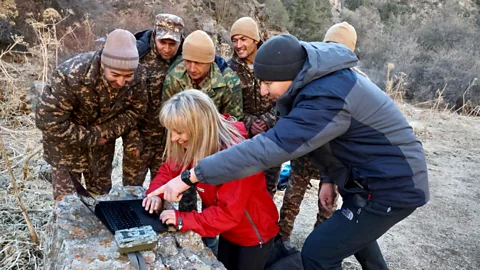
It was icy, around -6C (21F). Our hands were so cold they were barely functioning. We'd already sifted through three memory cards, looking through hundreds of clips, huddled in a mountain valley as the Sun slipped behind the snowy peaks looming over us. The camera traps had captured bears, ibex and a porcupine shuffling past in the dark. It was thrilling to see them, but a glimpse of the elusive snow leopard was the prize we were after.
And then suddenly, with a huge cheer from the team, there it was.
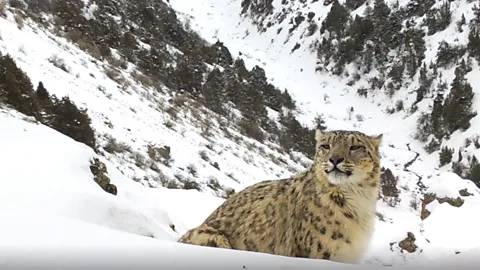
A beautiful snow leopard, the "ghost of the mountain", confidently prowling across the frame, its ridiculously long tail trailing behind it. We now knew, without question, that it lived in these mountains. Alive. Holding on.
Solitary, silent and brilliantly camouflaged, snow leopards are rarely seen. The broader Tian Shan mountain range which stretches more than 2,500km (1,550 miles) across Central Asia to China, is thought to hold more than 1,000 snow leopards, but only a few hundred roam its westernmost reaches in Uzbekistan.
And for a fleeting few seconds, one was right there in front of us.
Our team spent seven days filming in Uzbekistan searching for the world's most elusive cat in a Soviet-era nature reserve. You can watch a clip from the show further down this article.
Our journey began in Samarkand, one of the most famous Silk Road cities. Here we met our guide Inom Isroilov, who not only showed us the city's iconic architecture, but also pointed out the subtle presence of the snow leopard in its symbolism. The recognisable figure at the centre of Samarkand's emblem emblazoned on a huge sign welcoming visitors and painted by calligraphers onto parchment souvenirs in the courtyards of Registan Square.
"Snow leopards are part of our identity," Isroilov says. "They are a symbol of protection. But now, we need to protect them."
In 2017, The International Union for Conservation of Nature reclassified the snow leopard from "endangered" to "vulnerable" on its Red List, citing improved data and conservation efforts but scientists warned that the species still faces significant threats. These include habitat loss, poaching, prey decline and the growing impacts of climate change.
We left the city to drive south. Arid plains gave way to bulging rock formations, dust rising as the air thinned and the temperature dropped. Dusty villages dotted with roadside fruit huts disappeared. We travelled in a Soviet-era Lada, an iconic four-wheel drive built for rough roads. The vehicle felt like it was held together by stubbornness as much as metal. It seemed like a fitting way to enter a landscape that has changed little in the past 40 years or so, partly because of this Soviet legacy.
 Gissar State Nature Reserve
We were on our way to the Gissar State Nature Reserve, Uzbekistan's largest protected area. The 810 sq km (313 sq miles) reserve, roughly the size of New York City, was established as a "zapovednik" in 1985, when the country was still part of the Soviet Union. Often described as open-air laboratories, zapovedniks were strictly protected scientific reserves created to preserve entire ecosystems (zapoved means "sacred decree" or "commandment" in Russian). Unlike many Western national parks, which were designed in part for public access, these areas were largely closed to visitors; settlements, grazing and industry were tightly restricted, and access was typically limited to rangers and researchers. The model became the backbone of the Soviet conservation system and later influenced Unesco's biosphere reserve framework.
The reserve's position along Uzbekistan's border with Tajikistan also meant the region was treated as a security zone. In the years following Uzbekistan's independence from the Soviet Union, landmines were laid along parts of the border in response to militant incursions after the Tajik civil war. While cities expanded elsewhere, these mountains saw little development.
"The creation of Gissar had a positive ecological influence," says Elena Bykova, a researcher at the Uzbek Academy of Sciences. "Despite imperfect management, the territory experienced minimal human pressure and managed to remain in an almost untouched state. Observing today's rapid development, I think that the high-mountain ecosystems of Gissar reserve would have been destroyed, and today we would not be able to observe the nature that, despite all the shortcomings and imperfections of the system, has nevertheless been preserved."
The legacy, however, is not straightforward. Some of those minefields cut across seasonal migration routes, and there are documented cases of bears and ibex triggering explosives. Yet the combination of strict protection and restricted access meant the reserve avoided the infrastructure, intensive grazing and settlement that have transformed other parts of Central Asia, says Bykova.
According to Bykova, Gissar is one of Central Asia's most important ecosystems, with more than 270 animal species and over 1,200 plant types, many of which are rare and endangered.
 India Latham
We headed into a part of the reserve, accessible only with special permits. Since 2016, Uzbekistan has been open to tourism and visitor numbers to the buffer zones are growing, but core areas remain tightly controlled.
Our anticipation was building. In our years working with wildlife we had never gone in search of this gorgeous big cat. But now here we were, about to go trekking with a team of rangers, to try our luck and see if we could spot one in the wild.
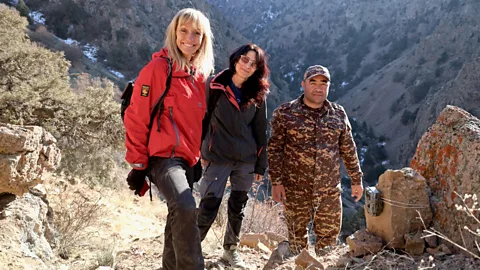
The mountains were cold but the views were unforgettable. We had given ourselves three days to hike with local rangers along rough paths and in demanding conditions. The Sun beat down, but the wind was bitter and in the shade the temperature dropped sharply. As we climbed higher into the thin mountain air that the snow leopards are so perfectly adapted to, the altitude took our breath away, both figuratively and literally. Snow leopards are infamously difficult to track. If we were to have any chance at all of seeing one, or at least seeing signs of its presence, we needed time and we needed to cover distance.
The rangers, led by Kakhramon Kamolovich, the reserve's director, have installed more than 70 camera traps across the mountain, hiking for days to reach the ridgelines where snow leopards roam.
That movement presents a challenge. Snow leopards roam across 12 countries, from Mongolia to Bhutan, often through politically sensitive regions. Protecting them requires cooperation, says Koustubh Sharma, Science and conservation director at the Snow Leopard Trust. In 2024 Uzbekistan led the way in developing a memorandum of understanding between member states of the Global Snow Leopard and Ecosystem Protection Program, which coordinates conservation efforts across borders. This strengthened existing collaboration between range countries, supporting coordinated monitoring and data sharing.
More like this:
• Rare images of Europe's 'ghost cat'
• The maritime lions hunting seals on the beach
• The best nature photography of 2025
Hiking with us was Mariya Gritsina, a scientist from the Institute of Zoology in Uzbekistan who works alongside the rangers, mapping snow leopards' movements and identifying their habitats. "One of the hardest things about snow leopards, is that even if you dedicate your whole life to them, like me, you might only see one once," Gritsina says, adding that scientists still have a lot of questions about snow leopards. "We can't cover all of the territory [with] our studies."
She isn't exaggerating. Snow leopards are most active at dawn or dusk and this crepuscular nature means sightings of these solitary animals are rare.
Globally, there are estimated to be between 4,000 and 6,500 snow leopards in the wild. Their wide-ranging nature means it's difficult to be more specific, though scientists are now working on a more comprehensive global assessment using improved survey methods, with some early analyses suggesting numbers may be higher than previously thought.
 India Latham
We scanned the ground as we walked and found fox tracks, ibex droppings and the faint paw print of a lynx. These were all positive signs that this was a healthy ecosystem for snow leopards.
Then, high on a ridge, an enthusiastic ranger shouted out. We scrambled up and there it was. Snow leopard scat.
As a wildlife presenter and producer, we are no strangers to the excitement that can come with finding animal poo. And this was no different. We were looking at proof that, not long ago, one of the world's most elusive predators had been right there, surveying the mountains below.
For us, it was thrilling. For local people, especially farmers, it can trigger a very different emotion. According to Bykova one of the issues with the zapovednik system was resentment among local communities, who often felt excluded from land that no longer "produced" anything for them. "Strict prohibitions produced results," Bykova says, "but they were unstable, because there was no public support. As a result, there were and still are cases of violations of the protection regime, including poaching, illegal grazing of livestock and cutting of juniper trees."
Long-term monitoring inside Gissar shows snow leopard numbers have risen steadily since the 1980s. According to reserve data, seen by the BBC, there are now 61 snow leopards in Gissar.
The increase shows what can happen when development is limited and ecosystems are given space, but protection alone is not enough. Around a third of Uzbekistan's snow leopard habitat exists outside protected areas, where poaching and grazing pressures persist.
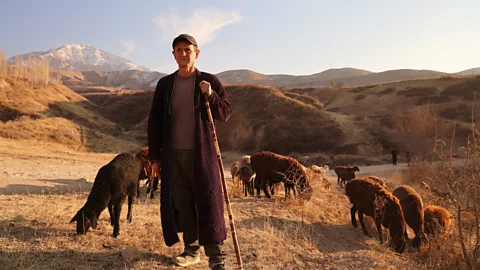
"They're beautiful animals. Scary, but beautiful," goat herder Askar Khasanovich Shermatov tells us. "They're multiplying. Every year we know there are more. But I'm happy, because the rangers protect the reserve and the prey. If there is enough prey, they don't need to attack my herds."
Gritsina is developing community engagement plans to identify attack hotspots and create compensation schemes for herders during increased periods of depredation. The aim is to reduce conflict and build trust through practical, locally tailored solutions.
Today, newer protected areas in Uzbekistan attempt a different balance, combining strictly protected core zones with areas for sustainable use. "We are still far from the ideal," Bykova says, "but there is growing understanding that biodiversity must be preserved not through isolation, but through careful management and cooperation with people."
Conservation isn't simple though. Bykova says the ongoing threats in Gissar include "overhunting and poaching of prey species, direct poaching, habitat degradation, the impacts of infrastructure development and climate change".
The challenges are compounded by geography. "Since a third of the world's snow leopards are distributed within 100km (62 miles) from international borders, a snow leopard protected in one country is at a risk in another," Sharma says. That, he says, is why harmonising laws, standardising research methods and sharing best practice on community engagement are essential, the kind of coordination the Global Snow Leopard and Ecosystem Protection Program is designed to support.
Cooperation is strengthening. In Gissar, that effort is visible in the work of rangers struggling in difficult conditions, scientists sharing data across borders and communities adjusting how they live alongside wildlife.
We didn't see a snow leopard in the wild, but the data shows they are here. And that, ultimately, is what conservation is about, building the knowledge needed to protect these wild landscapes that still feel vast, silent and relatively untouched, something which is sadly becoming increasingly rare.
* Michaela Strachan is a wildlife presenter best known for The Really Wild Show and as a long-standing presenter on Springwatch.
India Latham is a freelance producer-director working across wildlife, culture and current affairs. She has travelled to Uzbekistan three times with Electric Eel Studios to make programmes for the BBC.
Adventures in Conservation: Searching for Snow Leopards with Michaela Strachan will be broadcast on BBC News on 28 February at 12:30 (GMT) and 1 March 00:30, 07:30 and 19:30 (GMT).
--
For essential climate news and hopeful developments to your inbox, sign up to the Future Earth newsletter, while The Essential List delivers a handpicked selection of features and insights twice a week.
