'It caused so much upset': Why Tracey Emin's messy bed shocked the art world in the '90s - then became an icon

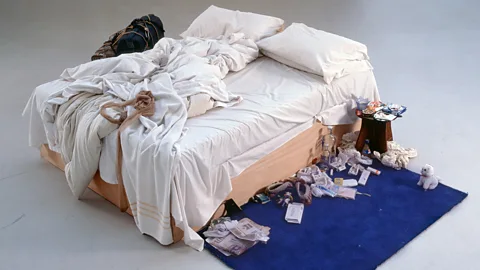 Courtesy of The Saatchi Gallery, London
In 1999, an artwork of a dishevelled divan strewn with condoms and lager cans sparked a media frenzy and turned artist Tracey Emin into a celebrity. Why? And what happened next?
Back when the world was spinning towards the 21st Century, creative culture was in its own state of revolution. In London, the city itself was shapeshifting, and the Young British Artists (aka YBAs) were an unruly constellation of rising stars (among them, Tracey Emin, Damien Hirst, Sarah Lucas, and Jake and Dinos Chapman) that embodied a collisional energy: visual art; nightlife; rock 'n' roll. Suddenly, the art scene was fuelling global media headlines, and it appeared that the most controversial, scandalous statement of all was… a woman's bed.
Warning: This article features language that some may find offensive
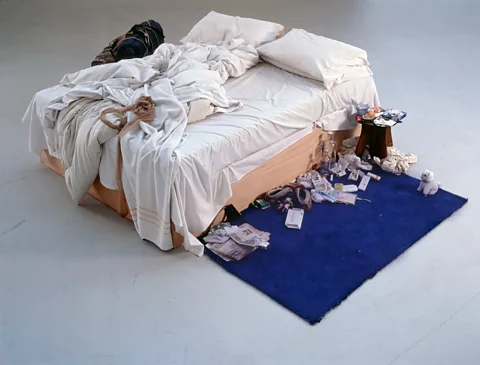
In 1999, Tracey Emin's My Bed (1998) was shortlisted for the prestigious Turner Prize and exhibited in Tate Britain's stately gallery: a dishevelled divan with stained sheets, strewn and surrounded with personal detritus such as contraceptives, slippers, bloodied period pants, empty vodka bottles, Polaroid selfies, an overflowing ashtray. It recreated a post-break-up depressive breakdown, when Emin had stewed in bed for days, before rising to view the chaos.
While it didn't win the prize, My Bed certainly seized the room – and sparked a furore for its messy candour; The Guardian newspaper bemoaned "Emin's insatiable appetite for exploring the sordid corners of her own life"; The LA Times reported: "Unmade Bed Exhibit Has London Tossing And Turning"; The Daily Mail lambasted the "stomach Turner". Emin would describe her work more astutely (in a 2014 BBC interview) as "half like a crime scene, half like a diary".
In 2026, I am gazing at My Bed. It is a pivotal highlight in A Second Life: Emin's new career-spanning exhibition at Tate Modern (a London landmark that hadn't existed when this sculpture was originally made). It feels like an intensely vivid, unexpectedly poignant reunion. I recall being intrigued when I first saw Emin's work in my '90s youth – but also confused, because it was so hard to focus amid the media frenzy.
 Courtesy of The Saatchi Gallery, London
Coming of age as a woman in that era was quite dizzying; pop culture was thrilling, brash, and sex-obsessed yet simultaneously prudish and misogynistic: famous (particularly working-class) women like Emin were hailed as hard-partying "ladettes" then slated for their hedonism. Men were not subjected to the same rules – and menstrual blood was apparently the most shocking medium of all. Decades later, it feels refreshing to cast off such baggage, but My Bed retains undeniable power. "I think people are so used to seeing it as an image that they forget that it's real," Emin told the BBC in 2014. "When they see it for real, it still evokes those feelings inside them, because you can see the trace of a human being in there."
"It felt really significant to bring the full range of Tracey's work back into the public eye; there are generations who know her name, but haven't had the chance to witness her art themselves," says Tate Director Maria Balshaw, who has co-curated A Second Life with Jess Baxter and Alvin Lee, working closely with Emin (now 62, and the survivor of life-changing cancer) and her studio director Harry Weller.
Balshaw also remembers her own first encounter with My Bed: "It felt like a liberation," she tells the BBC. "Something like My Bed being at Tate Britain… people didn't know where to put themselves in relation to the work, because it included the full range of an ordinary woman's life experience. What's exceptional is that it's not exceptional; it is pregnancy tests and tampons and knickers and condoms and cans of lager and crumpled pillows and an unmade bed, and I found it exhilarating that it was causing so much upset."
 Tracey Emin/ DACS
"The wonderful thing is that My Bed was highly relatable, blending art into the everyday – and then there was a deliberateness and mutual understanding that putting that work into the Turner Prize was not only bringing attention but stirring that debate of 'my six-year-old could do this – but why haven't they?'" adds Dr Vivienne Gaskin, senior lecturer at Leeds Beckett University and former director of live arts at London's Institute of Contemporary Arts (where, in the mid-'90s, she booked Emin to DJ to a packed crowd of club kids and art world luminaries). "It was quite tame if you look back but was perceived as unladylike. As a result of that work, everybody knew who Tracey Emin was. People were energised by it."
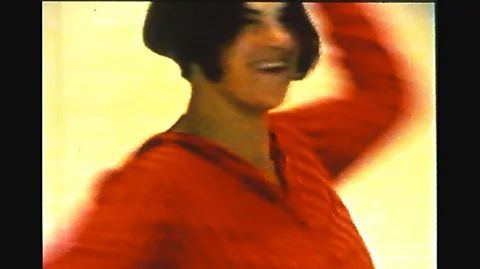
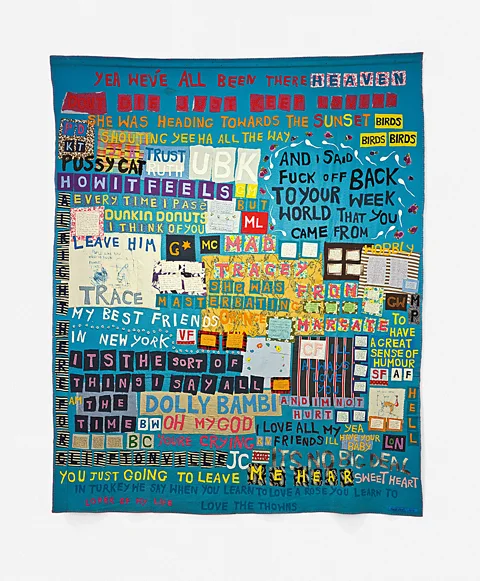
In A Second Life, My Bed is positioned as a kind of gateway between Emin's early autobiographical work (films including 1995's glorious Why I Never Became A Dancer; bluntly brilliant tapestries like 1997's Mad Tracey From Margate. Everyone's Been There; neon poetry) and captivating recent expressions: dynamic brass sculptures; raw photographs; gorgeously lucid paintings like 2023's I watched Myself die and come alive. Throughout, her art is exceptionally up-close and unfiltered, even when examining deeply painful experiences including rape, abortion, and brutal cancer surgery; it is also unexpectedly tender, generous, ultimately life-affirming. And while works like My Bed are often referred to as "confessional", it's a term Emin has rejected, preferring "truth".
 Tracey Emin/ DACS
"It's not [Emin's] confessional at work in My Bed," says Gaskin. "She is transparent and immediate in her interaction with you. It's more like the naughty girl at school whispering in your ear at the back of the class: 'Did you ever…?'; 'Would you like to…?' It's your confessional she solicits, and in doing so, she makes the audience all at once unnerved and complicit in her actions."
"I think a more useful term is 'autofictive'," suggests Balshaw. "She's using her own experiences, but they're crafted; performative but authentic. Even the darkest moments are imbued with a very wry humour."
'The shock is gone'
My Bed has been on a journey. Its 1999 appearance was disrupted by wacky stunts: two "visual artists" who staged a pillow fight on Emin's sculpture; an "outraged housewife" who attempted to clean the work (for its latest showing, a surrounding floor alarm deters repeat incidents). Over the years, it has been paired alongside paintings by William Blake and Francis Bacon; it has become Emin's most expensive artwork (auctioned for £2.54m/ $4.35m in 2014); it is now often taught in UK high school GCSE classes; and it is referenced in drama, such as Sex and the City spin-off show And Just Like That.
Despite its apparent disarray, this piece is meticulously conserved and painstakingly reconstructed. Balshaw smiles: "Each object is in its own labelled plastic bag: 'empty Duracell packet'; 'bloody knickers'; '3 X lager cans'… And [Emin's] instructions are both precise and brilliantly vague; the pillows have to be placed at the top ' in a way that's rumpled but natural-looking'."
More like this:
• Why critics scorned Beryl Cook's saucy British paintings
• Why there's more to Banksy than meets the eye
• The photographs that skewer British peculiarities
What do modern audiences find in My Bed? "You see people sitting with it, often drawing aspects of it, making their own sense of it," says Balshaw. She notes a generational shift in the way that we regard personal art: "We're exposed to so much more in terms of content these days. So, the shock is gone, but the bravery and commitment to intimacy is recognised in a very tender way."
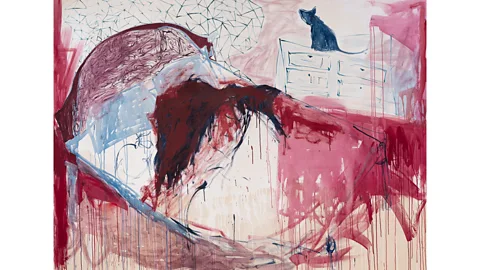 Tracey Emin/ DACS
Beyond its Tate Modern run, A Second Life will tour to Denmark, South Korea and Australia. Emin has obviously long outgrown the YBAs; she's now a dame (appointed in 2024); an active philanthropist (funding facilities for artists in her seaside hometown of Margate); a celebrity (take the recent media buzz around her hangout with Madonna); ultimately, a talent in her creative prime.
"The lack of self-consciousness is lovely, but it's the emotional work which hits really hard," says Gaskin. "And I think it's really time for this exhibition to happen now, because it needed time for all that YBA shouting to shut up for a while and let other things happen. I think it's symbolic that she has this longevity. She's got a chance to breathe out – and there's a nice sort of sober moment for us to look at her as a proper artist."
Emin concludes, in conversation with Balshaw for her exhibition catalogue: "My Bed… now, when people see it they don't go oh, they go ah. Because it looks so sweet. It's so sad. It's got this whole history. It has an entity that is not to do with me anymore. I'm awake. My Bed has its own life. And so people actually feel for that bed. Whereas at the time, they felt disgust, and shock…
"Or they build themselves up to something which isn't there. It's just a little bed really, with lots of things that show my life or how I lived for a moment."
Tracey Emin: A Second Life is at Tate Modern, London until 31 August.
--
If you liked this story, sign up for The Essential List newsletter – a handpicked selection of features, videos and can't-miss news delivered to your inbox every Friday.
