Fish market sells record £77m worth of stock

 BBC
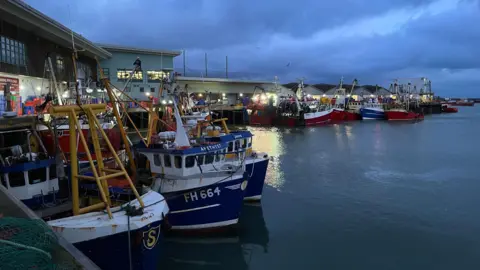
BBCA fish market landed and sold £77m worth of fish in 2025, beating its record for the previous year by £15m.
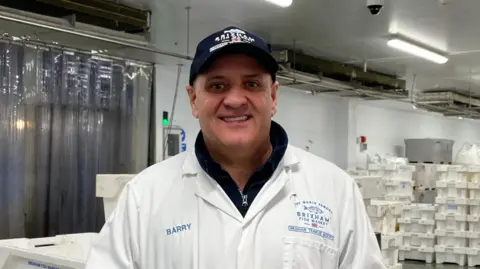
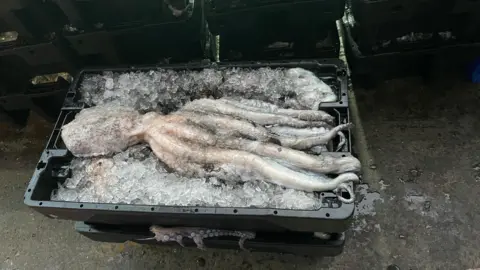
Brixham Trawler Agents (BTA) in Devon said its success included a "notable increase" of Mediterranean octopus landings. Managing director, Barry Young, said: "It just shows that the fishing industry's not dead", adding it had a "long-term future".
But the inshore fishing industry continues to struggle because of the influx of octopus, drawn by warmer seas, which prey on crabs, lobsters and scallops.
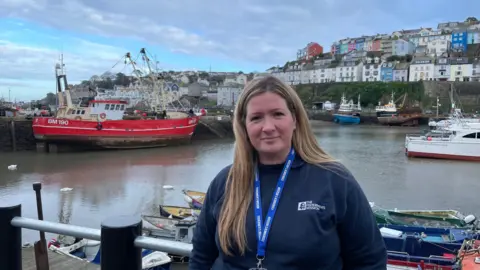
Area manager for charity Fishermen's Mission, Helen Lovell-Smith, said some people were "struggling" because of the octopus bloom, and were regularly pulling up empty pots.
'Collapsed overnight'
Young said the £77m figure meant Brixham was now the biggest port in England in terms of value.
In total, 13,830 tonnes of fish were sold at the town's market in 2025, including 3,183 tonnes of cuttlefish, 1,795 tonnes of Mediterranean octopus, and 1,665 tonnes of fish exported to overseas markets.
Young said another influx of octopus in 2026 would "be great" for BTA but said it was a different story for crab fishers.
"They probably need a lot of support and help at the minute," he said.
"When this octopus turned up, their fishing literally collapsed overnight."
Dartmouth shell fisherman, Jody Channer, has been working in the industry since 1988.
He said people were getting "really upset" by the effects of the octopus, and he himself was pulling up empty pots.
"If there weren't octopus in the pots, all we got were shells," he said.
"Scallop shells, crab shells, lobster shells, crawfish - all dead in the bottom. It's just soul destroying to see that."
"It's the not knowing what's going to happen further down the line," he added.
"The knock-on effect, it's not just about us."
According to data from Devon & Severn Inshore Fisheries and Conservation Authority (IFCA), seven out of 13 commercial crab potting vessels which operate out of Dartmouth, Salcombe and Plymouth had seen declines of more than 73% in 2025.
It said three boats had a loss in crab landings of more than 90%. For lobster landings, 11 out of the 13 vessels had landings "significantly lower" in 2025 than in 2023, IFCA said.
Lovell-Smith said the charity had seen an increase of people coming forward who had been "impacted greatly" by the octopus.
"Some of the boats that can get out in deeper water are doing really well, but it's a double-edged sword," she said.
"It's really, really tough at the moment or our shell fishing community," she said.
Follow BBC Devon on X, Facebook and Instagram. Send your story ideas to spotlight@bbc.co.uk.
