Future rare octopus blooms 'likely' in UK seas

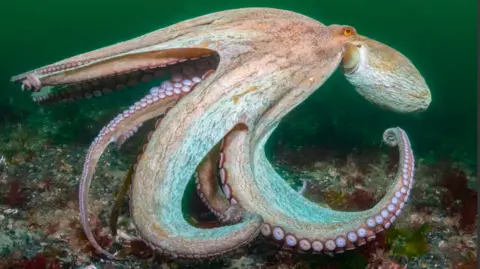 Cornwall Wildlife Trust/Kirsty Andrews
Octopuses are increasingly making British waters their home, researchers have said after the population of the species surged in 2025.
A report by the Marine Biological Association (MBA) says warmer sea temperatures have contributed to the common octopus migrating from southern Europe to the South West England coastline.
Some in the fishing industry, however, have warned they are being negatively impacted by the octopus preying heavily on crabs, lobsters and scallops.
The Department for Environment, Food and Rural Affairs (Defra), which part-funded the study, said it was an "important basis for furthering our understanding on the octopus bloom".
 South Devon and Channel Shellfishermen
The report said the south western waters of England saw "a major population bloom" of the common octopus in 2025 which was comparable to "rare historical blooms" in 1899 to 1900, 1932 to 33 and 1950 to 51.
It found the number of common octopuses landed by commercial fisheries in the region last year was almost 65 times higher than recent annual averages.
Scientists from the MBA, a charity, studied evidence from fishing industry catches and scientific surveys to confirm the surge, in research funded by Defra as well as Plymouth city and Devon county councils.
The common octopus can grow between 24-39in (60-100cm) long, has eight long arms, each with two rows of suckers, and glands that produce a venom used to incapacitate prey.
Its populations are often highly variable and strongly influenced by environmental conditions, according to scientists.
The report said lower saltiness in the water and sustained easterly winds helped newly hatched octopuses migrate from the Channel Islands and northern France, and "the 2025 bloom and all previous blooms were strongly associated with unusually warm sea and air temperatures".
Sea temperatures in the South West reached up to 4C above normal last year, an "unbelievably warm" anomaly and favourable for their reproduction and survival, according to Dr Bryce Stewart, from the MBA.
'Crisis for fishing'
Modelling of ocean currents suggests that larvae from Guernsey, which saw its own octopus bloom in 2024, "likely contributed to the UK surge", the report added.
An octopus bloom may reoccur again because of unusually strong breeding rates in the English Channel, researchers said.
"My feeling is that the common octopus will have become a resident species now in UK waters," Stewart told the BBC.
"It was always here, but in very low numbers, whereas now I think it will be actually common."
Councillor Tudor Evans, the leader of Plymouth City Council, said this was a "crisis" for the local fishing community and the study showed the bloom was a "sustained threat" not "a blip".
The growth of octopus numbers in UK waters is not without consequences. In a survey of 40 fishermen carried out by the MBA in collaboration with the Plymouth Marine Laboratory, the University of Plymouth and an independent consultant, the researchers found about two thirds reported negative impacts.
This was particularly the case for those fishers who mainly catch brown crabs, European lobsters and king scallops because the octopus are voracious predators of these species.
Catch rates for those three species have dropped by 30% to 50% according to figures from the Marine Management Organisation.
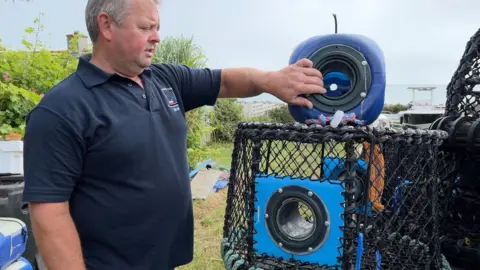
Some businesses have adapted to catching octopus, with a number investing in new fishing gear.
Some benefitted for a period of time by selling the octopus which can have an average price of around £7 per kilo, many are worried however about long term damage to shellfish stocks and some fishers have left the industry.
Alan Steer, a third generation crab fisherman, was able to adapt and make some money out of octopus last year but octopus die soon after breeding, so there are not as many in winter.
Steer, who is vice chair of the South Devon and Channel shell fishermen group, said: "We would normally be catching enough crab between October and December to tie us over until the start of the season in spring but the numbers just haven't been there."
He said if the surge comes back next year, he would consider changing over to an octopus fishery but this would involve investment.
"We don't want to do that if three years down the line, they disappear again," Steer added.
A spokesperson for Defra said in a statement: "We recognise the excellent scientific work in this study which we helped to fund and it is an important basis for furthering our understanding on the octopus bloom.
"We are working together with industry through Fisheries Management Plans to ensure we fish sustainably, alongside investing £360 million in a new Fishing and Coastal Growth Fund so the sector can thrive for generations to come."
