AI sea drone firms want regulations changed

 BBC
BBCPeople working at the forefront of cutting-edge maritime technology are pushing for changes to regulations they say are holding them back.
Plymouth is the National Centre for Marine Autonomy and has a thriving hub of businesses at Turnchapel Wharf developing vessels that operate without a crew.
Their calls for change are being backed up by the local MP who has raised the issue in Parliament with the secretary of state for defence.
The Maritime and Coastguard Agency (MCA), which regulates the industry, says there are "clear, flexible approval routes" in place and it is supporting businesses.
'Amazing group'
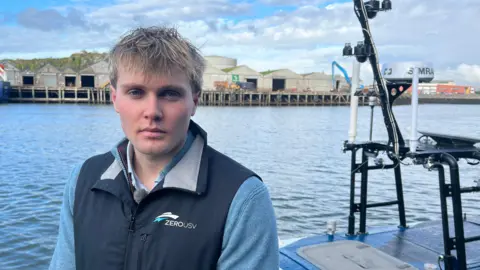
Bertie Ratsey is business development manager at ZeroUSV, which operates a fleet of autonomous vessels from its base at Turnchapel Wharf, in Plymouth.
He said: "There's so much excitement here about what could go on - there's a really amazing group of companies all based down here and all operating in the UK and leading in the world."
Ratsey says an unmanned vessel his firm has created has been certified for use in Canada, but can only operate under strict restrictions in the UK.
He said: "Very capable unmanned platforms that are safe and reliable are not able to go out and prove their worth."
Ratsey said his firm and others were not able to move at the speed they would like to due to the MCA regulations in place for autonomous vessels.
He said: "If it continues to go on like this the UK and if you don't have a local industry being able to push on, then we might not be in the same place in five years."
The Strategic Defence Review in 2025 recognised Plymouth's leading role in marine autonomy.
The firm Oshen, also based at Turnchapel Wharf, is working with the Ministry of Defence on using its robots for anti-submarine warfare.
The company develops and creates small autonomous vessels - about a metre (40 in) long - that can be controlled remotely around the world to gather data.
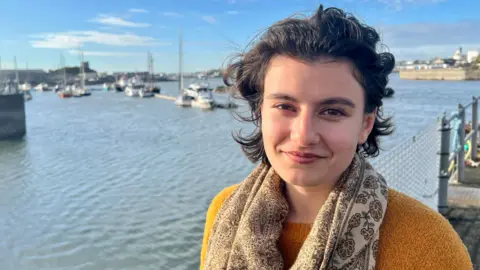
Anahita Laverack, the company's CEO, said the MCA needed to update its policies to meet the demands of emerging technology.
She said: "Right now if you put a propeller on a rubber duck it's legally categorised as a vessel.
"What we're really keen to see is something that actually clarifies what is and isn't a vessel, especially at the smaller scale of things."
The Conservative MP for South West Devon, Rebecca Smith, has twice raised the issue in Parliament.
On Monday, she asked Secretary of State for Defence John Healey if he would "commit to putting further pressure" on government legal services to update legislation.
Healey responded by saying a shipbuilding and marine autonomy plan would be published "shortly" which would show "exactly what we're doing on a number of fronts".
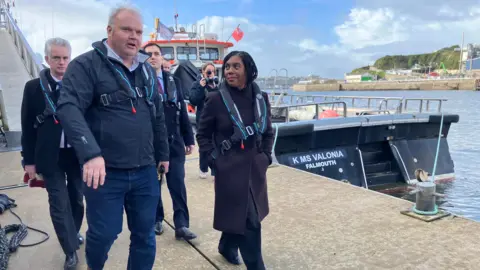
Meanwhile, Conservative leader Kemi Badenoch visited Plymouth to pilot one of the unmanned vessels and said she would like to make it easier for companies to test them in the city.
Due to regulations being different in other countries, she said businesses were were "missing out".
"People are going to Portugal or to Canada," Badenoch said. "They should be coming to the UK - to Plymouth.
"I want to see what we can do to help.
A spokesperson for the MCA said: "The MCA has implemented clear, flexible approval routes for autonomous vessels, with several having already been certified under existing frameworks.
"We continue to work with partners, including in the defence sector, to expand trials, provide support for innovators, and ensure the UK remains a world leader in maritime autonomy."
Follow BBC Devon on X, Facebook and Instagram. Send your story ideas to spotlight@bbc.co.uk.
