Fight to save church linked to St Cuthbert and Russian royalty

 BBC
BBCCampaigners fighting to save a south of Scotland church with links to Russian royalty and St Cuthbert are hopeful they can save it from falling into private hands.
Supporters of Wamphray Church near Beattock are optimistic it can be bought for the community but they need at least £35,000 to secure it.
They want to keep it as a venue hosting important life events, and to link it with regional tourist trails.
They have until early July before it is placed on the open market by the Church of Scotland - one of more than 100 properties it is selling off across southern Scotland due to dwindling congregations.
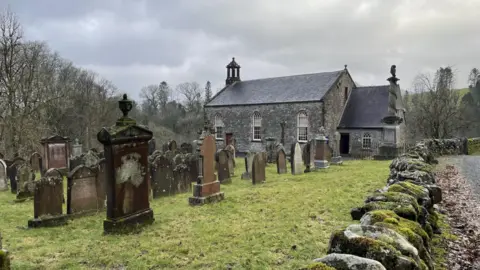
The Friends of Wamphray Church steering group is in the process of becoming a charity as it campaigns to reach its target before the buyout deadline on 8 July.
Jan Hogarth, who chairs the group, said visitors often commented on the spiritual energy and peaceful nature of the site.
Evidence of a druidical stone circle in the field next door shows it has been a gathering place for thousands of years, she said.
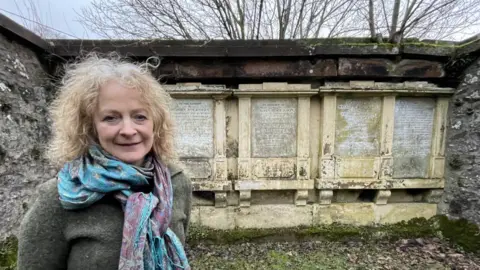
A family crypt within the graveyard provides a connection to the Russian Imperial Court. It is the resting place of Wamphray man Dr John Rogerson who was physician to the Emperor of Russia.
The group believes the rich history of the church site can be linked into wider tourism opportunities and pilgrimage routes.
Dumfries and Galloway archeologist Andrew Nicholson said a textual reference existed implying a link with St Cuthbert, the patron saint of Northumbria.
He said Anglo-Saxon metal work uncovered in the field next to the church in 2013 related to the Northumbrian expansion in the 7th Century and a period of dedications to St Cuthbert.
"This is clearly the Northumbrians stamping their patron saints into the area of new conquest, firmly establishing there is now a new power in charge," he said.
The artefacts discovered in 2013 are known as the Wamphray Horde and are displayed in Annan Museum.
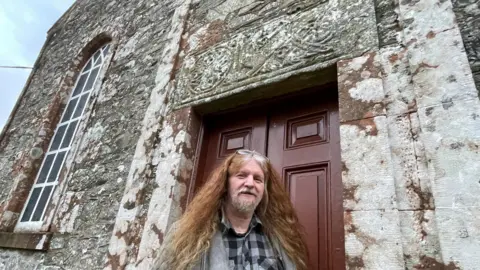
Mr Nicholson said the rare and unusual Anglo-Saxon sculpture above a door lintel showed the church had a history going back at least 1,300 years but that the site fitted into a landscape going back at least 6,000 years.
He said the connection with St Cuthbert could tie in with other sites in the north of England and through Dumfriesshire and into Galloway.
"There might be a basis for a wider research framework of which Wamphray is certainly one of the key elements," he added.
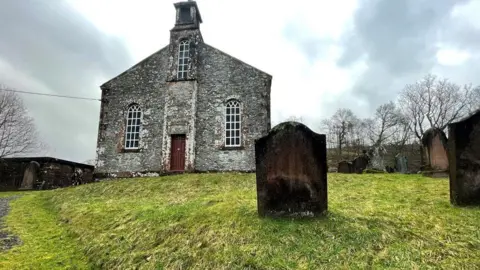
Steering group member Robert Harrison said it was hoping to reach out quickly to potential benefactors with ancestors in the graveyard and that he was heartened by the level of support within the community.
The churchyard includes a monument to the Rt Rev A H Charteris, founder of The Woman's Guild and moderator of the General Assembly of the Church of Scotland.
Harry Whitmore, a churches adviser with the Community Ownership Support Service, is helping to guide the campaigners through the buyout process.
"They've got a draft business plan and a good sense of what they're going to do with the building, they've done market research," he said.
Dumfriesshire MP David Mundell - who grew up in Wamphray - said the group's first public engagement had been really productive and that it was important to keep the church site as a gathering place.
"With the Roman influence here and what happened in the Iron Age, for people who want to do a walking route connecting up lots of places of interest, this church could be a focal point, " he said.
If successful, the Wamphray church purchase would be following in the footsteps of other south of Scotland communities.
Residents near both Ruberslaw Parish Church at Bedrule - between Hawick and Jedburgh - and Applegarth Church near Lockerbie successfully raised the funds they needed to buy their local places of worship last year.
A spokesman for the Church of Scotland said the decision to release Wamphray Church as a place of worship was made in 2022.
A deadline of December 2025 was designed to give a local group the chance to buy the building.
"We understand and recognise the emotional attachment people have to buildings and this is why Upper Annandale Parish Church Kirk Session has engaged positively and constructively with the community group since it was officially constituted late last year and agreed to give it exclusivity of sale, should it wish to proceed with a purchase," he said.
They will be given six months to raise the necessary funds to buy the property before it is put on the open market, he added.
