Hill could hide Viking grave of Ivarr the Boneless

 The British Library
A mound of earth in west Cumbria could contain a lost Viking king called Ivarr the Boneless, an archaeologist claims.
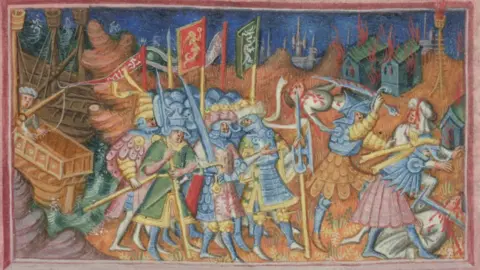
Ivarr - also known as The Legless or The Dragon - founded a Viking dynasty in Dublin and led an army that ravaged England during the 9th Century, but his grave has never been found.
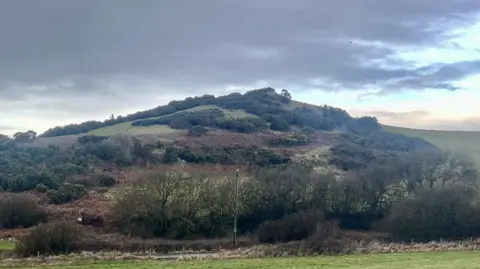
Archaeologist Steve Dickinson believes Ivarr was buried with his ship under a hill referred to as The King's Mound in medieval texts.
He said the "exciting" discovery could mean there was "Viking necropolis" hidden on the Cumbrian coast.
If Dickinson's theory is correct, The King's Mound would be one of only 16 monumental ship burials in north-west Europe, and the first to be found in the UK.
The practice of burying people in their ships was carried out by some cultures as a sign of respect, with the most famous UK example being an Anglo-Saxon ship unearthed in Sutton Hoo in Suffolk.
 Steve Dickinson
"It's a form of belief that is completely alien to us nowadays, whereby a principal ruler - a king or a queen - would be put into a ship under a mound," said Dickinson, who is a member of the European Association of Archaeologists.
"The ship would contain lots of things relating to the community's respect for that person, like jewellery, regalia, weapons, even foodstuffs and sacrificed animals, like pets."
At the time, it was believed the ship would then carry the deceased to the afterlife.
 Steve Dickinson
Ivarr, whose name is sometimes spelt Ivar, was the son of king Ragnar Lothbrok and was a character in the Amazon TV series Vikings.
Efforts have been made before to find Ivarr's burial site, and it was once believed he could have been interred at a site in Repton in Derbyshire.
But while researching an Icelandic Saga, Dickinson repeatedly found references to a place called Coningeshou - which means The King's Mound - which led him to believe it could be Ivarr's final resting place.
But even if a grave is discovered there could be no physical way of determining who is buried at the site.
The exact location of the mound has been kept secret to protect the site, but it is about 60m (197ft) in diameter, 6m (20ft) high and located close to the sea.
Dickinson plans to carry out scans of the ground later this year to determine if the mound is a grave site, but he said that finds in the area backed up his theory.
 Steve Dickinson
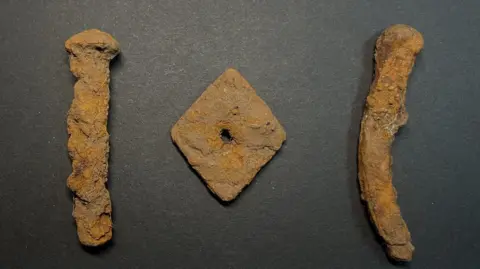
"We've been able to use metal detecting to find various things including, interestingly enough, very large ship rivets and lead weights used in weighing out a significant silver hoard that was found nearby," he said.
There are also 39 smaller mounds surrounding the hill, which he said could contain the graves of Ivarr's retainers, family members and warriors.
"They kind of formed the honour guard for the ruler," Dickinson added.
"It's quite exciting really - there's a whole kind of Viking necropolis up on the coast of Cumbria, which can keep archaeologists busy for years."
