'ME and Long Covid have brought my children's lives to a standstill'

 Family handout
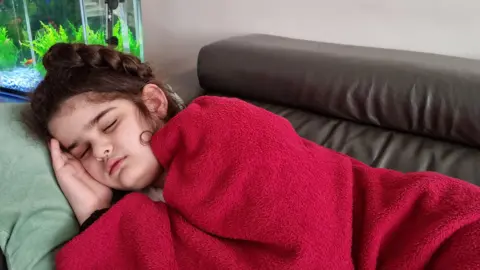
Harbinder remembers when her children were "on track to have a bright future".
Now all three have been diagnosed with myalgic encephalomyelitis (ME), also known as chronic fatigue syndrome (CFS).
Her son Talvin was also diagnosed with Long Covid after three bouts of Covid-19 at the age of eight.
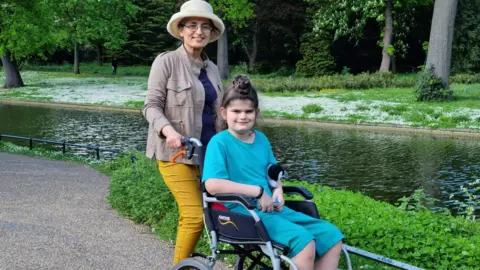
Allsuffer from "overwhelming fatigue", problems sleeping and cognitive issues. Two of them use a wheelchair.
But Harbinder says she is "hopeful" about a new £1.1m study that will analyse the links between Long Covid and ME, between them thought to affect about 1.3 million children and adults in the UK.
Funded by the Buckinghamshire-based ME Association and carried out at Imperial College London, the Rosetta Stone study hopes to look for biomarkers and "decode the immunological profile" of both conditions.
 Family handout
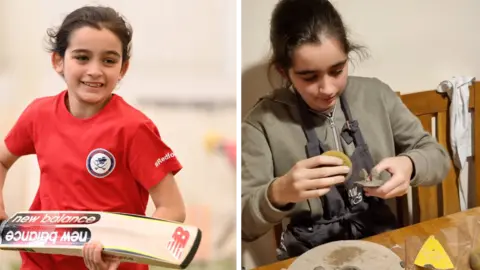
"My eldest daughter, who's now 15, was academically very bright and also sporty – she played cricket at Essex county level," says Harbinder, from Redbridge in north-east London.
"My twins Tara and Talvin, now 12, were also very able, and all three were healthy.
"As a family we went camping; we were outdoorsy people, keen skiers."
Life today is very different.
"They essentially now have learning difficulties," says Harbinder, who gave up her job as managing director of an international consultancy to care for her children.
"They can't remember what things are called, can't finish a sentence, have trouble comprehending a text."
 Family handout
Her children also have distinct symptoms.
"My eldest [Simrun] has also been diagnosed with PoTS, meaning she faints when she stands up," says Harbinder.
Simrun has also been bed-bound at times.
"She is under Great Ormond Street Hospital and is now mobile to a degree, but we still haven't got it under control. There are no answers," says Harbinder.
"She lives with blurry vision, ringing in her ears, pain in her joints and back, constant nausea, inability to eat."
Talvin, meanwhile, has suffered from "debilitating headaches" every day for the past four years.
"We have struggled to access any suitable education for them. No-one really knows what to do with these kids - we're operating in a vacuum.
"Their lives have come to a standstill."
 Supplied
Harbinder welcomes the study and hopes it may offer some answers.
Although her family have been through "some very dark times", she says they have "made peace with the world as it is".
She says: "We laugh every day. We can still watch films together and occasionally venture out to a cafe, and perhaps even the park".
'I'm on long-term sick leave'
 Tim Goodwyn
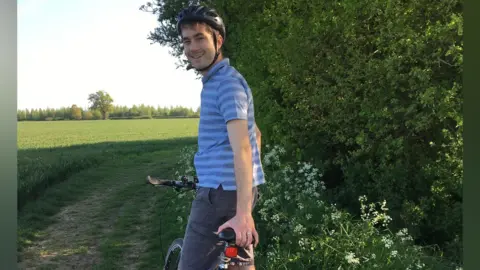
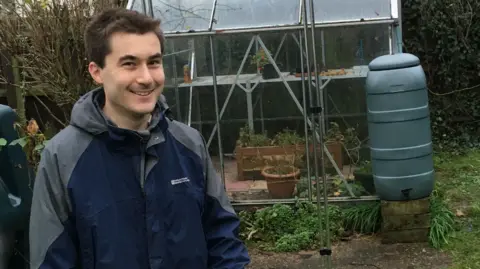
Tim Goodwyn, 37, wishes he could "go out on adventures" with his wife and young son, but is unable to leave the house.
"I mostly have to rest in bed. I can't stand for long or walk more than a few steps," he says.
"I can't shower – I can manage a bath once a week and my wife washes my hair. She pushes me in a wheelchair to medical appointments."
Tim, from Bury St Edmunds, Suffolk, was working as a software developer when he caught a virus in November 2023.
"It was just like a bad cold, and I got a negative Covid test.
"Even after the virus went away, I was still really achy and run down and didn't get my energy back."
 Tim Goodwyn
Tim's energy never really returned.
He tried to "cut down strenuous exercise" while continuing to work and go for walks but took long-term sick leave in August 2024.
"My body has lost the ability to recover from exertion," he says.
"If I do something, I'll have even worse fatigue a day or two later, along with things like headaches, nausea, heart palpitations, and going from hot to the chills.
"The closest thing there is to a treatment is having rest. We still don't know what's causing this illness.
"It's a complex illness. It affects your brain, nervous system, muscles, heart – all sorts."
Tim says research into ME has historically been underfunded, but that the amount being undertaken has increased in the past five years, partly due to Covid.
"This piece of research is not magically going to find a cure, but it could get us closer," he says.
 PA Media
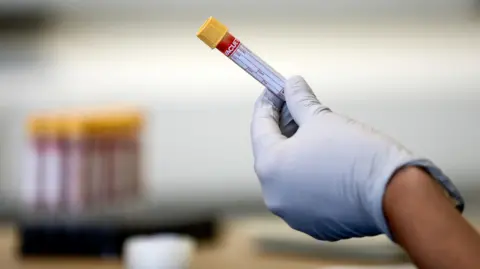
The three-year study will examine 250 people with ME and 250 with Long Covid, alongside matched healthy groups.
Stool, blood and saliva samples from volunteer participants will be analysed to build "an immunological profile" of both diseases.
"Researchers still don't fully understand what happens in the immune system that causes lasting symptoms for some people and not others," says Imperial.
It will also collaborate with the DecodeME team in Edinburgh and the ME/CFS Biobank at the London School of Hygiene and Tropical Medicine.
 ME Association
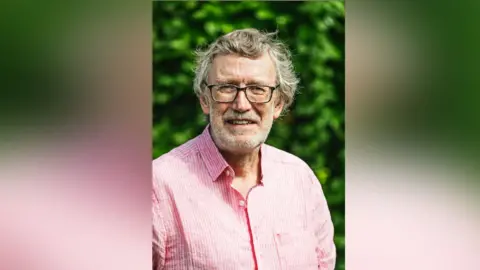
Dr Charles Shepherd, honorary medical adviser at The ME Association, says: "We now know that a significant proportion of people with Long Covid meet the diagnostic criteria for ME.
"It took an awfully long time for the medical community to pick this up, and recognise these are two overlapping conditions.
"It made sense to see what they have in common."
Prof Danny Altmann, from the Department of Immunology and Inflammation at Imperial, says there had been "little research" into the relationship between both "post-infectious, persistent conditions".
"Millions have had their lives destroyed by the disabilities that come with Long Covid and ME/CFS," he says.
"We're hoping that our work will make clearer the underlying mechanisms and inform further clinical trials and therapeutics in this area."
 Dr Rae Duncan
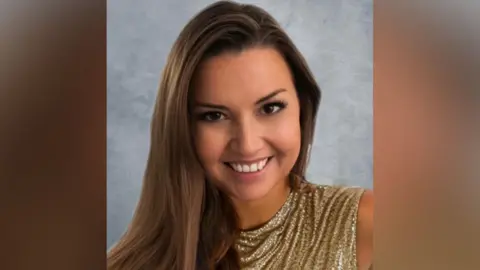
Dr Rae Duncan is a consultant cardiologist at Newcastle Hospitals NHS Foundation Trust and a Long Covid expert adviser at the World Health Network.
"I treat patients from 16 onwards, and to see schoolchildren whose lives have completely destroyed by this virus is horrific," she says.
"I also see young parents who are so ill, they cannot care for their children.
"What we need desperately is the level of funding research to match the level of need and disability."
She believes the new study is "a brilliant idea".
"We absolutely need far more biomedical research into the similarities and differences between Long Covid and ME/CFS, examining effects on brain, blood vessels, immune system autonomic nervous system, viral persistence and mitochondrial function, to help identify new and better treatments
"While they're not the same condition, both of them are incredibly debilitating."
A Department of Health and Social Care spokesperson said its ME/CFS delivery plan would "transform care" and "improve training for NHS staff".
"Everyone with ME/CFS and Long Covid deserves to receive the care and support they need.
"That's why we have invested £3.2m in the DecodeME study to unlock the genetic secrets of ME/CFS, while also funding vital research into diagnosis and treatment for Long Covid," they said.

Get our flagship newsletter with all the headlines you need to start the day. Sign up here.
Follow East of England news on X, Instagram and Facebook: BBC Beds, Herts & Bucks, BBC Cambridgeshire, BBC Essex, BBC Norfolk, BBC Northamptonshire or BBC Suffolk.
