Hunt for executed 19th Century murderers thought to be buried under council car park

 Getty Images
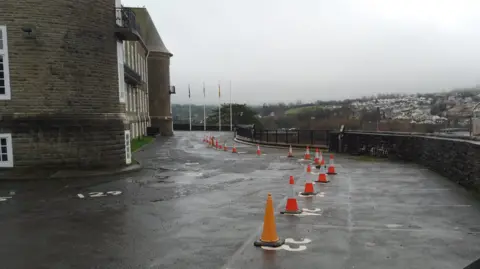
A car park at a council's headquarters is being scoured for the bodies of five prisoners from the 19th Century who are thought to be buried underneath.
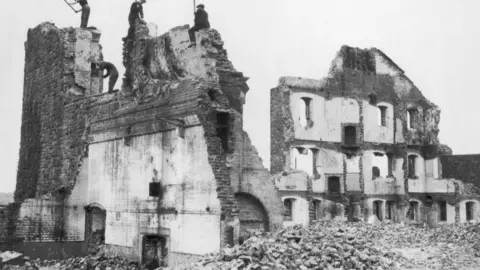
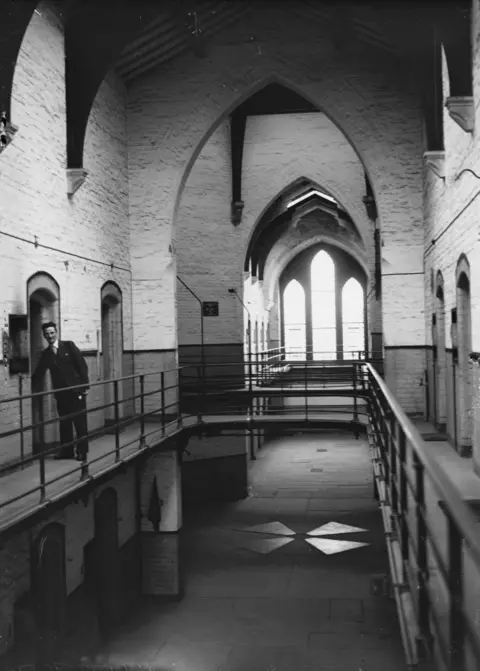
The four murderers and a forger were executed between 1818 and 1894 at the old Carmarthen Gaol, which was demolished in the 1930s and the site later became the home of Carmarthenshire County Council.
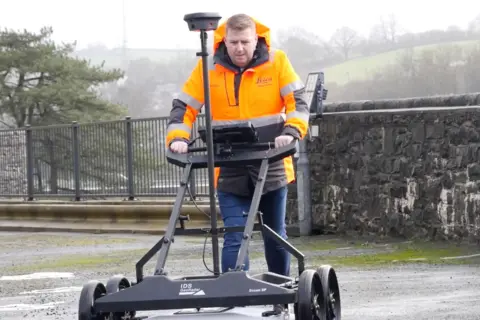
Specialist radar equipment has now been used to find out if the remains of the five men lie underground.
Former Carmarthen town mayor Richard Goodridge said such a discovery could solve "a mystery worthy of a Sherlock Holmes novel" that has lasted for generations.
 Carmarthenshire County Council
Using a digital radar scanner, surveyor Shane Gwilt carried out deep-ground scans over what was once the prison gardens.
The data has been sent to Italy for analysis, with results expected within days.
The council has said it does not intend to disturb or remove any remains if they are discovered.
 Getty Images
Who were the men executed at Carmarthen Gaol?
William Baines, from St Clears, was hanged on 23 May 1818 in front of a "vast concourse of spectators" for forging and passing Bank of England notes.
He had claimed he had forged the notes to replace genuine money, which he had accidentally burned. Baines offered to help the bank stop future forgeries in return for a pardon but this was rejected.
One of his forged £2 notes can be seen at the county archives in Carmarthen. His mother and sister were spared executions for their part in the crime and went to prison instead.
David Evans, executed on 21 September 1829, had been a schoolmaster.
He was convicted of murdering his pregnant lover, Hannah Davis, with a billhook and leaving her body in a brook near Llanybydder. Reports at the time said he wanted her "out of the way" after meeting someone else.
He was the last person to be hanged in public at the prison and about 10,000 turned up to watch. The rope broke the first time and he fell to the ground but despite his protestations that he should be reprieved, it worked the second time.
In 1888, David Rees, 23, was hanged for the murder of a messenger from Dafen tin works in Llanelli. He had beaten and kicked to death Tom Davies to rob him of between £500 and £600. But it was witnessed by an 11-year-old boy.
Rees had written a confession on the eve of his death and claimed he had been "muddled and confused" after drinking heavily and was "truly sorry" for what he had done.
The gallows used had been transferred from Dolgellau prison after its closure in 1878. Hundreds gathered solemnly outside the gaol to witness the raising of the black flag, just after 8am.
His reported last words were: "Arglwydd, trughara wrthyf" (Lord, have mercy upon me) and Rees "wailed piteously" on his way to his execution, in a purpose-built shed at the prison.
Another of the men, George Thomas, 25, was executed on 13 February 1894 after being convicted of murdering 15-year-old Mary Jane Jones in Carmarthen.
The Carmarthen Journal at the time reported that the former soldier displayed an "unfathomable calmness" in the moments leading up to his execution, which took place minutes after he left his cell.
He had been found guilty of a crime described in court as showing "deliberate cold bloodedness and atrocious brutality".
The final execution at the gaol took place later that same year. Thomas Richards, a sailor convicted of murdering his sister-in-law Mary Davies during a theft of money and her wedding ring at her house in Borth.
There was an "immense crowd" gathered in front of the prison, as he hanged on 29 November 1894..
Carmarthen's 'colourful history'
Executions at Carmarthen were initially public spectacles before being moved inside prison walls in the mid-19th Century.
Goodridge believes the five men were buried within the prison grounds and were never exhumed when the prison was demolished and the site was redeveloped.
"I strongly believe, based on the evidence and research I have carried out over the last two years, that the remains of these five convicted felons, hanged for their crimes, still remain where they were buried after their execution," he said.
"It is the last piece of the jigsaw puzzle, that if confirmed will lay to rest a great mystery that has fascinated Carmarthen residents for over a hundred years."
 Carmarthenshire Council
Councillor Alun Lenny, cabinet member for resources at Carmarthenshire County Council, said the scan did not disturb the car park surface and came at no cost to the authority.
"The work carried out on Sunday in an attempt to discover the remains of the five executed criminals didn't disturb the car park surface in any way, and was at no cost to the county council," he said.
"But it may add another chapter to the colourful history of Carmarthen as Wales' oldest town, so we await the results with anticipation."
