Police defend taking 26 years to find teen's killer

 Suffolk Police
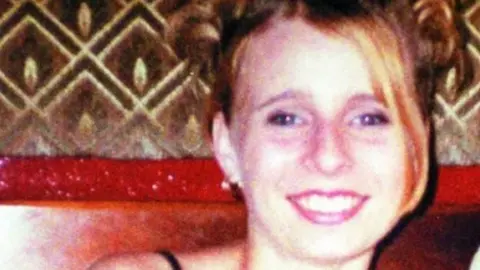
A police force has defended taking 26 years to bring serial killer Steve Wright to justice for murdering Victoria Hall.
Seventeen-year-old Victoria was kidnapped and murdered by Wright after a night out in Felixstowe in September 1999.
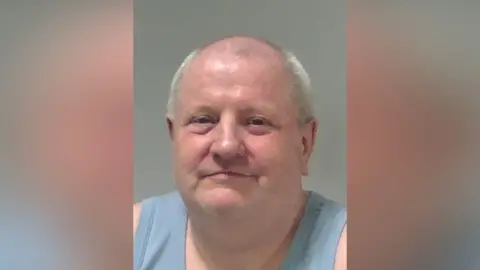
The killer - already serving a whole-life term for the murders of five women in Ipswich in 2006 - was given a further life sentence at the Old Bailey on Friday.
Questions were raised about whether there were missed opportunities to charge the 67-year-old sooner, and whether he could be behind other cold cases.
The BBC put those questions to Suffolk Police.
 Martin Giles/BBC
Did the police miss opportunities?
In 2008, Wright was convicted for the murders of five women in and around Ipswich, so why was he then not considered in Victoria's case?
Also, just the day before Victoria disappeared, Wright had attempted to kidnap Emily Doherty Why did Suffolk Police not link those two incidents sooner?
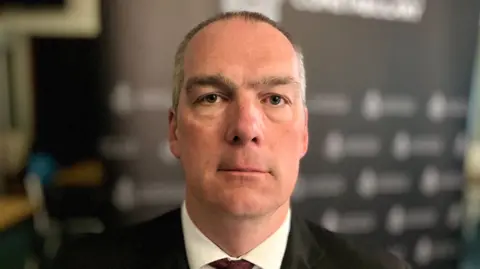
Det Supt Phill Gray is head of the Joint Norfolk and Suffolk Major Investigations Team.
He said in 1999, the investigation into Victoria's murder was the biggest the force had been carrying out at that time and it involved "a lot of information".
Gray said the investigative techniques and forensic opportunities at the force's disposal today had not been available then, or even in 2008, when Wright was convicted of the five murders.
"Steve Wright in 1999 was an individual, a name of an individual, along with other individuals, but he wasn't the Steve Wright that we later established in 2008," he explained.
"It was the DNA evidence, as our prosecution barrister highlighted, that glued all of that circumstantial evidence together to build such a strong case that led to his guilty plea," Gray said.
Wright's sentencing hearing on Friday was told that advances in DNA testing, not available to the original investigation team, had helped pin him to Victoria when her case was reopened in 2019.
The prosecution also told the court Doherty's official statement had not been taken by the police until 2021, despite her reporting it to the force on the night it happened.
The force did concede after the hearing that the "line of inquiry relating to the attempted kidnap could have been more prominent in the original investigation".
Asked if he thought there were missed opportunities, Gray added: "What I am sorry about is the fact that the investigative techniques and forensic opportunities that were available to us in 2026 were not available in 1999."
Why was Emily Doherty dismissed?
 Suffolk Police
During Wright's sentencing, a victim impact statement from his attempted kidnap victim was read to the court.
A key part of her statement was that after she had been stalked for 40 minutes and police had arrived, she did not feel they took her seriously and they questioned how much she had to drink.
"I had to insist that the danger that I felt had been real and had to ask for a lift home to [Felixstowe] Ferry," she said in her statement.
"To this day I am furious. I wasn't taken seriously. I was made to feel like a silly little girl and they told me to forget all about it."
Gray said he was "sorry with the way in which Emily feels police treated her that night", but he said the officers "understood the enormity" of what she had told them.
"What I would say is that I am disappointed with the way she felt that night," he added.
"Homicide investigations are really complex and at that time in 1999 it was the biggest case that Suffolk were dealing with and I cannot make comment as to why they didn't follow that up further but actually this is a whole system approach.
"The police present the evidence gathered to the [Crown Prosecution Service] and a decision is made as to whether that is then [enough for] a prosecution.
"I cannot comment on what the [senior investigating officer] did at that time or not."
Is Wright being considered in other cases?
 Martin Giles/BBC
One of the main questions raised since Wright admitted Victoria's murder is, could he be behind other crimes?
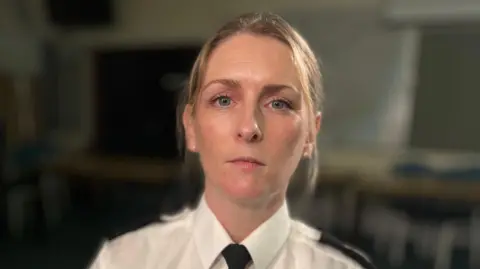
"So the investigation now into Steve Wright has finished," said Assistant Chief Constable Alice Scott.
"At this stage... Steve Wright is not currently a suspect in any other cases at this time in Norfolk and Suffolk."
She said the force was open to hearing any information people may have.
Speculation has grown about whether Wright is behind the disappearances of 28-year-old Kellie Pratt, last seen in Norwich in 2000, and 26-year-old Amanda Duncan, who went missing from Ipswich in 1993.
"I think at this stage it's really unhealthy, the speculation around those cases," Scott continued.
Scott said it could have an impact on the victims' families.
"We have to be really careful how this is reported and how we investigate.
"It's not fair to re-traumatise families."
Was the force focused on the wrong man?
 PA Media
In 2000, 26-year-old businessman Adrian Bradshaw was charged with the kidnap and murder of Victoria, which he denied.
A year later he would go on trial at Norwich Crown Court with the case against him centred around soil found in his car.
The prosecution argued it was similar to soil found near the murder scene, but experts for the defence said it could have come from anywhere in the region.
After just 90-minutes of deliberation, the jury found Bradshaw not guilty.
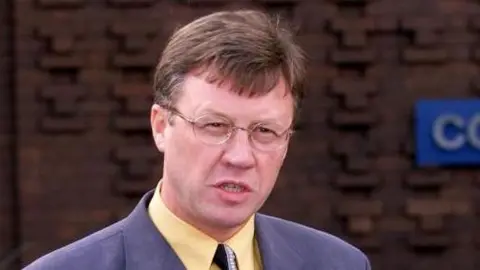
Det Supt Roy Lambert, who had led the case, told reporters he was "very disappointed" by the verdict, adding: "I believe I know who murdered Vicky Hall."
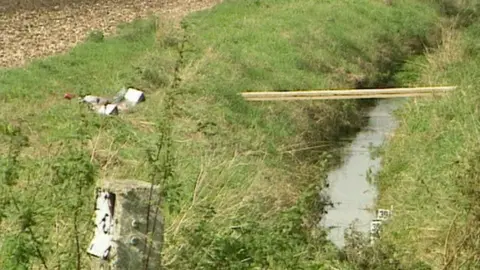
Asked if the force was convinced Bradshaw had been behind Victoria's murder, Det Supt Gray said: "That is not the case.
"What is important is that an unsolved homicide is an unsolved homicide.
"It's not cold, it's never forgotten, it is always reviewed and we will always look at new investigative opportunities and forensic opportunities to bring justice to the families of those victims."
After Wright's sentencing, Lambert said he was "very pleased" with the result.
"This prosecution and conviction some 27 years on from the original investigation shows the importance of cold case reviews and exploiting advances in technology," he said.
"These cases never leave you and I am delighted with the outcome."
Follow Suffolk news on BBC Sounds, Facebook, Instagram and X.
