Princely burial amazes nuclear site archaeologists

 BBC/Rare TV
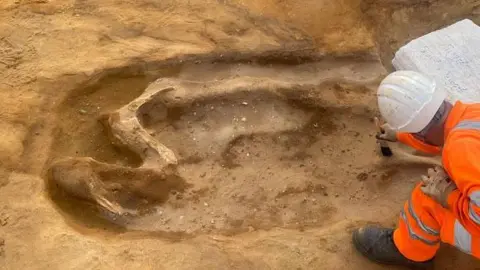
A "princely" grave of a horse buried alongside two people has been discovered by archaeologists working on one of Britain's biggest digs.
The excavation is being carried out by Oxford Cotswold Archaeology (OCA) ahead of the building of the Sizewell C nuclear power plant, near Leiston, Suffolk.
Archaeologist Len Middleton said the burial was in "the same elite tradition seen at Sutton Hoo, Snape and Prittlewell", adding that it was of national importance.
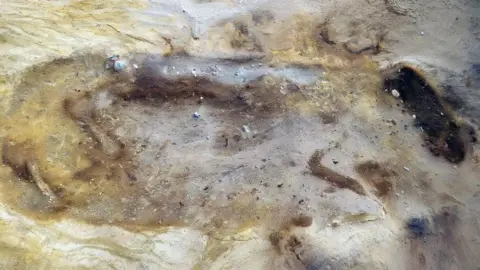
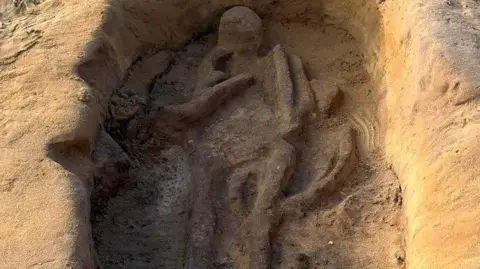
The acidic soil meant all that was left of the remains were sand skeletons - haunting shadows of painstakingly revealed bones and body shapes.
 Oxford Cotswold Archaeology
The grave included a fully harnessed horse, weapons and personal items, and was described as a "'princely burial", by Middleton, who was OCA's project officer on the site.
He said: "Soil conditions have resulted in little preservation – we are instead left with striking sand silhouettes that capture the outlines of the bodies in remarkable detail.
"Discoveries like this are of national importance because they deepen our understanding of power, belief, and identity in early medieval England, and how those ideas were expressed along the East Anglian coast."
 Oxford Cotswold Archaeology
The barrow was among 11 Anglo-Saxon burial mounds dating to the 6th to 7th Centuries.
This means it comes from the same era as the ship burials at Sutton Hoo and Snape, both in east Suffolk, and the Prittlewell Prince, found near Southend-on-Sea in Essex.
Nigel Cann, chief executive officer of Sizewell C, said the discovery was made during preparatory works for the 6.5km (4 mile) Sizewell Link Road.
It "offers a fascinating glimpse into Suffolk's rich heritage and the lives of its early communities and has been "carefully recorded and preserved for future study", he added.
 Oxford Cotswold Archaeology
More than 200 archaeologists are working across 70 sites ahead of the building of the power station and in 2023 they found an "extraordinary" hoard of 321 11th Century silver coins.
Some of their 2025 discoveries will be featured on BBC Two's Digging for Britain on Wednesday from 21:00 GMT.
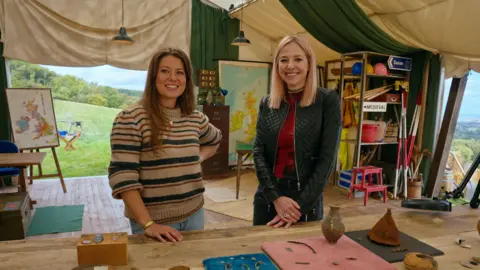
Rosanna Price, in her role as OCA's archaeology engagement manager, is seen regularly checking in with some of the teams during the programme.
At one site, archaeologists discovered the post holes of early neolithic building, stone tools and pottery, dating back to between 4,000 and 3,500BC.
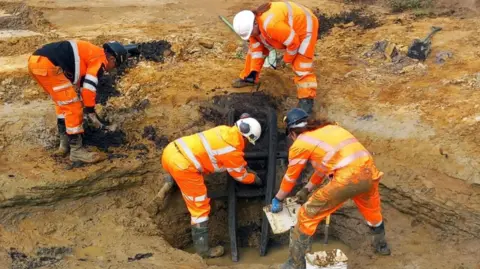
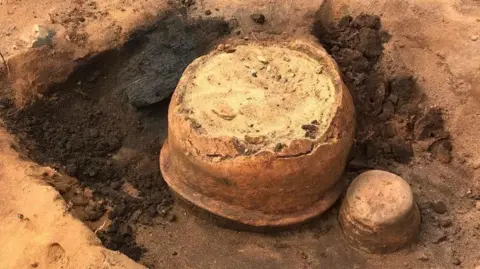
At another, a Bronze Age cremation urn was unearthed, while an extremely rare Iron Age oak ladder has also been excavated.
 Oxford Cotswold Archaeology
A number of the vast site's more unusual finds will be brought to the Digging for Britain tent by Price to show presenter, Prof Alice Roberts.
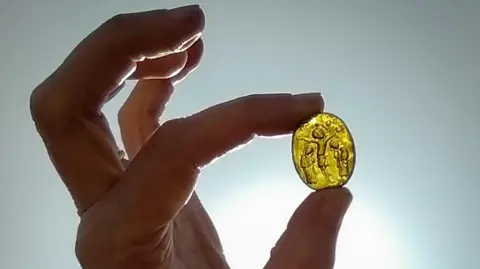
They include a 40,000-year-old Neanderthal hand axe, fine arrow heads dating back to 4,000BC, Roman dress pins - and a rare type of medieval pilgrim's badge made from Venetian glass, only a couple of which have ever been discovered in western Europe.
Another of the more unusual finds revealed to Roberts was a full bottle of beer discovered at a World War Two site. It remained capped.
 BBC/Rare TV
Price said she grew up in Suffolk and described it as a privilege to watch her county's "expansive and epic history be revealed".
"All human life - from conflict to domestic issues to eating to self-care to death - it's all there, uncovered at Sizewell," she added.
Debbie Richards, Suffolk County Council's deputy cabinet member for archaeology and landscape partnerships, said: "Suffolk continues to reveal its stunning past, and the magnitude of these discoveries should not be under-estimated."
The finds will eventually join the council's archive, but in the meantime, some of them will be on display during an open weekend at Yoxford Village Hall on 21 and 22 February.
 BBC/Rare TV
Follow Suffolk news on BBC Sounds, Facebook, Instagram and X.
