Why location of first human-made fire was perfect

 British Museum
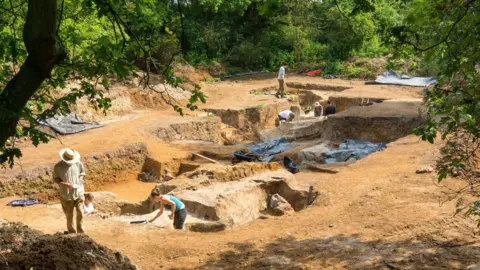
The site where the earliest known human-made fire was discovered was the "perfect location" for early humans, a researcher has said.
On Wednesday it was announced that an archaeological dig in Barnham, Suffolk, had learnt that human-created fire had happened at the site 400,000 years ago.
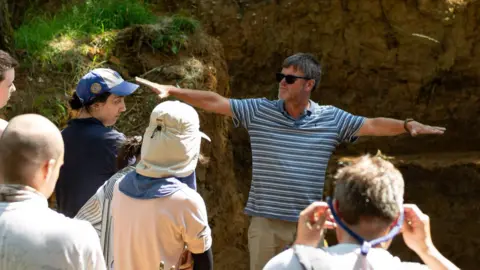
Nick Ashton, a curator at the British Museum who worked on the site and made the initial discovery, said it was one of the "most significant sites" of this pre-historic period.
He said it was "very lucky" to have this preservation of fire evidence at Barnham and it offered plenty of resources for our ancestors.
The site in Barnham was used during the 1900s as a clay pit from which people could make bricks.
The first excavations then took place between 1989 and 1994, where floral and faunal remains dating back 400,000 years ago were found.
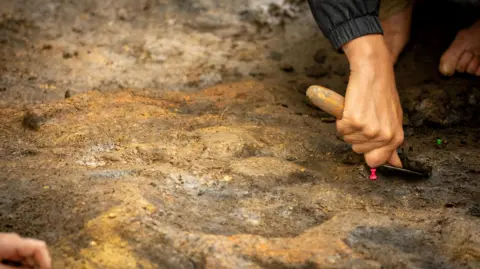
The current work, which led to the discovery of man-made fire, started in 2013 and Mr Ashton said they kept discovering "more and more" as the work went on.
It was not just humans using the site thousands of years ago though, with larger "exotic" creatures also living in this area including a form of rhino, an elephant twice the size of today's elephants and a lion one-and-a-half times bigger than those living today.
 Nick Ashton/British Museum
It is not just Barnham claiming significant firsts in the wider region.
In 2014 scientists discovered the earliest evidence of human footprints outside of Africa, on the Norfolk coast at Happisburgh, dating back more than 800,000 years ago.
Far more recently in human's history, Colchester, Essex, is recorded as the UK's oldest town dating back 2,000 years, likely thanks to its strategic location near the River Colne and coastline.
Mr Ashton explained there was a reason why Barnham and East Anglia were so special in terms of the geology.
"It preserves the right sediments for the questions that we're asking, so it's a sort of geological circumstance that preserves sediments," he said.
"From Happisburgh over 800,000 years ago, we were part of a team that dealt with that and the footprints that came from there, the oldest footprints anywhere outside Africa.
"That's because on the East Anglian coast, you've got this amazing thing, the Cromer Forest Bed."
 British Museum
The Cromer Forest Bed formed during the Ice Ages, leaving sediments in the ground.
When the Anglian glaciation occurred 450,000 years ago — the most intense ice age event seen in the British Isles — and then melted, more sediment was left in the ground, Mr Ashton said.
Thick layers of clay were left and huge blocks of ice that took time to melt left hollows in the ground, later forming ponds.
Mr Ashton explained this was what the Barnham site was as well as others in the region.
"It's a nice, safe, remote part of the landscape, but it's also got flint to it," he added.
"And of course, as a watering hole, it would attract animals.
"It's a perfect location for early humans to make their camp and indeed make fire."
 PA Media
Mr Ashton said the team would continue to research at Barnham and extend their work across Europe.
He added: "Early Neanderthals, they're intelligent people, we call them people, their brains are very similar to our own in terms of size and so we imagine that we're lucky, very lucky to have preservation of this evidence at Barnham, but almost certainly this is happening elsewhere in Europe and indeed beyond Europe."
Follow Suffolk news on BBC Sounds, Facebook, Instagram and X.
