Trepanned skull of Viking-era man found in mass grave

 Cambridge Archaeological Unit/David Matzliach
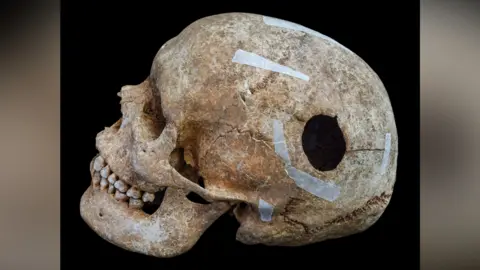
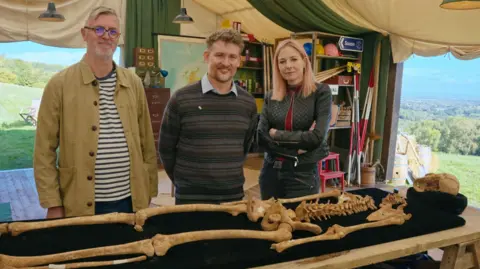
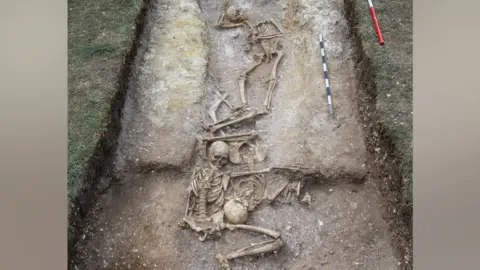
The skeleton of a young 6ft 5in-tall (1.9m) Viking-era man who had undergone trepanation has been found in a mass grave.
A hole had been bored in his skull while he was alive. It had signs of healing before his remains were flung into a burial pit with nine other men, some dismembered.
Bone expert Dr Trish Biers suspects he had suffered from a pituitary gland tumour "causing headaches that the trepanning may have been an attempt to alleviate".
The grisly discoveries were found during a University of Cambridge training dig just outside the city last year and will feature on BBC Two's Digging for Britain.
 BBC/Rare TV
If the young man had had a tumour on his pituitary gland, this could have caused an excess of growth which might explain his height, explained Biers, curator of the Duckworth Collections at the University of Cambridge where the finds are being analysed.
For context, the average male height of the time was about 5ft 6in (about 1.65m).
Trepanned skulls have been found all over the world, including in ancient Greece and Rome.
The practice was thought to relieve symptoms of conditions such as migraines and seizures, along with disorders now known to be psychological.
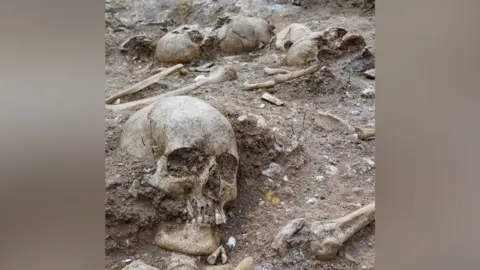
The individual was between 17 and 24 years old at the time of his death, and had been flung face-down, jumbled in with other remains, archaeologists found.
 BBC/Rare TV
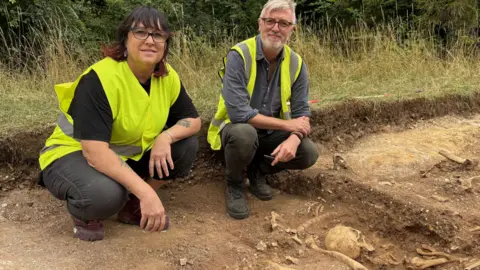
The mass grave was found at the nationally important Iron Age hillfort at Wandlebury, just south of Cambridge.
They appear to date to the 9th Century when the Cambridge area was a "frontier zone" in the conflict between the Saxon-run kingdom of Mercia and the kingdom of East Anglia, which was conquered by the Vikings in about AD870.
Cambridge was sacked by the Viking Great Army in AD874 to 875 and Cambridgeshire remained under Viking control until the early 10th Century.
They were the first human remains found at Wandlebury since 1976 when five skeletons dated to the same era were uncovered.
 Cambridge Archaeological Unit/David Matzliach
Archaeologists were puzzled by the mix of complete and dismembered remains, including skulls without bodies, a stack of legs and four complete skeletons, some in positions suggesting they were tied up.
There was not enough evidence to suggest they were the victims of a battle; one had been clearly beheaded, while another was apparently bound suggesting a possible execution, according to Dr Oscar Aldred, who led the Cambridge Archaeological Unit training dig.
"Those buried could have been recipients of corporal punishment, and that may be connected to Wandlebury as a sacred or well-known meeting place," he said.
"It may be that some of the disarticulated body parts had previously been displayed as trophies, and were then gathered up and interred with the executed or otherwise slaughtered individuals."
 Cambridge Archaeological Unit/David Matzliach
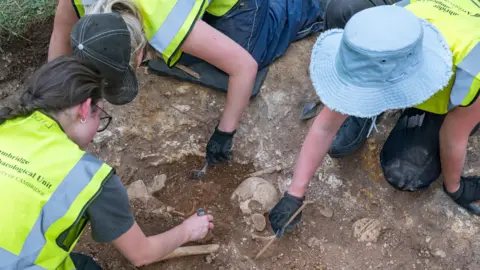
The excavation is part of a five-year project by the university to train the next generation of archaeologists, working with charity Cambridge Past, Present and Future, which owns Wandlebury.
Most of the remains belonged to young men, and student Grace Grandfield, who is from York, said it was a sobering experience to uncover individuals similar in age to her and to "realise the extent of the suffering that had taken place".
Third year student Olivia Courtney, from Bath, said: "It was incredibly rewarding to be active in the returning of identity to these individuals, especially considering the brutal nature of their final moments."
Post-excavation work on the remains will include DNA and isotopic work to investigate health, kinship and ancestral links.
This will also help establish whether they were the remains of Viking invaders or Saxons.
 Cambridge Archaeological Unit/David Matzliach
Tony Calladine, East of England regional director, Historic England, said: "The extraordinary discovery there speaks to the story of our nation and the lives of ordinary people living during turbulent times."
The organisation, which monitors the excavation of protected scheduled monuments such as Wandlebury, has commissioned a new geophysical survey of the area, that archaeologists hope will reveal more about the site surrounding the burial pit.
Digging for Britain is on BBC Two at 20:00 GMT.
Follow Cambridgeshire news on BBC Sounds, Facebook, Instagram and X.
