'Bullet' used in Bonnie Prince Charlie shooting attempt found in bed

 Getty Images
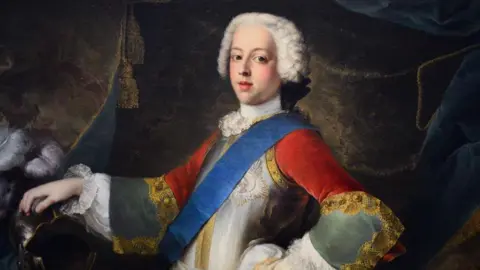
A bullet fragment thought to have been fired at Bonnie Prince Charlie during an assassination attempt almost 300 years ago has been found in the headboard of a bed.
The 13.5mm shard of lead musket ball was discovered while moving the frame at Bannockburn House in Stirling.
Previous research had uncovered a bullet hole in the wall of the room Prince Charles Edward Stuart stayed in while recuperating from illness in 1746.
The latest discovery adds new evidence to the theory the prince was targeted months before the Jacobite rising collapsed.
The prince, who led the rebellion in 1745, was taken to the A-listed house in January 1746 after falling ill during the Jacobite siege of Stirling.
He stayed in a large bedroom in the west wing of the home which was owned by Sir Hugh Paterson, the third Baronet of Bannockburn and a prominent Jacobite supporter.
Volunteer researchers found a musket ball hole hidden amidst plaster work and wooden panelling in the room in April 2024.
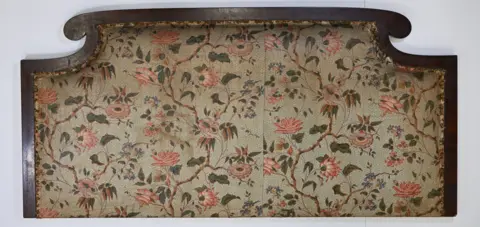
Conservation trustee, Dr Catherine Bradley, said an assessment was being carried out on a bed known to be associated with that room when she noticed the footboard was "unusual".
It was later identified as the original headboard of the bed buried under several centuries of upholstered fabrics.
When the volunteer team moved the bed, an item was heard clattering around inside.
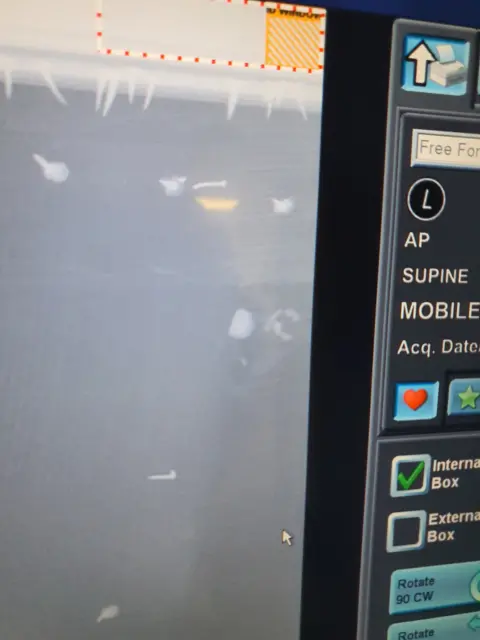
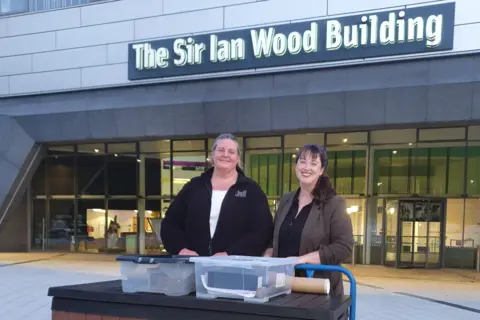
Dr Bradley rented a car to drive the headboard to Robert Gordon University (RGU) in Aberdeen, where Katharine Rubinetti, a graduate student from Johns Hopkins University in Maryland, carried out an X-ray.
That uncovered a "deformed projectile" made of similar material as a musket shot from the 18th century.
 Bannockburn House Trust
Dr Bradley said the discovery was "genuinely exciting," and added to previous evidence of the attack.
She told BBC Radio Scotland Breakfast: "No one thought the bed was really old enough to be the bed that Bonnie Prince Charlie slept in.
"But when we picked it up and moved it, we heard a bit of metal rattling around inside it. It didn't really click until we found the other hole in the panel wall what it was."
Dr Bradley said stories about Bonnie Prince Charlie's stay at the house and written evidence of a shooting had been passed down locally.
But physical evidence had not been found until the last two years.
"This has become a careful piece of historical detective work," she said.
"Every new detail sends us back to the archives, back to the objects, and back to the building itself.
"We're testing stories that have been told locally for centuries and finding that some of them may be rooted in very real events."
 Bannockburn House Trust
Bonnie Prince Charlie was the grandson of King James II of England, who was also King James VII of Scotland.
The Jacobite rising effectively ended after his defeat at The Battle of Culloden in April 1746.
He fled Scotland after the battle via the Outer Hebrides where he was assisted by supporters including Flora MacDonald.
He returned to France but died in Rome, aged 67 in 1788.
 Bannockburn House Trust
But who did dare to take a shot at the prince?
Dr Bradley said the size of the lead ball meant it probably came from a pistol rather than a traditional longer musket.
Its trajectory likely means it was fired from a height of two meters or over, raising the possibility the assassin would have been on horseback.
However, combined with the bullet hole in the wall, it raises the prospect more than one gunman was involved.
Researchers are also investigating whether Bonnie Prince Charlie and his trusted advisors were able to make their escape through a secret network of underground tunnels.
Traces of gold were also found alongside the musket ball, with further specialist ballistics analysis set to be carried out to confirm the exact type of weapon used.
Dr Bradley said: "The more we look, the clearer it becomes that there is still a great deal to uncover."
