'Do you love me?': The Viking messages unearthed on Sweden's rune stones

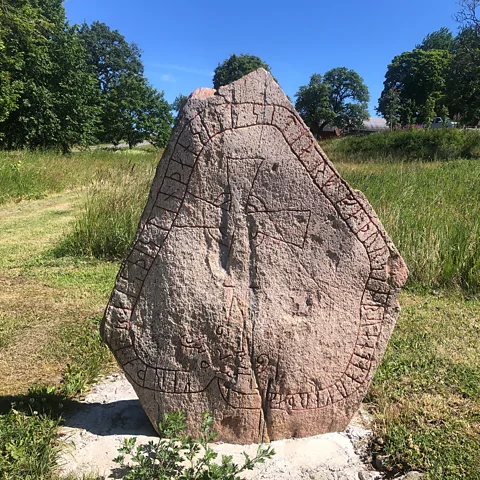 Magnus Källström, the Swedish National Heritage Board
Runic inscriptions from the Viking Age still turn up in Sweden 1,000 years after they were written – revealing fascinating stories of love, loss and epic battles.
A few years ago, Magnus Källström, a Swedish rune expert, travelled to a farm a few hours south of Stockholm to look at a stone covered in ancient runic writing. A farmer had found the stone in a field and had planned to use it as a doorstep until he turned it over and saw rows of ancient, twig-like signs: runes, used by Vikings around 1,000 years ago.
When Källström arrived, the residents at the farm and local archaeologists gathered around him as he stumbled at the first word, then read the text out loud. Word by word, he was voicing a message no-one had read or heard in almost a millennium: "Gärder erected this stone in memory of Sigdjärv his father, Ögärd's husband."
As surprising as this discovery may sound, it's not uncommon for ancient rune stones to turn up by chance in modern-day Sweden and other Scandinavian countries. They emerge as people build bike lanes or plough their fields. Some are extremely old and date to the earliest days of this mysterious script, such as an up to 2,000-year-old rune stone discovered in Norway in 2023. Over their lifetime, some simply ended up as raw material for construction, smashed to pieces to provide a house foundation or accidentally covered in granite under a church doorstep.
For ordinary Swedes like me, the stones are also a familiar part of the scenery. They appear in fields and meadows, in the middle of roundabouts and in industrial parks. Specific signs point to heritage sites near roads, often containing runes – signs that I, once a child stuck in the backseat of the family car on holidays, still associate with boredom. And yet, despite this familiarity, the stones and the enigmatic writing on them still hold many surprises and unsolved puzzles.
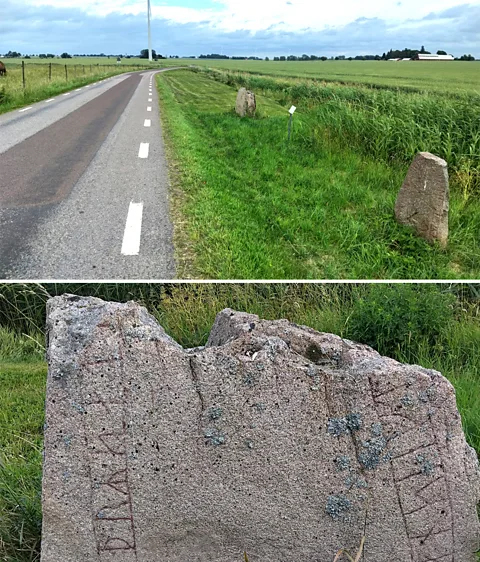 Matilda Welin
The word "rune" stems from the Old Norse word rún, which means secret. Runic writing, a script that has many variations but usually consists of 24 or, later, 16 letters, was first used in northern Europe some 2,000 years ago. It was invented, researchers believe, when merchants and travellers from northern Europe came across scripts such as the Latin alphabet on their trips to southern Europe. They then used those scripts to come up with their own form of writing, capturing northern European languages such as Old Norse.
Runes were written on a range of materials, including wood, bone and stone, and even on ordinary tools. "Do you think of me, I think of you, do you love me, I loveyou", says a message on a textile tool from the end of the 11th Century, found outside Gothenburg. Stone texts, however, are the most durable and visible form. Runic writing can even be found on cliffs, though most commonly, it appears on inscribed stone slabs that are often human-height or taller; rune stones.
Rune stones were put up as "memorial stones, often erected where people pass by, roads and fords and council places and such, visible and public", says Källström, the foremost expert of runes of the Swedish National Heritage Board. The stones became popular in Scandinavia from around 300 AD, but their golden age is associated with Viking times, between the years 800-1050 AD. In fact, the stones have even been described as the social media of the Viking Age.
However, commissioning a stone wouldn't have been cheap, Källström explains, and often, a professional carver was employed. "You can suspect that it wasn't for just anybody," he says. They were popular during the time missionaries brought Christianity to Sweden, Källström says, and the scripts often included references to the new faith, such as calls for prayers to be read for the dead, alongside decorations of crosses.
But runes were used more informally, too, for jokes, riddles and puns, according to Källström. He gives the example of animal bones carved with runes for training. When read from one direction and then turned 180 degrees for the rest of the text, they spell out messages like: "ráð þat" (decipher this), or, "ǫlgott", (tasty beer).
"So that's a form of Viking party trick, like: 'What does this say?'," he says of the riddle bones. "That's one of my favourites."
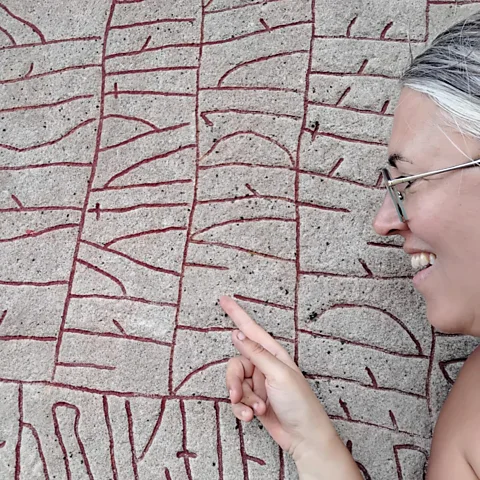 Matilda Welin
Runes for the afterlife
Most of the stones were erected in what is today southern Sweden and southern Norway. Others can be found in Denmark, on Iceland and in the UK, where runes were used to write Old English. Some have even been found as far east as in Turkey or as far west as Greenland, showing how widely the Viking culture was spread, through epic voyages and invasions. In all, there are around 7,000 known rune inscriptions around the world. As Christianity and influences from the rest of the world took further hold of Sweden in the 1100s, the runic script started falling out of use, replaced by Latin letters.
Today, the stones have faded to grey, but in their time, they were typically painted with natural dyes in an eye-catching colour, such as pink. The texts of them tend to follow a standard format, marking someone's death, sometimes with additions about what they achieved in life and with well-wishes for their afterlife:
"Here shall these stones stand, reddened with runes: Guðlaug raised [them] in memory of her sons; and Hjalmlaug in memory of her brothers," reads one stone from around 1,000 AD, found west of Stockholm.
"Tóla placed this stone in memory of Geirr, her son, a very good valiant man. He died on a Viking raid on the western route," reads another stone from roughly the same era, around 1,000 AD, found north-west of Gothenburg.
The stones sometimes also had a practical purpose, marking borders or stating an old form of land inheritance rights, known as odal in Old Swedish. Some evoke dramatic conflicts. "Bjǫrn, Finnviðr's son, had this rock-slab cut in memory of Óleifr, his brother," says one in northern Stockholm, also from about 1,000 AD. "He was betrayed at Finnheiðr. May God help his spirit. This estate is the allodial land and family inheritance of Finnviðr's sons at Elgjastaðir."
And some reveal glimpses of love, loyalty and private grief, as in the case of a stone found near the town of Sala: "The good husbandman Holmgautr had (the stone) raised in memory of Óðindísa, his wife. There will come to Hǫsumýrar no better housewife, who arranges the estate. Red-Balli carved these runes. Óðindísa was a good sister to Sigmundr."
A man called Jarlabanke raised several, many still standing along the road bank he constructed. All honoured… himself. As one said: "[Jarlabanke] had these stones raised in memory of himself while alive, and made this bridge for his spirit, and (he) alone owned all of Tábýr. May God help his spirit."
For Källström and other experts, the craftspeople who carved the stones can become recognisable by their style. This has helped piecing together broken and dispersed rune stones, completing jigsaws and spelling out messages that had been scattered for centuries.
Apart from letting us into the Vikings' lives and deaths, runes may also tell us about the wider world of the time – including the climate.
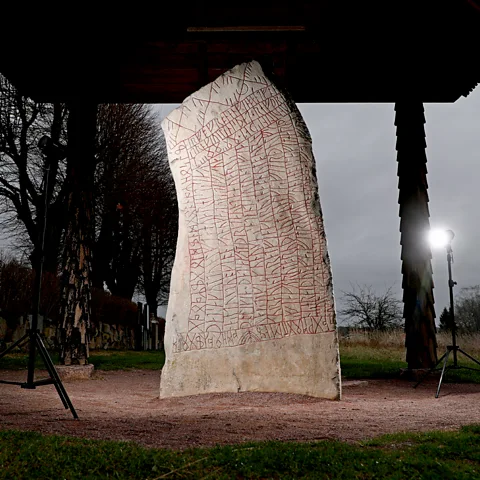 Alamy
AlamyA Viking climate riddle?
The sleepy village of Rök sits on a plain some 250 kilometres south west of Stockholm. Here, under a specially-built roof outside the local church, stands the Rök stone, the focus of one of the biggest debates gripping rune scholars today.
Erected in the 9th Century, a few hundred years before the runestone boom and when Sweden was still mainly pagan, it carries the world’s longest rune text.
"After Vamoth stand these runes," it starts. "And Varin, the father, made them after the death-doomed son." Then follows line after line of riddles.
For a long time, the text was understood to be related to Gothic king Theoderic and to heroic deeds. But over the last decades, bit by bit, this interpretation has been questioned. The text’s themes about a father grieving his dead son were highlighted, and in 2020, Professor of Runology at Uppsala University Henrik Williams, Professor of Scandinavian Languages at the University of Gothenburg Per Holmberg and their colleagues suggested that the stone tells of our dependency on the weather – specifically about a cold snap three centuries earlier, caused by volcanic eruptions and leading to many deaths.
I visit it a day in June.
As I approach the stone, gusts of wind tug at the crops in the fields surrounding the church. Church bells are ringing and an elderly couple exit the graveyard and drive away in their car. Then, I am alone. Everything, except the wind, is quiet. I lean against the stone and find it is steady. I cannot believe anyone can read the enigmatic red patterns etched into it, but later, I listen to a clip of Professor Williams reading the inscription aloud: a ghostly, insistent call from the distant past.
The new interpretation of the Rök text made headlines around the world. But does it say more about the modern lens through which we look at history than of history itself? "Each era has its interpretive frameworks," Holmberg says when I ask him. Nationalism was popular in the early 1900s, and the old King Theoderic interpretation has "certain nationalistic overtones" which matches this well, he explains.
Similarly, he says, some of his colleagues have cautioned that the new climate interpretation may be based on reading the text in the light of our own current worries about global warming.
However, in his view, the climate interpretation makes sense because past societies did worry about the climate and weather: "It becomes kind of a funny thing, like, 'the Vikings had climate anxiety', as it was written in the press a little jokingly," he says. "But everyone had climate anxiety before the breakthrough of the industrial and modern world. People thought: 'How are we going to cope? Aren't the harvests worse now than before, than in my dad's time?' [Climate] has [always] been the big topic of conversation."
Holmberg suggests that there are clues in the way the stone is placed, and even its font sizes and angles. Maybe, he says, it was meant to point to the sun at the spring and autumn equinox, or to certain stars, and these natural features would have been part of the riddle and its solution.
Henrik Williams, who wrote a book about the Rök stone, says it is difficult to interpret. "I think the stone worked the same way religion does today at funerals, when the priest talks about the Bible or so," he says. It uses myths to console the grieving: "The son is said to travel to Odin and then he fights in Ragnarök, the final battle. He has died prematurely, so this thought gives his dad comfort."
I leave Rök and cycle on, the wind in my back. Soon, I pass a pair of metre-high, worn-down rune stones, easy to miss in the grass along the road. They are bathed in the swishing noise of the rotating blades of a nearby wind farm.
Today, some people still experiment with and imitate runic writing. Rune-like artwork decorates my mum's underground station in Stockholm. The signs are used in playful online quizzes where you can find out your own "birth rune", tapping into a Viking belief that linked runes to dates and predicted destinies.
But there is also a darker side to the modern-day use of runes: ever since the Nazis appropriated runes and Old Norse mythology to construct the idea of a Nordic race, what was originally a practical, border-crossing writing system has been used as a symbol of racist views and far-right sympathies.
Cycling through the Swedish countryside, past these millennia-old inscriptions, I see the familiar stones with new eyes. Because of their sheer size and weight, the stones can't just be gathered up easily like old manuscripts, and instead they are still scattered across the landscape. Moving them requires major effort. In fact, the day before our planned interview, Källström emailed me to reschedule, because he had to go supervise the tractor move of a restored stone to the church where it is normally on display.
As for the stone that was found by a farmer, and which Källström read out to a small, spontaneous crowd: it's been moved from the field, and now stands in front of grassy slopes and trees, secured in a concrete casting. The sun is shining on its pockmarked surface. The message about Gärder, Sigdjärv and Ögärd, which Källström was the first to read for 1,000 years, is displayed to the world yet again.
--
For essential climate news and hopeful developments to your inbox, sign up to the Future Earth newsletter, while The Essential List delivers a handpicked selection of features and insights twice a week.
For more science, technology, environment and health stories from the BBC, follow us on Facebook and Instagram.
