Henry VIII's lost castle and the ghost of the Devil's Post

 BBC
BBCBeneath the towers of a formidable fortress, a big, burly sergeant stands sentry in the still night air. From across a river, a clock chimes midnight. Suddenly, he sees something that chills him to his bones. Then, he collapses in terror.
Afterwards, as he recovers in hospital, the sergeant claims to have seen the spectral figure of a young lady. And, as the story goes, he was not the first to do so.
Many soldiers and even a clergyman claimed to have seen the mysterious woman at the old Hull Citadel – a castle built by King Henry VIII. Such was their fear, the sentry point became known as the Devil's Post.
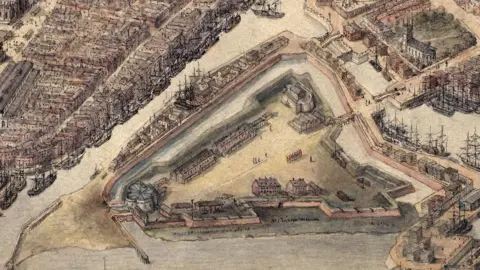
Today, the Citadel is long gone and the site where it stood, in the Drypool area of the city, is home to The Deep aquarium and a housing estate.
But, more than 160 years after the fortress was demolished, the chilling tale of the Drypool ghost continues to puzzle and intrigue people, as the Hidden East Yorkshire podcast has been hearing.
Neil Chadwick, an archivist at the Hull History Centre, says what is known about the ghost today comes from a letter in the Leeds Mercury newspaper, written by an individual called JD Bramley, and published in 1889.
"JD Bramley recalls in this letter that, shortly after midnight, the ghost of a girl or a young lady would appear at a certain sentry point.
"She would walk the walls. And then, all of a sudden, no sooner than she had appeared, she'd vanish, not to be seen again until the following night."
According to the letter, rumours went around the Citadel's garrison and the soldiers became petrified. The story spread to the people of Hull, across the river from the fortress.
So, one night, four soldiers and a chaplain decided to meet at the sentry point where the ghost of the woman had been seen.
"The chaplain and the men stand there at guard, and, all of a sudden, just after midnight, the ghost of this young lady appears," Neil explains.
"She has a candle in her hand, apparently.
"The chaplain freezes in fear, absolutely petrified. But the other men rouse him and he challenges the ghost, asking where do you come from?
"And the young lady turns around and beckons the group of men with a hand, saying, 'follow me, come with me'.
"They walk along the garrison walls to the north-east corner. She points to the ground, to a patch of grass, and then she disappears."
 Hull History Centre
The next day, so the story goes, the men dug up the grass and found human bones.
"It's clear it's a body. Somebody must have been murdered. That's the belief," Neil says.
Eventually, one of the soldiers confessed to meeting a girl there.
"They would meet at the sentry point and eventually something happened between the couple and he ended up murdering her and burying her."
From that time on, the ghost was never seen again.
So, is there any truth to the tale, or was it simply a ghost story spun from memory, myth or mischief?
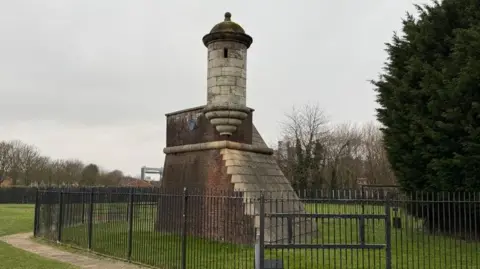
"For those people who played in East Park as youngsters, on the rocks, or the rockies as they were called, there was a guard tower," Neil says.
"And that tower was originally at the Citadel. The children would play on the rocks and hide in the tower.
"Perhaps that was the sentry point, we don't know."
Today, that tower can be seen close to the site of the Citadel on Victoria Dock.
"We don't know who the girl was," Neil adds. "Presumably she was a local girl but, having searched the records, we've got no reference to a girl going missing.
"We've certainly got no record of a girl being found on the grounds of the Citadel."

Perhaps, however, there is a more plausible explanation.
The letter published in the Leeds Mercury set the events in the early years of the 19th Century, around the time of the Battle of Waterloo.
"The regiment who arrived in Hull in 1815 may have been the 92nd Highlanders," says Neil.
"They'd marched from Colchester to Hull. They'd just returned from the continent from the Napoleonic Wars.
"A new regiment in town - it's going to attract children. People are going to be interested.
"These children might be a nuisance to the soldiers, so then the soldiers create this story to keep the children away, that there's a ghost.
"In fact, it just caused more intrigue really, and certainly the account written by JD Bramley suggests that it became quite an interesting event at that time in Hull."
Today, there are plans to build a new visitor attraction on the site of the Citadel.
And it is perhaps unsurprising that the fortress was a magnet for ghost stories.
"The Citadel was built in the 16th Century. It was in use for 300 years," Neil explains.
"Certainly, we know during the reign of Elizabeth I, Catholics were held in there and tortured and killed in the old block houses.
"So it's got a long history. It's perfectly plausible that a number of ghosts perhaps haunted the citadel. The Drypool ghost was perhaps just one of them."
Listen to highlights fromHull and East Yorkshire on BBC Sounds, watch the latest episode of Look Northor tell us about a story you think we should be coveringhere.
Download the BBC News app from the App Storefor iPhone and iPad orGoogle Play for Android devices
