The motorcyclist fighting a deadly disease in the African bush

 Kang-Chun Cheng
As a child he survived the world's second deadliest parasite. Today he is working to stop this little-known killer from the back of a motorbike.
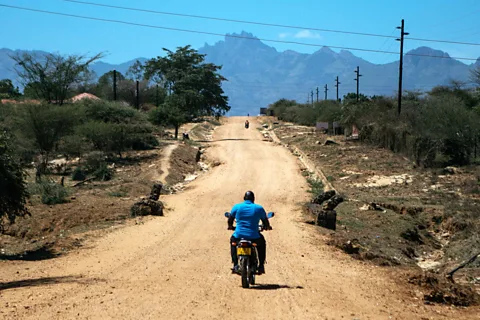
Andrew Ochieng dons his helmet and swings his legs astride his trusty motorbike. He's armed with medical testing kits and decades of experience. For years, Ochieng has crisscrossed the vast rural landscape of the Kenya-Uganda border region on a mission to thwart a terrible, and potentially deadly disease. Few people have ever heard about visceral leishmaniasis, known locally as Kala-azar, or the devastation it can cause.
But Ochieng is well aware – he has survived it himself. "I felt so sick," says Ochieng, remembering his own experience of the disease. His fever lasted for weeks. Like being run over by an 18-wheeler, he adds. He was around 12 years old at the time.
Ochieng's parents and neighbours had no idea what was wrong with him. They brought him to a traditional healer for treatment, who cut his stomach with a razor blade, then smeared it with camel and cow dung that had been burned in a fire. They also fed him bitter herbs. Eventually, he received medical attention. But he still remembers the pain. Hospital staff gave Ochieng 60 injections over the course of nearly two months. To this day, Ochieng bears scars from the traditional healing ritual on his torso.
Driven by a motivation to prevent other people going through the same ordeal, Ochieng now works as a community mobiliser for Drugs for Neglected Diseases Initiative (DNDi), a non-profit organisation.
More than 600 million people globally are at risk of contracting visceral leishmaniasis, with the vast majority (73% in 2022) of cases confined to East Africa. The disease remains poorly studied and relatively unknown outside of the impoverished communities it afflicts. A parasitic disease, it actually kills more people than any other parasitic disease, except for malaria.
An estimated 50,000 to 90,000 cases of visceral leishmaniasis occur worldwide every year, yet only between 25-45% are reported. The disease, which is spread by sandfly bites, causes fever, weight loss, liver and spleen swelling and can advance to psychosis and even death. The name, "visceral", refers to its effects on internal organs such as the liver.
Visceral leishmaniasis has a 95% fatality rate if left untreated. It's also a disease that particularly affects children. Half of cases in 2022 occurred in children under 15, according to the World Health Organization.
Crucially, current treatments for visceral leishmaniasis are painful and toxic – not unlike chemotherapy for cancer patients. Patients generally receive twice-daily injections for at least 17 days in a hospital setting. That's a total of 34 jabs. Scientists are looking for less drastic solutions – and ways of informing communities about the disease, in the hope of reducing the number of people who get infected.
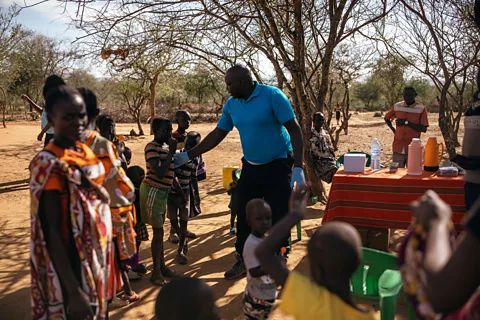
Ochieng is part of the effort. At Akorikeya village, a 20-minute drive north of Amudat in northeastern Uganda, he sets up his workstation beneath an acacia tree where men gather to drink milky tea every day.
 Kang-Chun Cheng
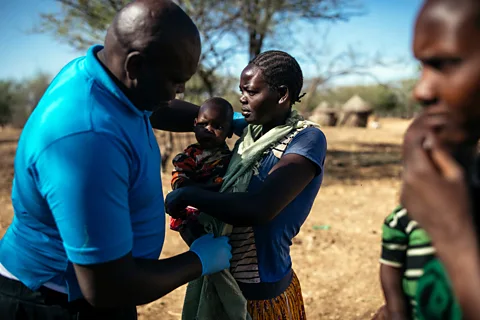
Akorikeya is home to a few hundred people. He begins by taking stock of the villagers' appearances and energy levels, giving special attention to the children. He then examines everyone's lower left torso in order to check for a swollen spleen – one of the tell-tale symptoms of visceral leishmaniasis.
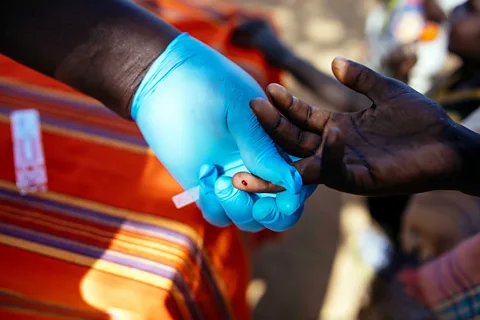
Those who exhibit symptoms, including joint pain, on-and-off fevers, and nosebleeds, undergo a RK39 rapid test, which uses reacts with antibodies from a spot of blood and yields a result within 10 minutes.
Ochieng also carries with him rapid tests for HIV, since those who are immunocompromised are particularly susceptible to the disease. (A HIV patient is 100 times more likely to develop visceral leishmaniasis).
"From September to February, you see higher [visceral leishmaniasis] cases," says Ochieng. The short rains during this period encourage sandfly nesting and hatching, he explains.
In a normal month, he might travel to as many as 16 villages. He checks in on former patients, hoping that they have not suffered a relapse, or investigates reports of new cases.
The drylands in this area are the ancestral home to the Pokot ethnic group, who cross back and forth from Kenya to Uganda in order to water and feed their animals. They sometimes travel more than 50km (31 miles) in a day on foot. That makes it tricky for Ochieng to keep track of Kala-azar patients for follow ups.
"Sometimes when I'm returning to check in on a patient, I find that they've moved," he says.
And so his detective work begins, asking neighbours if they know where a certain individual has gone, and when they left. With a handful of leads, he'll jump back on his motorcycle and head off on his search, looking for a wandering human somewhere in this extraordinary, parched landscape.
 Kang-Chun Cheng
While visceral leishmaniasis transmission may be blamed on sandfly bites, there are also socioeconomic factors that affect its spread and impact.
"Visceral leishmaniasis affects only the poorest of the poor – those who are chronically malnourished and sleep in places lacking a concrete floor," says Joy Malongo, an access manager at DNDi.
A lack of access to healthcare, nutrition, proper sanitation and population displacement all influence visceral leishmaniasis cases. Research suggests that environmental factors including irrigation schemes, deforestation and climate change raise relative humidity and temperature, thus encouraging sandfly breeding and resting sites.
When Ochieng finds someone suffering from visceral leishmaniasis, he often takes them to Amudat Hospital in northern Uganda, near the border with Kenya, on the back of his motorbike.
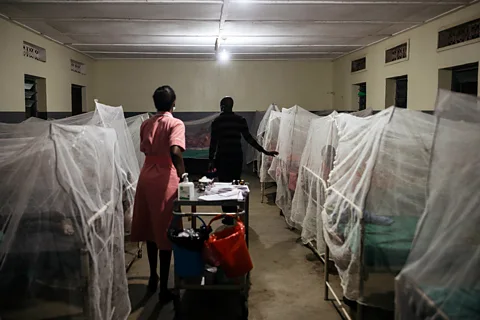
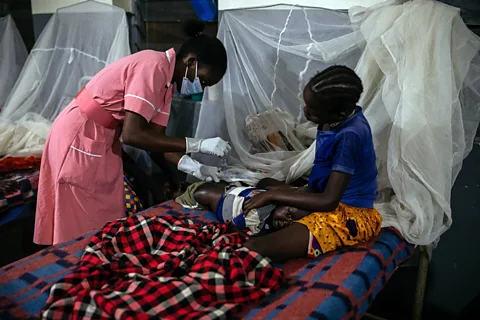
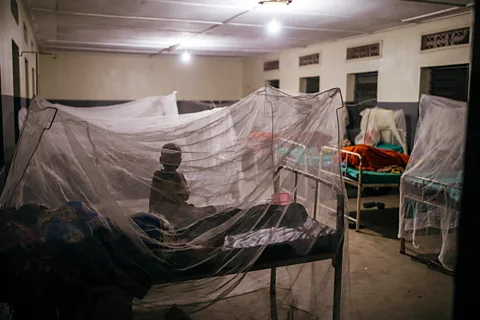
When I visit the hospital for myself, I go early in the day. It's barely 05:00 in the morning, but Priscilla Chebjira, the head nurse at Amudat Hospital, has already prepared daily treatments for the 34 patients in the Kala-azar Treatment Centre.
Wearing a bubble-gum pink uniform, Chebjira and her colleague roll a trolley laden with injections – mainly cocktails of sodium stibogluconate (SSG) and paromomycin (PM) – into the first of two wards. The patients, from infants to adults, stir beneath the mosquito nets covering each bed.
 Kang-Chun Cheng
The need for improved interventions is all too clear. Many of the ailing younger patients are accompanied by their mothers, though some of the children's guardians are barely adolescents themselves. As the nurses work their way down the beds, injecting patients on their exposed buttocks, the youngest cannot help but wail in pain.
More like this:
• The global fight against snake bites
• Why clean air is a luxury that many can't afford
• The rare disease that stops people from feeling fear
Patrick Sagaki, a doctor and medical superintendent from Jinja at the mouth of River Nile, has treated visceral leishmaniasis patients since he arrived at Amudat Hospital in 2007. At the time, he was the only medical officer in the region specialising in visceral leishmaniasis. "I saw that there was really a need," he says.
But he knows there are many more cases that never receive adequate treatment. The remoteness of Kenya's West Pokot County and Uganda's Karamoja region mean that it is difficult to identify cases. And active searches are costly. "If it weren't for DNDi, we probably couldn't reach most of these Pokot," says Sagaki.
Pokot men prefer sleeping outside but that makes them more vulnerable to sandfly bites. And villagers tend to resist destroying the anthills where sand flies breed, since they eat white ants during the rainy season.
 Kang-Chun Cheng
Sagaki does not have access to all the treatment options he would prefer. Liposomal amphotericin B (L-AmB), which is the first-line treatment for visceral leishmaniasis in India, is logistically challenging to store and administer in many parts of East Africa as it needs to be kept refrigerated. It must also be administered intravenously. L-AmB is a second-line treatment in the region, supplied through a donation programme from Gilead, an American biopharmaceutical company, to the WHO – countries do not directly procure it for visceral leishmaniasis treatment.
In Kenya and Uganda. the current standard treatment is a 17-day combination of SSG and paromomycin (PM), which replaced the older 30-day SSG treatment in 2010. While this shorter regimen represents progress – the combination therapy is generally more cost-effective and has a lower risk of the parasite developing resistance, it still includes SSG, meaning that potentially life-threatening side effects on the heart, liver and pancreas remain.
Children are generally excluded from clinical trials of treatments for neglected diseases like visceral leishmaniasis. A 2019 study found that, across 360 clinical trials for neglected diseases, only 17% included people under 18.
However, in 2018, DNDi launched an open-label clinical trial of a new treatment: miltefosine (MF) with paromomycin (PM). During the roughly two-year-long trial, 408 patients from seven sites in Kenya, Uganda, Sudan, and Ethiopia received either SSG and PM, or MF and PM. Many children were included in the trial – the median age of participants was 11.
After six months, both cocktails of treatments were found to have had a high efficacy, of over 91%. However, the MF and PM option was judged to be more patient-friendly, requiring one less injection per day, a three-day shorter treatment course, and there were fewer SSG-associated risks such as heart damage.
But even with improved treatments, the stark reality is that reinfections can be inevitable, according to Malongo. "It depends on where patients return and whether there are any improvements in lifestyle. If they're going back to the same [living] situation, nothing's going to change."
 Kang-Chun Cheng
Sagaki still sees patients coming in too late or with marks from traditional healing practices. But he is also aware that some former Kala-azar patients have recognised symptoms in people from the same community and subsequently referred them to Amudat Hospital.
There were serious outbreaks of visceral leishmaniasis in Kenya in 2020 and 2022 and nearly four million Kenyans are estimated to be at risk of infection from the disease during upsurges such as these.
Sagaki says, however, that visceral leishmaniasis elimination is achievable when proper interventions are made. "Look at Bangladesh," he says. "They identify cases very fast, and access [to treatment] is easy. Locals there know much more about visceral leishmaniasis than Ugandans and Kenyans."
Among the people I meet on my journey with Ochieng is Chemket Selina, now a mother of four children. As a child, she had malaria and typhoid but when she was stricken by fatigue and a burning fever for more than a month, no-one knew what was wrong with her until Ochieng came and diagnosed her.
He ferried her on the back of his motorbike to Amudat Hospital, some 20km (12 miles) away.
Now, she worries about her own children's health. She is in her twenties but unsure of her exact age. People in this part of the world tend to mark the passage of time by rains, rather than calendar years. Either way, she looks older than she really is. In Pokot culture, women bear all the essential burdens of life, from birthing children and fetching water to building houses and cooking.
 Kang-Chun Cheng
Ochieng finds that, thankfully, her four young children all appear to be free of the disease. But the risk of visceral leishmaniasis, and poor health exacerbated by poverty, is constant.
Selina's family eats just once a day, in the morning: tea, ugali (boiled maize meal), and sokoria leaves, which she plucks from a tree. Selina boils them, pounds into a mash and then fries the mixture. "What we can find is what we eat," she says, her toddler clinging to her side.
She still remembers the painful injections she received all those years ago. But, to her, that made them more effective than any other kind of medication. It is a common belief here, according to Sagaki – that pain is the best way to deal with disease.
--
For trusted insights into better health and wellbeing rooted in science, sign up to the Health Fix newsletter, while The Essential List delivers a handpicked selection of features and insights.
For more science, technology, environment and health stories from the BBC, follow us on Facebookand Instagram.
