'His brilliance is in danger of being diluted': Has pop art icon Keith Haring been 'sanitised'?

 Getty Images
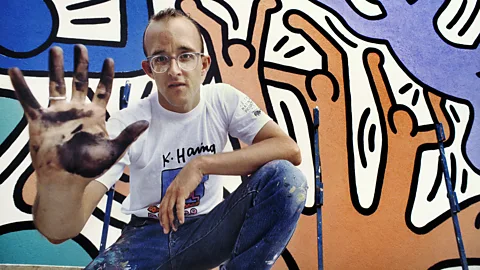
From shop rails to gallery walls, the late New York artist's distinctive humanoid figures are ubiquitous these days – but some worry his work's real meaning is being lost.
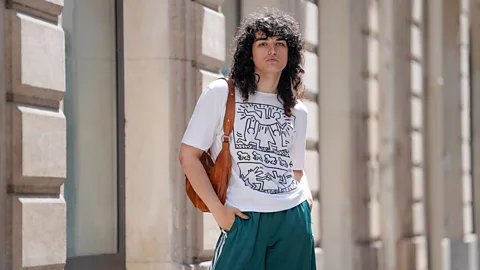
Thirty-six years after his death, Keith Haring's kinetic pop art is arguably more popular than ever. His distinctive and dynamic drawings of colourful humanoid figures adorn T-shirts and hoodies that are widely available at high street stores like H&M and Uniqlo. DJ and electronic musician Honey Dijon, who collaborated with the artist's estate on a 2022 fashion line that printed Haring's uplifting illustrations on ponchos and jumpsuits, has described his work as "hieroglyphics of the soul".
Haring's creations have proved so malleable that his iconic dancing figures have even been turned into a 3D Lego set. All of these brand collaborations fill the coffers of the Keith Haring Foundation, which in 2024 distributed more than $5.7m (£4.3m) in charitable grants.
Established by Haring in 1989, a year before he died of complications from Aids, the foundation supports organisations that help children as well as those involved in HIV/Aids education, prevention and care. The brand collaborations it brokers don't just raise money for charity, but also make Haring's work accessible – something very much in keeping with his famous credo that "art is for everybody".
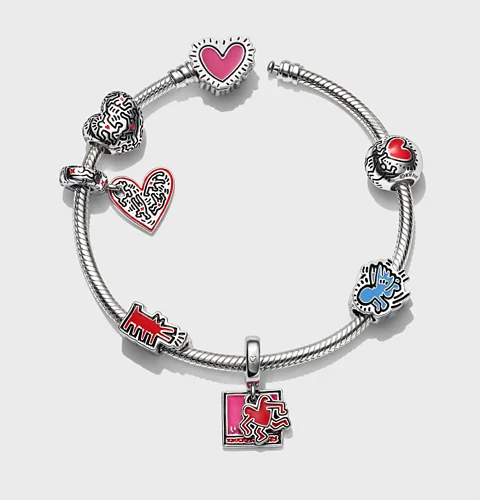
However, some of the brands that pay for Haring's creativity and cultural cachet take a rather selective approach to honouring his legacy. In 2022, jewellery manufacturer Pandora was criticised for failing to mention Haring's sexuality and HIV/Aids activism in the messaging for a collection of charms, necklaces and rings using his designs. It simply described them as "inspired by [his] pioneering principles of inclusivity and diversity".
 Getty Images
That year, the foundation's then-executive director Gil Vazquez acknowledged to The Guardian that "we are often accused of not highlighting Keith's fight against HIV in our licensing programme". Yet in the same email, Vasquez maintained that "we don't think it is fair to force a brand to tell a story that doesn't make sense for them". The BBC has approached the foundation's current executive director Simon Castets for comment.
Haring is hardly the only late artist whose legacy has been embraced by brands in a way that some commentators view as crass commodification. Similar quibbles surround Jean-Michel Basquiat, his friend and contemporary in 1980s New York, whose street art has also been turned into an H&M collection, and Mexican painter Frida Kahlo, whose early 20th-Century folk art now decorates everything from a makeup range to a moka coffee pot. All these cases raise a debate about whether artists can become too commercialised to the detriment of their art's meaning.
The layers of his work
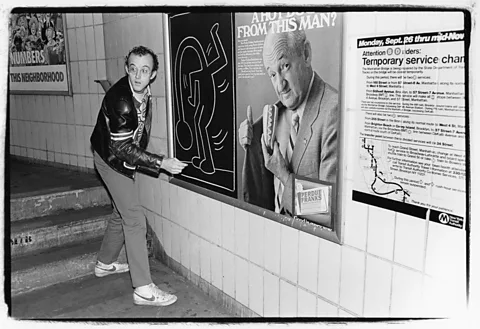
Despite some critiques of the way his work is licensed, Haring's stock as a serious artist has arguably never been higher. Last week, an exhibition dedicated to his formative years in early 1980s New York opened at The Brant Foundation in Manhattan. Now this week, an entirely separate exhibition featuring Haring's highly influential subway drawings is opening at the Moco Museum in London. Titled Voice of the Street, it features some of the thousands of graffiti illustrations that Haring drew with chalk on blacked-out advertising panels in New York subway stations between 1980 and 1985.
"Where other people saw the emptiness of a blacked-out space, he saw a real opportunity," Kim Logchies Prins, the founder and curator of Moco Museum, tells the BBC. "His mission was to break down barriers so that art wasn't only available in high-end galleries; he was literally giving it to people on their way to work." Indeed, Haring only stopped making his subway drawings when people began stealing them to sell to collectors.
Haring's subway drawings were supposed to be spontaneous and ephemeral – he started sketching them while bored waiting for trains – but they helped him to hone an instantly recognisable aesthetic that has proved enduring. His work's continued appeal is predicated on the accessibility that Haring, who grew up in small-town Pennsylvania before moving to New York in 1978, baked into the way he made and disseminated his art.
Dr Fiona Anderson, a senior lecturer in art history at Newcastle University in the UK, tells the BBC that "anybody looking at a Haring [piece] can get something out of it". However, she also believes that his pieces operate on multiple levels. "You can analyse his work in relation to semiotics, the study of signs and symbols," Anderson says, "but you can also look at a staple Haring image like a barking dog or the 'radiant baby' and enjoy it [more simply] as a joyful, playful icon".
 Laura Levine/ Corbis via Getty Images/ Moco
During his lifetime, Haring kept devising new ways to make his art widely available. In 1986, a year after he pressed pause on his subway drawings, he opened his famous Pop Shop on Lafayette Street in Manhattan's SoHo district. The store, which remained open until 2005, sold everything from fridge magnets to Swatch watches covered in Haring's signature designs.
As the New York Times reported when Haring died in February 1990, Haring defended his decision to commercialise his work in this way by insisting it was based on principle, not profit. "I could earn more money if I just painted a few things and jacked up the price. My shop is an extension of what I was doing in the subway stations, breaking down the barriers between high and low art," Haring maintained.
When a second Pop Shop in Tokyo closed after a few months in 1988 due to disappointing sales, Haring observed drolly that "there are just too many Haring fakes available all over Tokyo and, this time, they're really well done". In a way, the proliferation of counterfeit merchandise was an ironic sign that he had made it.
At the same time, Haring was always open to a commercial commission. He designed posters for the Montreux Jazz Festival in 1983 and 1986 – the latter a collaboration with Andy Warhol, whose populist approach he was greatly influenced by – and a poster for Absolut vodka in 1986. He also designed record sleeves for David Bowie and disco singer Sylvester, body-painted Grace Jones for her 1984 photo shoot with Warhol's Interview magazine, and created stage outfits for his friend Madonna.
None of this diminished a fierce political streak in his work. Another famous Haring poster promoted the Free South Africa movement, which sought to end the country's racially segregated apartheid regime. In 1986, he painted an attention-grabbing mural in Manhattan to raise awareness of growing crack cocaine use in US cities. Its snappy slogan – "crack is whack" – was later quoted by Whitney Houston in an infamous 2002 TV interview.
Perhaps most notably, Haring created a wealth of imagery for the HIV/Aids campaign group ACT UP (Aids Coalition to Unleash Power), including a powerful poster proclaiming that "ignorance = fear" and "silence = death". In effect, Haring became an activist by speaking publicly about his diagnosis with HIV in 1987 and then with Aids a year later. One of his final paintings was poignantly titled Unfinished Painting; Haring left most of the canvas blank to highlight the way his life would soon be cut short by the disease.
Why Haring is so in vogue now
Art historian Dr Jay Hicks, creator of the Start Art History podcast and gallery tours, argues that Haring's commitment to distributing his art through so many different channels was ahead of its time. "He kind of established the template for the multi-hyphenate cultural producer," Hicks tells the BBC. "He's collaborating with famous brands, making merch and doing activism, all at the same time. Any student in art school now wants to build that kind of career."
Ian Giles, a London-based artist whose work explores queer histories, collective memory and language, believes Haring's commercial savvy helped to pave the way for others to find "new funding routes" to sustain their artistic practice. "Haring was such a striking iconoclast that his work was always going to translate really well as bold imagery on a T-shirt or bucket hat," he says.
 Pandora
Along the way, Haring's art seems to have gained a vague but evocative cultural cachet. "I think his aesthetic has become synonymous with an idea of 'good old times' in the late 20th Century: times that people think of as better, or at least simpler, than now," Hicks says. He suggests that Haring-branded clothing items appeal to Gen Z consumers in particular because they represent "the enduring cool of the 1980s queer underground in New York", but also tap into our collective nostalgia for all things 1990s. Though Haring died just six weeks into the decade of Friends and Britpop, his work continued to wield an influence. "If you look at the graphics and visuals of early 1990s MTV, they're often very Haring-esque," Hicks says.
More like this:
• The tragedy hidden in a 19th Century painting
• The messy bed that sparked a media frenzy
• The modern art masterpiece that sold for $236m
It all adds up to a legacy as multifaceted as Haring's own creative practice. Hicks believes art critics and museum curators take him more seriously now than when he was alive because his enduringly resonant activism adds gravitas to impulses they initially dismissed as "populist". However, it is precisely this aspect of his work that is vulnerable to being glossed over by brands who turn his work into merchandise.
On the website for its Haring-inspired collection, H&M mentions Haring's "strong social messages" without going into specifics. "Any brand that tries to gain cultural capital from Haring without acknowledging his queerness is under-selling him and not engaging with his work in its truest sense," Anderson says.
Dan Glass, an author and activist for ACT UP London, agrees. "Haring dedicated his creative expression to some of the most demonised and oppressed people on the planet – people living with HIV/Aids," he says. "His art was more than just pretty pictures on the subway or gallery walls. It was a joyful stand against oppression and for the liberation of the masses."
In Glass's eyes, the artist's "true brilliance is in danger of being diluted and sanitised" if his activism isn’t baked into every brand collaboration as a key ingredient. He believes that Haring's legacy could "shine even brighter" in the future if the foundation committed to only "aligning with brands that genuinely contribute to mass positive transformation [in the world] rather than those "simply using [Haring's work] for their own profit margins".
At this point, Haring's art isn't just more popular than ever; it also means different things to different people. It's impossible to know whether Haring would approve of every single way his work has been displayed and distributed since his death, but its lasting mass appeal seems to chime with something he once wrote in his journals, which were published in 2010: "I am interested in making art to be experienced and explored by as many individuals as possible with as many different individual ideas about the given piece with no final meaning attached. The viewer creates the reality, the meaning, the conception of the piece."
Voice of the Street: Keith Haring's Subway Drawings is at Moco Museum, London from 18 March until 18 June. Keith Haring is at The Brant Foundation Art Study Center, New York, until 31 May.
--
If you liked this story, sign up for the Essential List newsletter – a handpicked selection of features, videos and can't-miss news, delivered to your inbox twice a week.
For more Culture stories from the BBC, follow us on Facebook and Instagram.
