'It was a real battle of the titans': The moment one polar bear took on a walrus herd

 BBC/ Planet Earth
Twenty years on, relive the iconic scene from Sir David Attenborough's Planet Earth that changed our understanding of how polar bears adapt to survive.
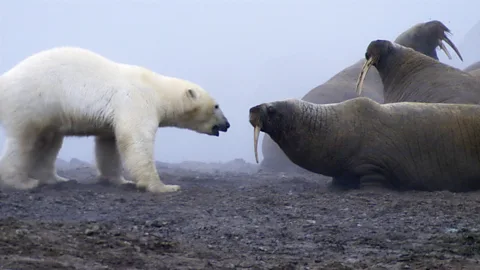
It is an extraordinary scene: a lone male polar bear attacks hundreds of walruses – circling them and persistently trying to penetrate their six-inch blubber to secure a long-awaited meal.
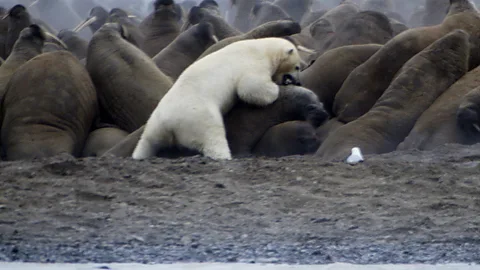
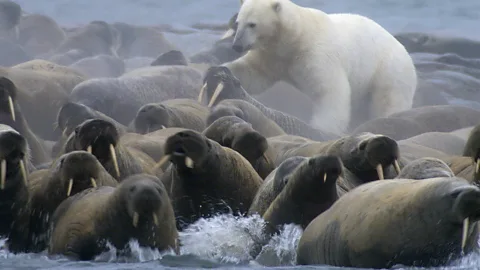
Using the foggy landscape as cover, he approaches a walrus colony. The adult walruses work as a team, pushing their young into the centre, and creating a barrier of blubber and hide. The bear begins its ambush tentatively, jumping up onto a walrus' back to find a chink in the armour to reach the pups. He targets a female walrus, repeatedly biting her neck. She fiercely shields her pup, and his claws and teeth are unable to pierce through her thick hide. The herd start to flee into the sea, and the bear becomes increasingly desperate, turning to fight the adult walruses.
His chance of securing his first meal in months is slipping away. The bear latches onto an adult walrus, but the flailing animal uses its immense power and manages to slip from his grasp.
At the end of the sequence we see the bear limping, deafeated, and gravely wounded from the walruses' tusks.
Watch the video at the end of the article to see the ferocious battle unfold.
This dramatic sequence was captured by award-winning underwater cinematographer Adam Ravetch in 2004. He spent two years in the Arctic, filming footage for the Ice Worlds episode in Planet Earth, the landmark natural history documentary series presented by Sir David Attenborough.
It was a moment of high drama in the natural world, which would become characteristic of the Planet Earth series. But this was more than a moment of striking television. This battle was a symptom of the ways polar bears were adapting to survive in some of the world's harshest conditions.
 BBC/ Planet Earth
In his second year of filming, Ravetch and his guide were two weeks into their third "stake-out" in a remote part of the Arctic Ocean, when it became clear that their food supplies were thinning. Ravetch decided to stay on location alone.
Soon enough, an exhausted polar bear appeared after a long swim, drawn in by the "pungent smells emanating from the island" as Sir David narrates in the episode. The bear hadn't eaten in months and was forced onto land in search of food.
One small obstacle lay ahead, however. "It had to [get past] me to get to the walrus," Ravetch says. The bear circled the small self-built cabin which he perched on top of (dubbed "the coffin"), before launching its full-blown attack on the walrus herd with Ravetch close behind, his camera in tow.
"I've never felt more in danger and alive in my life," he recalls. Polar bear attacks on humans are rare, but when they do occur they are often fatal.
But Ravetch knew he was witnessing something remarkable. Polar bears typically target walrus cubs and rarely attempt to take on adult walruses. They had never been documented being injured by a walrus herd. "I thought the bear would […] grab a walrus calf successfully in minutes, but this was brand new behaviour to see the walrus fight back and win," Ravetch says. The length of the sequence also meant that he was able to capture multiple failed attempts by the polar bear.
 BBC/ Planet Earth
The walruses took a while to escape into the sea, allowing Ravetch to film this extraordinary behaviour at length and in intimate detail. It was "the first time we so intimately saw walruses banding together to protect their babies as they slowly escaped the bear by going into the sea," he says, adding it was an "extraordinary display of protection [and] maternal instincts".
Polar bears had been observed previously preying on walruses, but it was a rare sight. "That one shot where the bear is face to face with the walrus, [it] is incredible to see the walrus stand the bear down with just a stare," he says.
The iconic scene documents how polar bears have adapted their behaviour to cope with rapidly declining sea ice due to climate change, and how they are being forced to swim longer distances, increasing their risks of drowning or starvation.
The Planet Earth team wanted to film animals impacted by extreme changes in the seasons. They settled on the apex predator of the Arctic to tell this story, risking its life to take on a walrus herd.
Vanessa Berlowitz, the award-winning producer and director of the episode the fight appeared in, Ice Worlds, says that the scene beautifully represented the plight of the polar bear. "You admired [the polar bear] for having been forced to try and take on this huge adversary, and then you realised it was a real battle of the titans," says Berlowitz.
"You felt for the walruses when they were attacked, you felt for the polar bear," she says. "It was actually a very balanced scene. No one's a winner here. Everyone's struggling."
Tom Smith, professor of wildlife science at Brigham Young University in Utah, the US, agrees. "Most people relate to both the plight of the polar bear and that of the walrus protecting its juvenile. These life-death struggles always make for gripping cinema as we can all relate, viscerally, at some level."
Sir David narrates: "Unable to feed, this bear will not survive. If the global climate continues to warm, and the Arctic ice melts sooner each year, it's certain that more bears will share this fate." Shortly after the sequence was filmed, Ravetch was airlifted out of the location, and the bear's ultimate fate is unknown.
Since 1979, the Arctic has been warming nearly four times faster than any other place on the planet. Polar bears rely on the sea ice to hunt seals, and a marked reduction in their habitat has been associated with more land-based denning and evidence of nutritional stress due to a loss of sea ice. Polar bears have a history of adaptive foraging behaviour, are opportunistic, and will pursue novel prey across their Arctic habitat.
They have been known to feed on beluga whales, reindeer, berries, and in certain instances, even each other. Cannibalism in polar bears has long been observed by Inuit hunters in Canada and Greenland but researchers warn that this type of predation may increase with the decline of Arctic sea ice, as polar bears will have less access to seals. While climate change is not the only cause of terrestrial foraging, earlier ice breakup has catalysed an increase in land-based hunting.
In some parts of the Arctic, the high-risk strategy of hunting land-based prey is paying off. For example, recent research from Svalbard show that polar bears in the Norwegian Arctic are getting fatter and healthier despite sea ice loss. Over 24 years, researchers observed an initial worsening in body condition among the 770 bears studied, before then seeing an improvement after 2000, which coincided with a period of rapid sea ice decline.
The study suggests that the polar bears may have coped with reduced access to seals by turning to other land-based prey like walruses and reindeer to survive. While these bears showed a high level of resistance to climate-related changes to their habitat, there is clear evidence that sea ice decline has negatively impacted other subpopulations.
Smith warns that the Svalbard success story is not representative of the wider polar bear population in the Arctic. People are searching for "bright lights" in an otherwise dark story, he says. While research has shown bears eating eggs, raiding seabird colonies and killing caribou, he cautioned that these nutritional sources won't sustain a global population of up to 30,000 bears: "It's not a happy day."
In one bear subpopulation, one study found that the survival rates for polar bears decreased as the ice-free days increased. Pregnant female polar bears rely on the sea ice and the hunting of seals to build up their fat reserves before a period of fasting. They enter their dens to give birth and nurse their offspring – all without eating. A polar bear's most important food source in the Arctic is the ringed seal, and alternative terrestrial and freshwater food sources do not provide the bears with the energy they need, one study notes.
More like this:
• The polar bears living on a Russian 'ghost' island
• The dramatic photo of huskies walking on water
• The maritime lions hunting seals on the beach
Stories such as Planet Earth's polar bear-walrus predation sequence help reveal how these animals are impacted by a warming world."What this did was bring this to the public's attention with amazing photography and narration. So, for polar bear biologists – [this was] nothing new. For the public – a revelation of sorts," says Smith.
The scene highlighted the long-term resilience of polar bears in an ever-changing landscape despite the existential threats they face. "It is a generational legacy of our planet earth at this time, archived for future generations to see," Ravetch reflects.
The sequence is still referenced today, says Berlowitz. "In conferences and talks that I've done since, with Arctic specialists or people talking about climate change, they still talk about that scene as really powerfully bringing home the challenges of climate change for life on Earth," she says.
Twenty years since Planet Earth first hit our screens, the dangers polar bears face from human conflict and climate change have only become more acute. "As goes the ice, goes the bear,"scientist Steven Amstrup, who spent 30 years as Polar Bear Project Leader for the US Geological Survey, famously said. After all, polar bears' scientific name Ursus maritimus translates to "sea bear".
Ravetch, however, remains hopeful that polar bears will prevail. "They are truly masters of their realm."
--
For essential climate news and hopeful developments to your inbox, sign up to the Future Earth newsletter, while The Essential List delivers a handpicked selection of features and insights twice a week.
