The Turkish city built on 'green gold'

 Getty Images
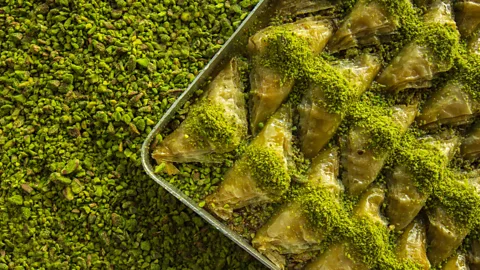
For centuries, pistachios have defined Gaziantep. Today, they remain the most prized ingredient in Turkey's culinary capital – and the secret behind its legendary baklava.
By late summer, bakers in the Turkish city of Gaziantep leave their kitchens to prowl pistachio orchards cross-hatching the nation's sunbaked south-eastern plains. Known locally as "green gold", this valuable crop isn't just an economic boon – it's the single most important ingredient in Turkey's culinary capital and a beloved symbol of Gaziantep itself.
Though typically harvested in September, some pistachios are hand-picked nearly a month early, when the nut-like drupes are still small with emerald-coloured flesh. "Bakery owners go around to all the trees, tasting as they go," said Aylin Öney Tan, editor of Gaziantep cookbook A Taste of Sun and Fire. "When the harvest is nearly ready, they'll buy an entire orchard's worth on the spot."
That's because early-season pistachios – known for their extraordinary flavour – are essential for sweets like katmer (creamy breakfast pastries) and baklava (reputed to be the best in Turkey) that have made Gaziantep a pilgrimage place for desserts lovers. For locals, these foods are more than sugary treats; they're a vital part of life in one of the world's oldest continuously inhabited cities.
 Getty Images
"Sweets go beyond desserts here – they mark nearly all of our milestones," said Hatice Pekmez, an associate professor at Gaziantep University who studies gastronomy and culture, when we met at her office over cookies and tulip-shaped glasses of ruddy Turkish tea. The sweet tradition spans cradle and grave: families welcoming a new baby pass around trays of syrupy pistachio baklava; mourners dip spoons into soft semolina halva fried in aromatic butter.
"Sharing these dishes is a way we strengthen community bonds," Pekmez said.
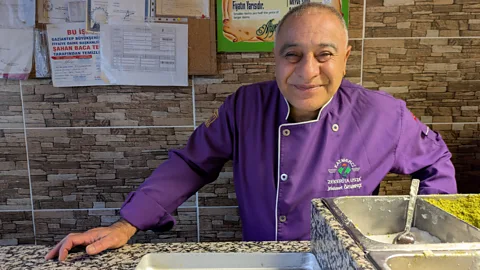
Before dawn breaks in the city, bakers kindle oak-fired ovens prized for their pure, smokeless heat, rising early to produce katmer, envelopes of thin-stretched dough folded around a plush filling of sweet pistachios and clotted cream. By 08:00, when I arrived at the century-old, family-owned bakery Katmerci Zekeriya Usta, locals were gathered around small wooden tables, handing jugs of chilled milk across plates of katmer served hot and crisp-edged from the ovens.
"Newlyweds have katmer as their first breakfast," said Mehmet Özsimitçi, the bakery's third-generation owner. "The idea is that they will eat sweetly and talk sweetly in their new lives."
 Jen Rose Smith
Özsimitçi began working alongside his father in the family bakery as a child; at 65, he still starts each day with katmer prepared by his master bakers. As he explained, it would be impossible to reproduce Gaziantep katmer without the local flavours of the surrounding landscape, such as pistachios from nearby orchards and clarified butter from herds grazed in nearby mountains.
"In Gaziantep we have great respect for the ingredients," Özsimitçi said.
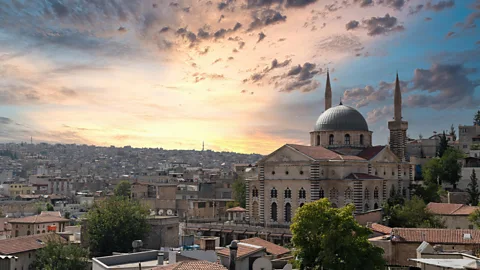
Ovens at Katmerci Zekeriya Usta waft their rich scent through a maze of streets in Gaziantep's old city, which some researchers believe began as a Neolithic settlement more than 10,000 years ago. At the city's small and free-to-visit Pistachio Museum – housed in a pistachio-shaped building amid pistachio trees – I learned that pistachio remains dating to the 3rd millennium BCE have been found at Oylum Höyük, an archaeological site surrounded by small homes 50km south of Gaziantep, with signs of continual habitation since 3400BCE.
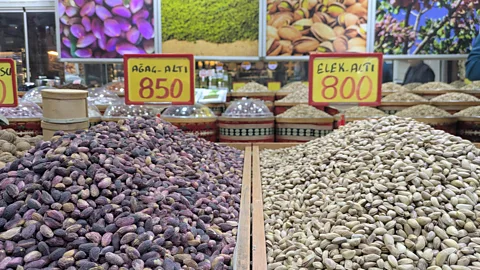
Today, travellers here could spend days following an unofficial pistachio trail. The nuts mound in pyramidal piles at shops in the city's ancient covered markets: fresh ones still in their blushing petal-like outer skin as well as roasted versions ready for snacking. Stalls at the Bakırcılar Çarşısı (the Coppersmiths' Bazaar) proffer pistachio-dusted Turkish delight for grazing, and sweet rolls of pistachio paste to slip in your luggage. Neon signs outside bakeries flash the word "fıstık" (pistachio) in garish lime-green letters.
 Jen Rose Smith
"Fıstık" is a good word to know in Gaziantep. If you want to tell a friend how cute they are, you could say " fıstık gibisin" – literally, "you are like a pistachio". Calling someone "fıstığım", or "my pistachio", is a term of endearment.
Today, locals celebrate the pistachio harvest with the annual GastroAntep Festival, which hosts workshops and pop-up dinners each September. More than 70% of Turkey's pistachio crop still comes from this region, where rocky soil forces the trees to develop deep roots, and summer heat bakes the nuts to perfect ripeness.
"Gaziantep pistachios are sweeter and greener than those grown elsewhere," said Mustafa Özgüler, executive chef of Gaziantep bakery-restaurant Orkide, whose cases are filled with pistachio cookies and pistachio baklava. At the back of the restaurant, a katmer maker shapes pastries to order. After sharing one at breakfast another day, Özgüler and his son, Emir, joined me for a visit to a hilltop pistachio orchard in the heart of the city, not far from Orkide. A caretaker explained that its 500 trees were decades old, deeded to the city when the former owner died in the devastating 2023 Turkey-Syria earthquakes.
"Many people have a bağ evi, a house with pistachio and walnut trees where you spend the weekend," said Emir, as we wandered the rows, fallen leaves crunching underfoot. "In earlier times, wealth in Gaziantep was measured in the pistachio lands you had."
 Jen Rose Smith
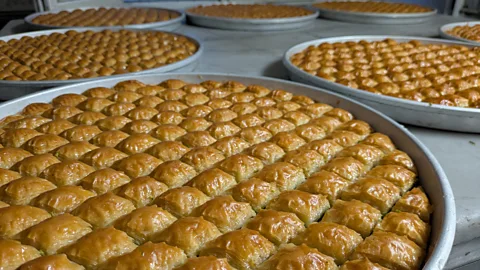
For all the variety of Gaziantep's pistachio desserts, baklava is the uncontested king of its pastry pantheon. Founded in 1871 within the covered Elmacı Bazaar, the tiny shop Güllüoğlu claims to be the oldest continually operated baklava bakery in the country, its display window showcasing trays of classic square-shaped baklava, turnover-like şöbiyet baklava and slim wedges of havuç dilimi baklava. A brilliant pistachio filling spills from each of them.
On a mid-19th-Century pilgrimage to Mecca, Güllüoğlu founder Güllü Çelebi was entranced by the walnut baklava he saw in the sweet shops of Damascus and Aleppo, then part of the Ottoman Empire. Returning home, he adapted the recipe, swapping the walnuts for locally abundant pistachios, a tweak that would transform his city's culinary traditions.
More like this:
• A Turkish secret hiding in plain sight
"There's a huge pride in baklava production," said Filiz Hösükoğlu, a gastronomy expert who grew up in the city. "It's like the sense of workmanship that Michelangelo brought to Florence," she said. "It's the same with baklava in Gaziantep."
When Hösükoğlu was a child, her father bought trays of pistachio baklava to mark the end of Ramadan, serving some to every guest who dropped by to celebrate. Families maintain lasting allegiances to their preferred bakers.
 Jen Rose Smith
Travellers, unaffiliated, can make the most of the city's variety. After nibbling a selection at Güllüoğlu, I took a cab to Koçak Baklava in a newer part of the city, where a palatial dining room draws a well-dressed crowd to linger over carefully plated confections. Early one morning towards the end of my trip, I found my way into the upstairs baklava workshop of İmam Çağdaş, a bakery-restaurant founded in 1887.
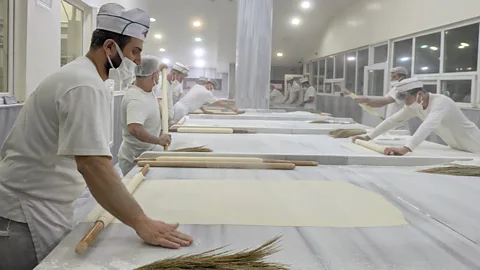
There, white-coated bakers working in a floury cumulus used slender wooden batons to roll dough into sheets thin enough to see through. They slid metal trays deep into stone ovens lit by the orange coals of that morning's fires. Syrup bubbled in great vats, foaming as chefs ladled the liquid onto baklava fresh from the heat.
Burhan Çağdaş, the bakery's fourth-generation owner who joined the family business at the age of 12, told me that some of these bakers had worked in the kitchen for more than 50 years, starting at eight or nine years old.
"It takes a minimum of five years to educate a great baklava master," he said.
 Jen Rose Smith
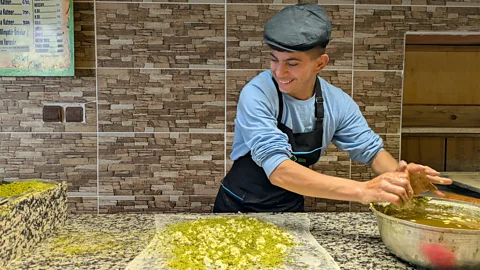
Çağdaş, now 63, had joined me over a plate of baklava in the back of the restaurant, instructing me to eat each piece upside-down, so the syrupy bottom was on top and the flaky top layers wouldn't stick to my teeth.
He said the family business is about more than food. It ties him inextricably to his city's rituals, from birth to marriage and religious celebrations and funerals. "It is a culture, a whole way of life," he said. "There is air, water and baklava."
--
If you liked this story, sign up for The Essential List newsletter – a handpicked selection of features, videos and can't-miss news, delivered to your inbox twice a week.
For more Travel stories from the BBC, follow us on Facebook and Instagram.
